Seven common percentage mistakes and how to avoid them
Seven percentage mistakes that produce confident wrong answers: wrong base, adding percentages, reversing by subtraction, points vs percent and more, each with a quick check.
The most common mistakes are using the wrong base, adding successive percentages, undoing a change by subtracting the same percentage, confusing points with percent, averaging percentages from groups of different sizes, misplacing the decimal point, and treating a decrease as the mirror of an increase. Each has a one-line check below.
On this page
Percentage mistakes are easy to make because the wrong method often produces a plausible number. Here are seven that come up again and again, with a quick way to catch each one.
1. Dividing by the wrong number
A price goes from $50 to $40. Is that a 20% drop or a 25% drop? Percentage change divides by the starting value: 10 ÷ 50 = 20%. Dividing by the new value gives 25%, which would be the answer to “how much higher was the old price than the new one?”
Check: the base is the “before” number, or whatever follows “of”.
Try it: $50 to $40
Open in calculator2. Adding percentages that happen one after another
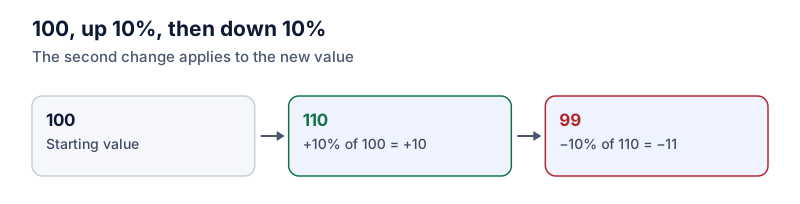
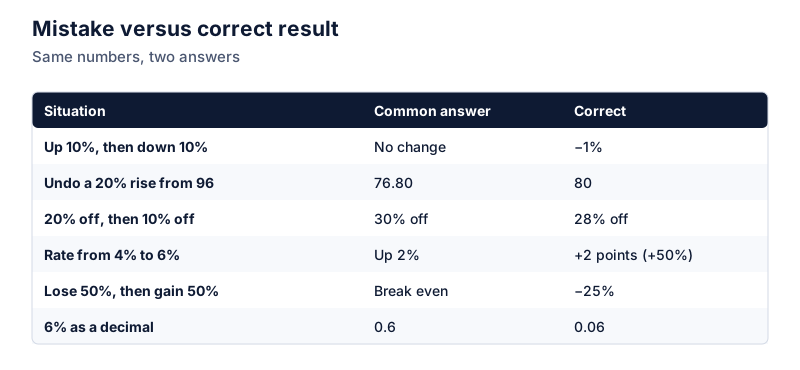
A price rises 10% and then 10% again. That’s not 20%. The second rise applies to the already-higher price: 1.1 × 1.1 = 1.21, a 21% total increase. In the other direction, a 10% rise followed by a 10% fall leaves you at 1.1 × 0.9 = 0.99, 1% below where you started.
Check: multiply the multipliers instead of adding the percentages. See successive percentage changes.
Try it: Up 10%, then down 10%
Open in calculator3. Undoing a change by subtracting the same percentage
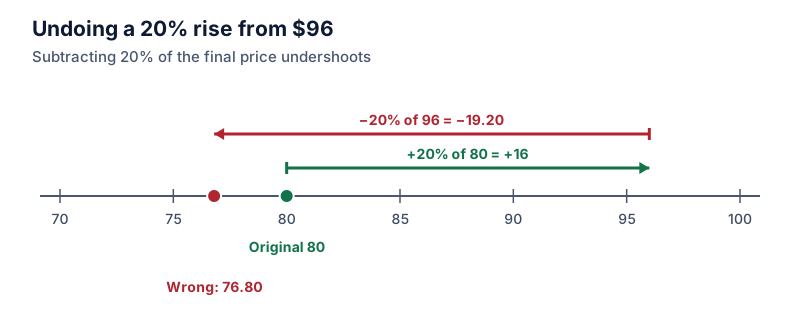
If a price is $96 after a 20% increase, the original isn’t $96 minus 20%. It’s $96 ÷ 1.2 = $80. Subtracting 20% of $96 gives $76.80, because 20% of the bigger number is a bigger amount.
Check: apply the change to your answer and see if you get back to the final value. See reverse percentages.
4. Stacking discounts by adding them
“20% off, plus an extra 10% off” is a 28% discount, not 30%. The 10% comes off the already-reduced price: 0.8 × 0.9 = 0.72, so you pay 72%.
Check: the combined discount is always less than the sum. See stacked discounts.
5. Confusing percentage points with percent
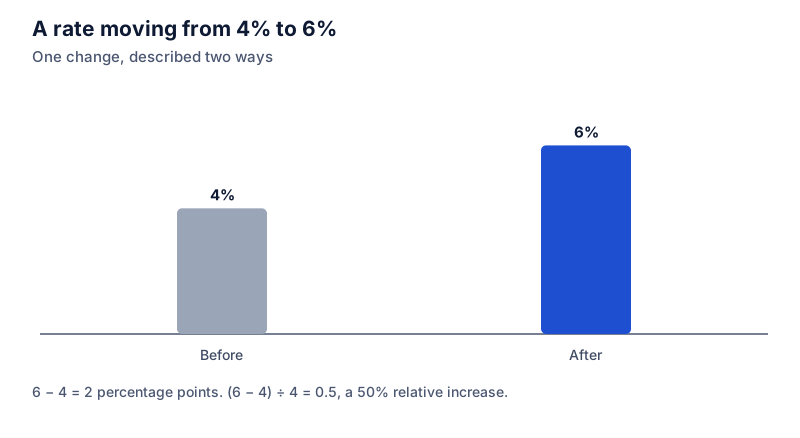
A rate rising from 4% to 6% went up 2 percentage points, which is a 50% relative increase. Calling it “up 2%” is wrong under either reading.
Check: when both numbers are percentages, say “points” for the difference. See percentage points vs percent.
6. Averaging percentages from groups of different sizes
One class of 10 scored 90% on average, another class of 30 scored 70%. The overall average isn’t 80%. It’s (10 × 90 + 30 × 70) ÷ 40 = 75%, because the bigger class counts more.
Check: go back to the counts, add them up, and divide. See averaging percentages.
7. Moving the decimal point the wrong distance
6% is 0.06, not 0.6. 0.5% is 0.005, not 0.05. An error here makes the answer ten times too big or small.
Check: estimate first. 1% of 300 is 3, so 6% of 300 is 18. If you get 180, the decimal point is one place off.
A bonus: losses and gains aren’t symmetric
An investment that falls 50% and then rises 50% ends at 0.5 × 1.5 = 0.75 of its starting value, a 25% loss. You’d need a 100% gain to recover from a 50% loss. This is mistake 2 in another form, but it costs people real money often enough to deserve its own mention. See recovering from a percentage loss.
The general fix
Most of these errors come from forgetting that every percentage is a percentage of something, and that something changes from one step to the next. Before you add, subtract or compare percentages, check that they share the same base. If they don’t, convert to actual amounts or multipliers first.
The calculator links in this guide are checked against the PercentSwift calculator every time the site is built. How we calculate explains the rounding rules. If you spot a mistake, email hello@percentswift.com.