Why a 50% loss needs a 100% gain to break even
A 50% loss needs a 100% gain to get back to even. Why equal percentage moves don't cancel, a recovery table from 5% to 90%, and the formula behind it.
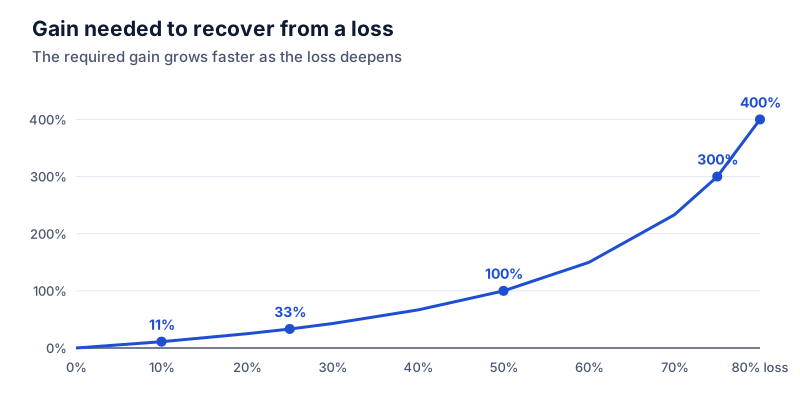
After a loss of L%, you need a gain of L ÷ (100 − L) × 100 percent to recover. A 20% loss needs a 25% gain, a 50% loss needs 100%, and a 75% loss needs 300%. The gain is bigger because it starts from a smaller base.
On this page
If an investment drops 50%, a 50% rise doesn’t get it back. It needs to double, a 100% gain.
Start with $10,000. A 50% fall leaves $5,000. A 50% rise on $5,000 adds $2,500, ending at $7,500. To get back to $10,000 you need to add $5,000, which is 100% of $5,000.
Try it: Recovering from $5,000 to $10,000
Open in calculatorWhy the percentages don’t match
The loss is measured against the higher starting value. The recovery is measured against the lower value after the loss. The same dollar amount is a bigger percentage of a smaller number.
required gain = L ÷ (100 − L) × 100
Where L is the loss as a percentage
For a 20% loss: 20 ÷ 80 × 100 = 25%. For a 60% loss: 60 ÷ 40 × 100 = 150%.
Recovery table
| Loss | Gain needed to break even |
|---|---|
| 5% | 5.26% |
| 10% | 11.11% |
| 15% | 17.65% |
| 20% | 25% |
| 25% | 33.33% |
| 30% | 42.86% |
| 40% | 66.67% |
| 50% | 100% |
| 60% | 150% |
| 70% | 233.33% |
| 75% | 300% |
| 80% | 400% |
| 90% | 900% |
What it means in practice
Investing. Large drawdowns take a long time to recover from. At a steady 7% a year, it takes a little over 10 years to double, which is what a 50% loss requires. This is one reason diversification and position sizing matter more than they first appear to.
Business. If revenue falls from $2.4 million to $1.8 million (a 25% drop), getting back needs a 33.3% increase on the lower figure.
Pay. A 10% pay cut from $50,000 to $45,000 followed by a 10% raise lands at $49,500. Restoring the original salary would take an 11.1% raise.
Try it: $45,000 back to $50,000
Open in calculatorIt works the other way too
Gains are easier to give back than they were to earn. A stock that rises 100% from $20 to $40 only needs to fall 50% to return to $20. A 25% gain is wiped out by a 20% loss.
The underlying rule
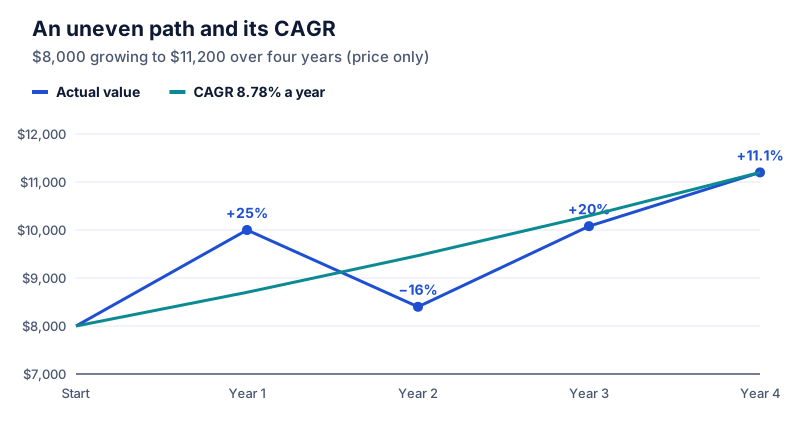
Percentage changes in sequence multiply rather than add. A 50% loss multiplies the value by 0.5, and to get back to 1 you need to multiply by 2. The guide on successive percentage changes covers the general method, and investment return and CAGR shows how this affects average returns over several years.
Questions
Does this apply to prices and salaries too?
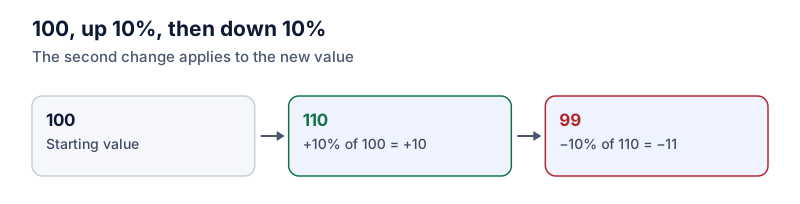
Yes. Any time a value falls by a percentage and then rises by a percentage, the rise is measured from the lower value. A 10% pay cut followed by a 10% raise leaves you 1% below where you started.
Is there a quick estimate?
For small losses, the required gain is roughly the loss plus the loss squared divided by 100. A 10% loss needs about 10 + 1 = 11%.
The calculator links in this guide are checked against the PercentSwift calculator every time the site is built. How we calculate explains the rounding rules. If you spot a mistake, email hello@percentswift.com.