Reverse percentages: how to find the original number
To undo a percentage change, divide by the multiplier instead of subtracting the percentage. Why the obvious method fails, and how to check your answer.
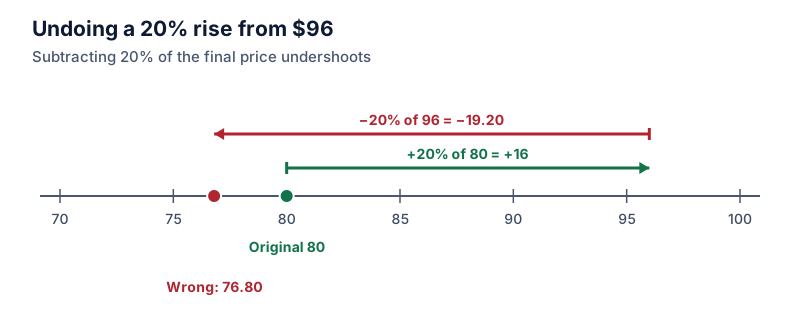
Divide the final value by the multiplier for the change. After a 20% increase, divide by 1.2. After a 20% decrease, divide by 0.8. A price of $96 after a 20% rise started at 96 ÷ 1.2 = $80, not $76.80.
On this page
When a number has already been increased or decreased by a percentage, you get back to the original by dividing by the multiplier.
original = final ÷ (1 + P ÷ 100) after an increase
original = final ÷ (1 − P ÷ 100) after a decrease
A jacket costs $96 after a 20% price rise. The multiplier for a 20% rise is 1.2, so the original price was 96 ÷ 1.2 = $80.
Try it: $96 after a 20% increase
Open in calculatorWhy subtracting the percentage fails
The tempting shortcut is to take 20% off $96, which gives $76.80. Check it by going forward: 20% of $76.80 is $15.36, and $76.80 + $15.36 = $92.16. That’s not $96.
The 20% in “a 20% rise” was 20% of the original price. Once the price has risen, 20% of the new price is a bigger amount, so subtracting it overshoots.
The same thing happens in the other direction. A coat marked down 25% to $60 did not cost $75 ($60 plus 25% of $60). It cost 60 ÷ 0.75 = $80. Check: 25% of $80 is $20, and $80 − $20 = $60.
Try it: $60 after 25% off
Open in calculatorFinding the multiplier
The multiplier is what the original gets multiplied by.
| Change | Multiplier | To reverse, divide by |
|---|---|---|
| +5% | 1.05 | 1.05 |
| +20% | 1.20 | 1.2 |
| +100% | 2.00 | 2 |
| −10% | 0.90 | 0.9 |
| −25% | 0.75 | 0.75 |
| −40% | 0.60 | 0.6 |
For an increase, add the percentage to 100 and divide by 100. For a decrease, subtract it from 100.
Common uses
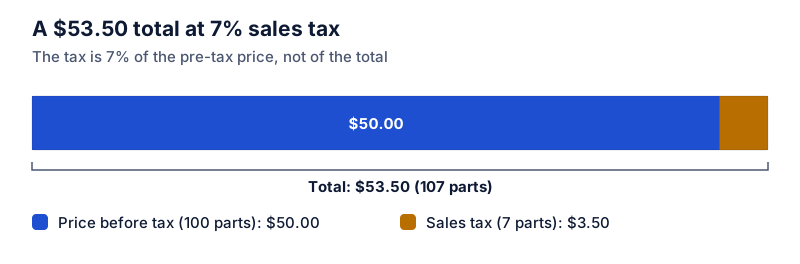
Prices without tax. A receipt shows $54.00 including 8% sales tax. The pre-tax price is 54 ÷ 1.08 = $50.00. The sales tax guide covers this in detail, and VAT works the same way.
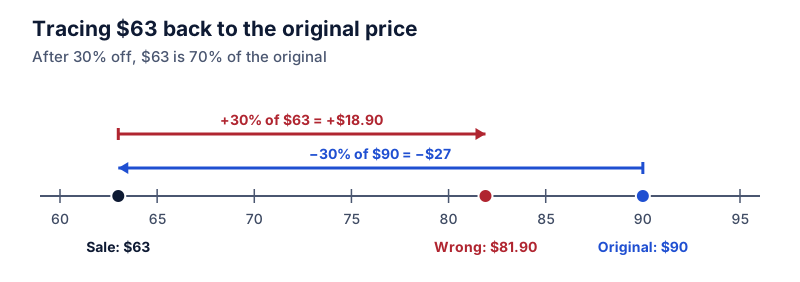
Original price before a sale. A sale tag says $42 after 30% off. The regular price was 42 ÷ 0.7 = $60. See original price before a discount.
Salary before a raise. If your new salary is $55,620 after a 3% raise, your old salary was 55,620 ÷ 1.03 = $54,000.
Try it: $55,620 after a 3% raise
Open in calculatorAlways check by going forward
Take your answer, apply the original percentage change, and see if you land on the final value. $54,000 × 1.03 = $55,620, so the answer is right. This check catches the subtraction mistake every time, because the wrong answer never returns to the starting figure.
Not the same as “part of a whole”
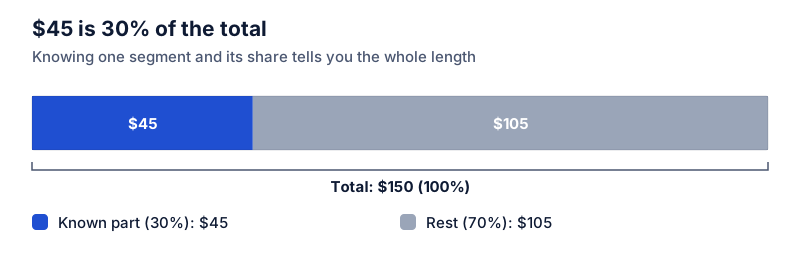
Reverse percentages answer “what was the value before it changed?” A related question, “45 is 30% of what?”, is about a part and a total, and you divide by 0.3 rather than by 1.3 or 0.7. The guide on finding the whole from a percentage explains how to tell the two apart.
Questions
Why doesn't subtracting the percentage work?
The percentage was calculated on the original value, but you’re subtracting it from the final value, which is a different base. A 20% rise followed by a 20% cut ends 4% below where it started.
How do I reverse two changes in a row?
Divide by each multiplier in turn, or by their product. A price raised 10% and then 5% is multiplied by 1.1 × 1.05 = 1.155, so divide the final price by 1.155.
The calculator links in this guide are checked against the PercentSwift calculator every time the site is built. How we calculate explains the rounding rules. If you spot a mistake, email hello@percentswift.com.