Successive percentage changes: why +10% then −10% isn't zero
To combine percentage changes, multiply their multipliers instead of adding the percentages. Why +10% then −10% leaves you 1% down, with a formula you can reuse.
Turn each change into a multiplier (+10% → 1.10, −10% → 0.90), multiply them together, and subtract 1. 1.10 × 0.90 = 0.99, so +10% then −10% is a 1% decrease overall. The order of the changes doesn’t affect the result.
On this page
When percentage changes happen one after another, each one applies to the result of the last. That means you can’t add them up.
A price of $100 rises 10% to $110, then falls 10%. The fall is 10% of $110, which is $11, so the price ends at $99. Overall, that’s a 1% decrease.
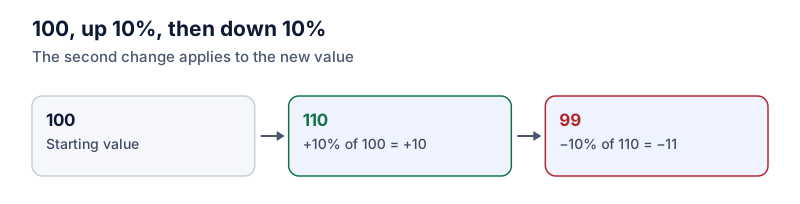
Try it: +10% then −10% on 100
Open in calculatorThe multiplier method
- Convert each percentage change into a multiplier: 1 + (change ÷ 100).
- Multiply the multipliers together.
- Subtract 1 and multiply by 100 to get the overall percentage change.
overall change = (m₁ × m₂ × m₃ × … − 1) × 100
Where m = 1 + change ÷ 100, so +15% is 1.15 and −20% is 0.80
Examples
Two price rises. +5% then +8%: 1.05 × 1.08 = 1.134. That’s a 13.4% rise, a bit more than the 13% you’d get by adding.
A rise and a cut. +20% then −20%: 1.2 × 0.8 = 0.96. A 4% fall overall.
Three changes. Rent goes up 3%, then 4%, then 6% over three years. 1.03 × 1.04 × 1.06 = 1.135472. Total rise: about 13.55%.
Try it: Rent up 3%, 4% and 6% from $1,000
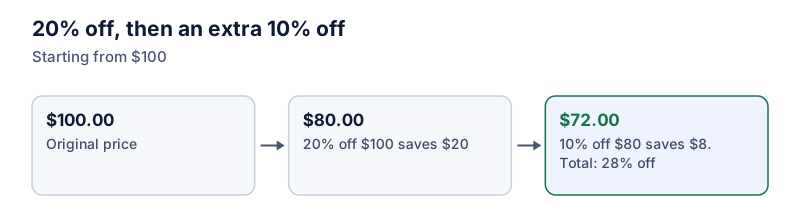
Open in calculatorStacked discounts. 25% off, then an extra 10% off: 0.75 × 0.9 = 0.675. You pay 67.5%, a 32.5% discount, not 35%. See stacked discounts.
Why adding is close but wrong
For small changes, adding gives nearly the right answer. +2% then +3% is really 1.02 × 1.03 = 1.0506, a 5.06% rise. Adding says 5%. The extra 0.06% comes from the second change also applying to the first change’s gain.
For large changes the gap is large. +50% then +50% is 1.5 × 1.5 = 2.25, a 125% rise, not 100%. −50% then −50% leaves 0.25, a 75% fall, not 100%.
Reversing a chain of changes
To work out the starting value from the end value, divide by the combined multiplier. If a price is $226.80 after rising 5% and then 8%, the original was 226.80 ÷ 1.134 = $200.
Average change per period
If something grew 13.4% over two steps, the average per step isn’t 6.7%. It’s the number that, applied twice, gives 1.134: the square root of 1.134, which is about 1.0649, or 6.49% per step. Over more periods, use the nth root. When the periods are years, this is the compound annual growth rate. See investment return and CAGR.
Where this shows up
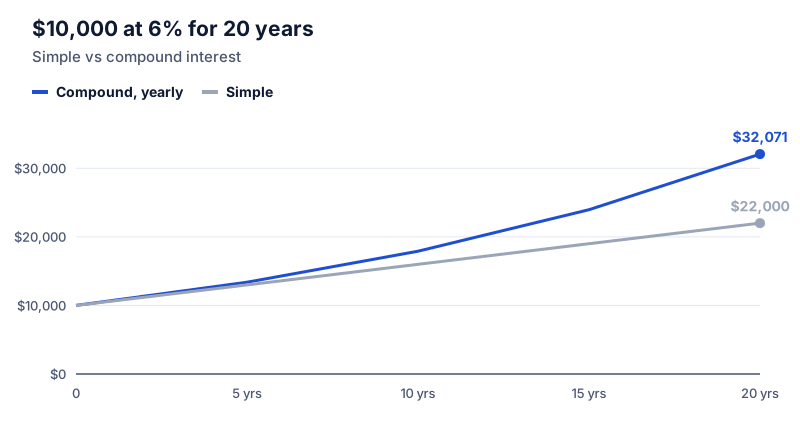
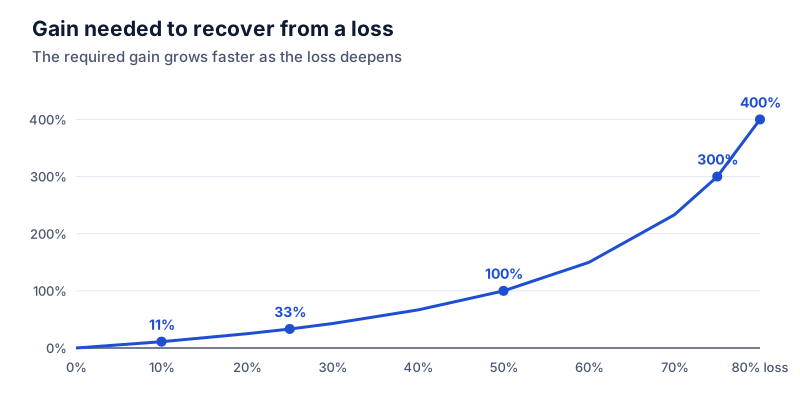
Compound interest, inflation over several years, salary history, investment returns, stacked discounts, and population growth all chain percentage changes. The same multiplier idea explains why a 50% loss needs a 100% gain and how compound interest grows.
Questions
Does the order of the changes matter?
Not for the final result. Multiplication can be done in any order, so −10% then +10% also ends at 99. The values in between are different.
How do I find the average change per period?
Take the combined multiplier to the power of 1 ÷ (number of periods) and subtract 1. This is the compound annual growth rate when the periods are years.
The calculator links in this guide are checked against the PercentSwift calculator every time the site is built. How we calculate explains the rounding rules. If you spot a mistake, email hello@percentswift.com.