Stacked discounts: why 20% off plus 10% off isn't 30% off
Two discounts in a row multiply rather than add: 20% off then 10% off is 28% off. The formula for the combined discount, a lookup table, and whether order matters.
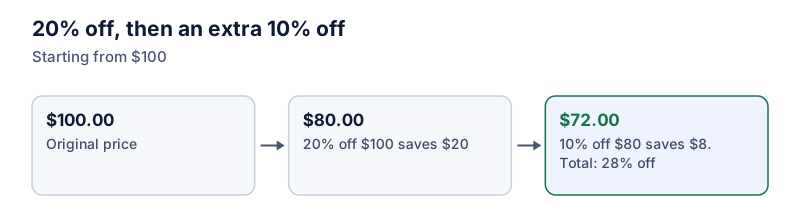
Multiply what you pay after each discount: 20% off then 10% off is 0.80 × 0.90 = 0.72, so you pay 72% of the price and the combined discount is 28%, not 30%. The order of the two discounts doesn’t change the final price.
On this page
Stores often advertise an extra discount on top of a sale price: “40% off, plus take an extra 20% at checkout”. It’s tempting to add them to get 60% off. The real discount is smaller, because the second percentage comes off the already reduced price.
The method
Convert each discount to the share you pay, multiply them, and subtract from 100%.
you pay = (1 − a ÷ 100) × (1 − b ÷ 100)
combined discount = 100% − you pay
20% then 10%: 0.80 × 0.90 = 0.72. You pay 72%, so the combined discount is 28%.
Try it: $100 with 20% off, then 10% off
Open in calculator40% then 20%: 0.60 × 0.80 = 0.48. You pay 48%, a 52% discount, not 60%.
Try it: $150 with 40% off, then 20% off
Open in calculatorCombined discount table
| First | Second | Combined | Simply adding |
|---|---|---|---|
| 10% | 10% | 19% | 20% |
| 20% | 10% | 28% | 30% |
| 25% | 10% | 32.5% | 35% |
| 30% | 20% | 44% | 50% |
| 40% | 20% | 52% | 60% |
| 50% | 25% | 62.5% | 75% |
| 50% | 50% | 75% | 100% |
The bigger the discounts, the bigger the gap. Two 50% discounts give 75% off, not a free item.
Does order matter?
For two percentage discounts, no. 0.8 × 0.9 = 0.9 × 0.8. You’ll pay the same whichever is applied first.
It does matter when one discount is a fixed amount. With a $100 item, 20% off and a $10 coupon:
- Percentage first: $100 → $80 → $70
- Coupon first: $100 → $90 → $72
Percentage-first is better for you here. Stores usually set the order in their terms, so check the fine print. The guide on percent off vs dollar off goes further into fixed coupons.
A shortcut for two discounts
Combined discount = a + b − (a × b ÷ 100).
For 30% and 20%: 30 + 20 − (30 × 20 ÷ 100) = 50 − 6 = 44%. The subtracted part is the “discount on the discount” that you don’t get.
Three or more discounts
Keep multiplying. A 25% sale, an extra 10% for members, and a 5% app discount: 0.75 × 0.90 × 0.95 = 0.64125. You pay about 64.1%, a combined discount of about 35.9%.
Why stores advertise it this way
“40% + 20% off” sounds better than “52% off” to many shoppers, even though it’s less than the 60% the eye adds up. Knowing the multiplication rule lets you compare a stacked offer fairly with a single discount from another store.
This is the shopping version of a general rule: percentage changes in sequence multiply. See successive percentage changes for the same idea applied to prices, salaries and investments.
Questions
Does it matter which discount is applied first?
Not for percentage discounts. 0.8 × 0.9 and 0.9 × 0.8 are both 0.72. It does matter when one of the discounts is a fixed dollar amount.
Is there a quick formula for two discounts?
Combined discount = a + b − (a × b ÷ 100). For 20% and 10%: 20 + 10 − 2 = 28%.
The calculator links in this guide are checked against the PercentSwift calculator every time the site is built. How we calculate explains the rounding rules. If you spot a mistake, email hello@percentswift.com.