Percentage word problems: a method that works every time
Translate the words into an equation: “of” means multiply, “is” means equals, “what” is the unknown. A phrase table and eight solved percentage problems, from basic to tricky.
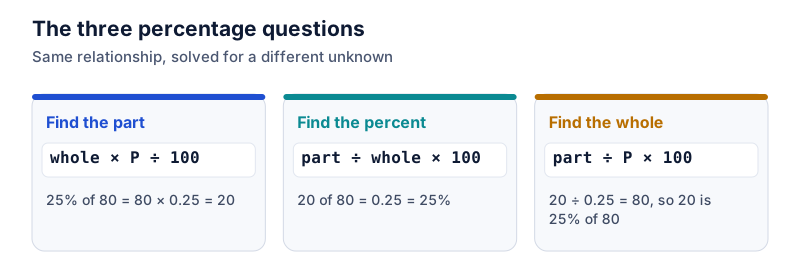
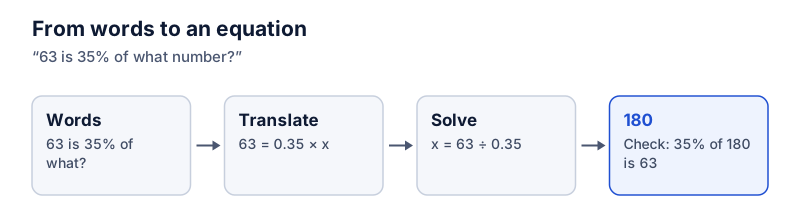
Rewrite the problem as an equation: “of” becomes ×, “is” becomes =, “what” becomes the unknown, and “percent” means ÷ 100. “63 is 35% of what?” becomes 63 = 0.35 × x, so x = 180. For changes, identify the starting value first, because that’s the base.
On this page
Most percentage word problems are one of a handful of patterns. The hard part is turning the sentence into an equation. After that, it’s one or two steps of arithmetic.
The translation table
| Word or phrase | Becomes |
|---|---|
| of | × |
| is, was, will be, equals | = |
| what, what number, a number | x (the unknown) |
| percent, % | ÷ 100 |
| what percent | x ÷ 100 |
| increased by P% | × (1 + P ÷ 100) |
| decreased by P%, P% off | × (1 − P ÷ 100) |
Eight solved problems
1. What is 18% of 250? x = 0.18 × 250 = 45.
Try it: 18% of 250
Open in calculator2. 27 is what percent of 60? 27 = (x ÷ 100) × 60, so x = 27 ÷ 60 × 100 = 45%.
3. 63 is 35% of what number? 63 = 0.35 × x, so x = 63 ÷ 0.35 = 180.
Try it: 63 is 35% of what?
Open in calculator4. A $45 shirt is 20% off. What’s the sale price? 45 × (1 − 0.20) = 45 × 0.8 = $36.
5. A town grew from 12,500 to 13,750 people. What was the percentage increase? The base is the starting population. (13,750 − 12,500) ÷ 12,500 = 1,250 ÷ 12,500 = 10%.
Try it: 12,500 to 13,750
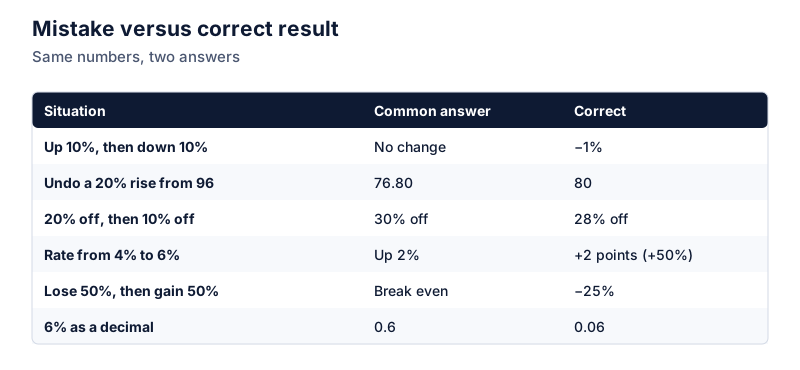
Open in calculator6. After a 15% raise, a salary is $46,000. What was it before? x × 1.15 = 46,000, so x = 46,000 ÷ 1.15 = $40,000. (Not $46,000 minus 15%, which is $39,100.)
Try it: $46,000 after a 15% raise
Open in calculator7. A price rises 25% and then falls 20%. What’s the overall change? Multiply the multipliers: 1.25 × 0.80 = 1.00. The price is back where it started: 0% change.
8. In a class, 40% of students are boys. 60% of the boys and 75% of the girls passed. What percent of the class passed? Use a share of each share: boys who passed are 0.40 × 0.60 = 0.24 of the class, girls who passed are 0.60 × 0.75 = 0.45 of the class. Total: 0.24 + 0.45 = 69%. (Averaging 60% and 75% gives 67.5%, which is wrong because the groups are different sizes.)
A routine that works every time
- Find the base. Which number is the whole, or the “before”?
- Translate the sentence using the table.
- Solve for the unknown.
- Check by putting your answer back into the original sentence.
Step 4 catches nearly every mistake. In problem 6, $39,100 × 1.15 = $44,965, which isn’t $46,000, so subtracting was wrong.
Patterns to recognize
- “X% of Y” → multiply. See three ways to find a percentage of a number.
- “What percent” → divide part by whole. See how to calculate a percentage.
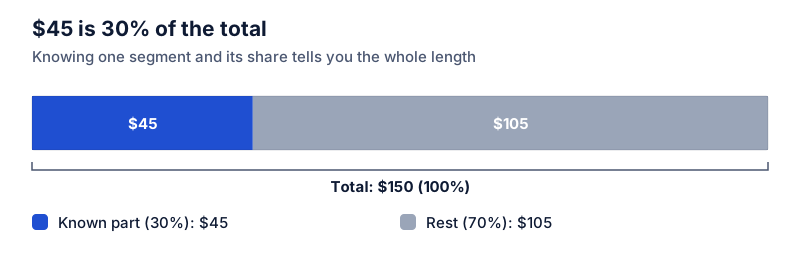
- “X is P% of what” → divide by the percentage. See finding the whole.
- “After a change of P%” → divide by the multiplier. See reverse percentages.
- Two changes in a row → multiply multipliers. See common percentage mistakes.
Questions
How do I know which number is the base?
It’s the number after “of”, or the original value before a change. In “what percent of 60 is 27?”, 60 is the base.
What's the fastest way to check an answer?
Put it back into the original sentence and see if it reads true. If 63 is 35% of 180, then 0.35 × 180 should be 63.
The calculator links in this guide are checked against the PercentSwift calculator every time the site is built. How we calculate explains the rounding rules. If you spot a mistake, email hello@percentswift.com.