How to find a percentage of a number: three methods
Three ways to find a percentage of a number (decimal, fraction and the 1% method) worked on the same examples, with notes on when each is quickest.
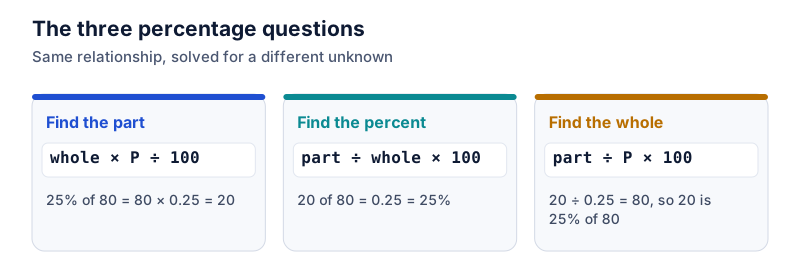
Divide the percentage by 100 and multiply by the number. 35% of 200 is 0.35 × 200 = 70. For round percentages a fraction is often faster (25% is ¼), and for mental math you can find 1% or 10% first and scale up.
On this page
To find a percentage of a number, convert the percentage to a decimal and multiply. That one method always works. The other two below are shortcuts that are faster in particular cases, and knowing them makes it easier to spot a wrong answer.
Method 1: convert to a decimal
Divide the percentage by 100, which moves the decimal point two places left, then multiply.
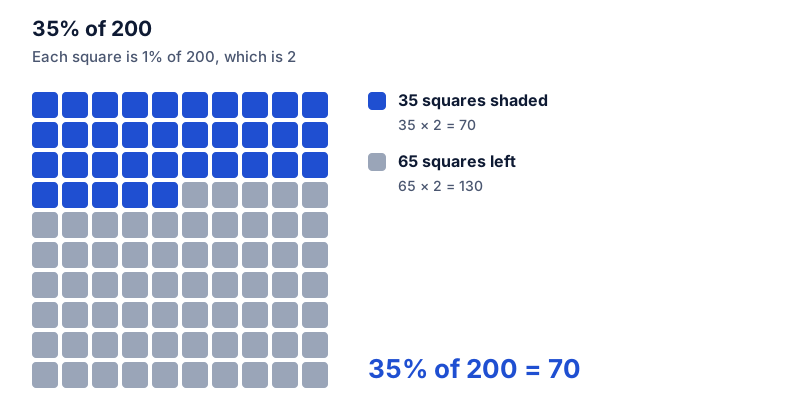
- 35% of 200: 0.35 × 200 = 70
- 6% of 1,450: 0.06 × 1,450 = 87
- 2.5% of 360: 0.025 × 360 = 9
Watch the single-digit percentages. 6% is 0.06, not 0.6, and 0.5% is 0.005. Putting the decimal point one place off gives an answer ten times too big or too small.
Try it: 35% of 200
Open in calculatorMethod 2: use a fraction
Some percentages are simple fractions. For these, dividing is quicker than multiplying by a decimal.
| Percent | Fraction | Do this |
|---|---|---|
| 50% | 1/2 | halve it |
| 25% | 1/4 | halve twice |
| 20% | 1/5 | divide by 5 |
| 10% | 1/10 | move the decimal point one place left |
| 12.5% | 1/8 | halve three times |
| 33⅓% | 1/3 | divide by 3 |
25% of 360 is 360 ÷ 4 = 90. 12.5% of 64 is 64 ÷ 8 = 8. Neither needs a calculator.
Be careful with 33%. A third is 33.333…%, so “33% of 300” is 99, not 100. If a question says “a third”, use the fraction.
Method 3: build it from 1% or 10%
For mental math, find an easy chunk and scale it.
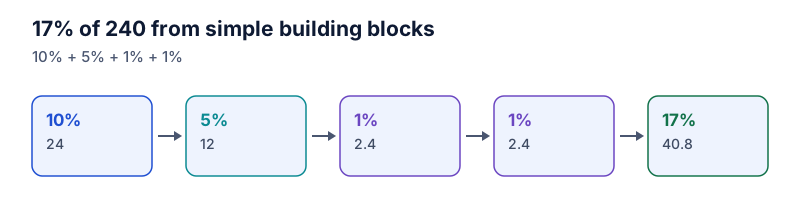
10% of a number is the number with the decimal point moved one place left. 1% is two places. From those you can build almost anything:
- 15% of 60: 10% is 6, 5% is half of that (3), so 15% is 9
- 35% of 200: 10% is 20, so 30% is 60, and 5% is 10. Total 70
- 4% of 2,250: 1% is 22.5, so 4% is 90
This is how most people work out tips and discounts in their heads, and it doubles as a check on calculator results. If you typed 0.35 × 200 and got 7, the 10% chunk (20) tells you right away that the answer must be bigger.
Try it: 4% of 2,250
Open in calculatorThe swap trick
X% of Y is always equal to Y% of X, because both are X × Y ÷ 100. When one direction is awkward, flip it:
- 8% of 25 is the same as 25% of 8, which is 2
- 18% of 50 is the same as 50% of 18, which is 9
Percentages above 100 and below 1
The same method works outside the 1–100 range. 150% of 40 is 1.5 × 40 = 60, more than the number you started with, which is expected for anything over 100%. 0.2% of 5,000 is 0.002 × 5,000 = 10.
Try it: 0.2% of 5,000
Open in calculatorWhich method to use
Use the decimal method when the numbers are messy or you’re using a calculator. Use a fraction when the percentage is 50, 25, 20, 10 or 12.5. Use the 10% and 1% chunks when you need an answer in your head or want to sanity-check a result.
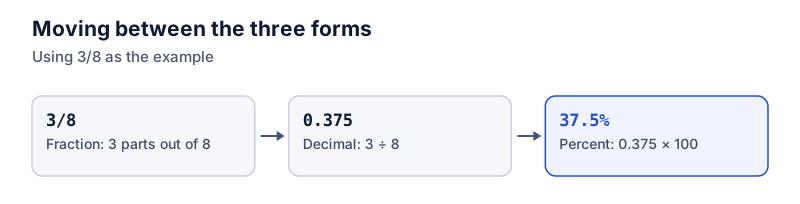
If you have the part and need the percentage instead, see what percent is X of Y. The guide to percentages in your head has more mental shortcuts, and percentages, fractions and decimals covers conversions.
Questions
Is X% of Y the same as Y% of X?
Yes. Both equal X × Y ÷ 100, so 8% of 50 and 50% of 8 are both 4. Swap the numbers when one order is easier to do in your head.
How do I find a percentage of a number on a basic calculator?
Type the number, press ×, type the percentage, then press %. On many calculators that gives the answer directly. If yours doesn’t have a % key, multiply by the percentage and divide by 100.
The calculator links in this guide are checked against the PercentSwift calculator every time the site is built. How we calculate explains the rounding rules. If you spot a mistake, email hello@percentswift.com.