How to find the whole when you know a part and its percentage
If you know a part and what percentage it is, divide the part by the percentage as a decimal. How to tell this apart from undoing a percentage change.
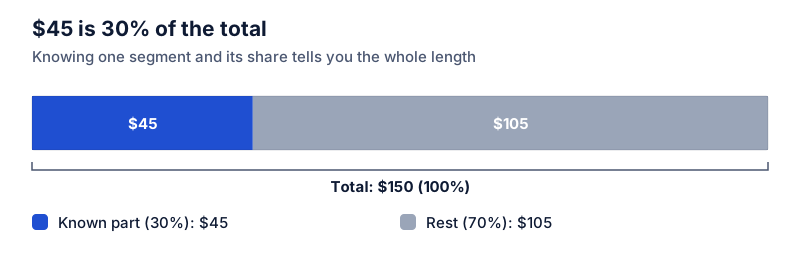
Divide the part by the percentage written as a decimal. If $45 is 30% of the total, the total is 45 ÷ 0.3 = $150. Check it: 30% of $150 is $45.
On this page
When you know a part and the percentage it represents, divide the part by the percentage as a decimal.
whole = part ÷ (P ÷ 100)
You’ve paid a $45 deposit, and the deposit is 30% of the total price. The total is 45 ÷ 0.3 = $150.
Try it: 45 is 30% of what?
Open in calculatorWhy it works
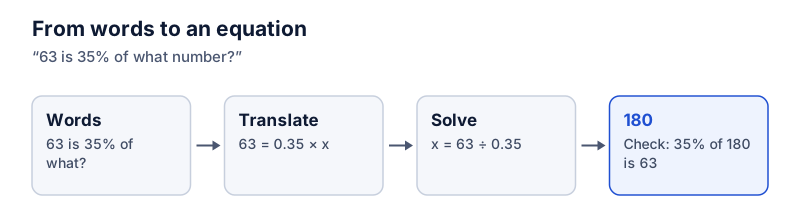
The basic percentage relationship is part = (P ÷ 100) × whole. If 30% of the whole is 45, then 0.3 × whole = 45. Divide both sides by 0.3 and the whole is 150.
A slower method that shows the logic: if 30% is $45, then 10% is $15, and 100% is ten times that, $150.
Examples
Fundraising. A school has raised $2,340, which a sign says is 65% of its goal. The goal is 2,340 ÷ 0.65 = $3,600.
Survey. 84 people said yes, and they were 35% of respondents. The survey had 84 ÷ 0.35 = 240 respondents.
Battery. A phone at 18% charge has 720 mAh left. The full battery holds 720 ÷ 0.18 = 4,000 mAh.
Try it: 720 is 18% of what?
Open in calculatorThe mix-up to avoid
Two problems sound alike but need different divisors:
- “$45 is 30% of the price.” The $45 is a slice of the whole. Divide by 0.3. Answer: $150.
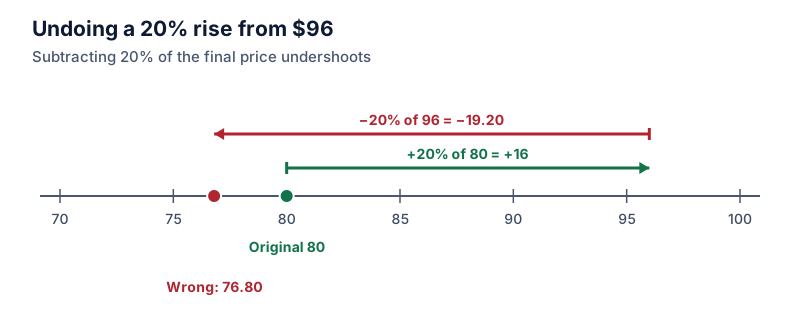
- “The price is $45 after a 30% increase.” The $45 is the whole, after it grew. Divide by 1.3. Answer: $34.62.
The second is a reverse percentage. Ask yourself whether the number you have is part of the total or the total after a change. Words like “after”, “now”, “including” and “marked down to” point to the second kind.
There’s a third version that sounds like both: “after a 30% discount, I paid $45.” The $45 is what’s left, which is 70% of the original price. You can treat it as part of a whole (45 is 70% of what?) or as a reverse decrease (45 ÷ 0.7). Both give $64.29.
Try it: 45 is 70% of what?
Open in calculatorChecking your answer
Multiply the whole by the percentage and you should get the part back. 30% of 150 is 45. 65% of 3,600 is 2,340. If the check gives a different number, you’ve likely divided by the wrong thing, or divided the percentage by the part instead of the other way around.
For practice problems that mix this with the other percentage shapes, see percentage word problems.
Questions
What's the formula for the whole?
Whole = part ÷ (percent ÷ 100). It’s the basic percentage relationship, part = percent × whole, rearranged.
How is this different from a reverse percentage?
Here the part is a share of the whole, so you divide by 0.3 for 30%. In a reverse percentage the known value is the whole after a change, so you divide by 1.3 or 0.7.
The calculator links in this guide are checked against the PercentSwift calculator every time the site is built. How we calculate explains the rounding rules. If you spot a mistake, email hello@percentswift.com.