How to calculate a percentage: the three formulas you need
Every basic percentage question is one of three shapes: find the part, find the percentage, or find the whole. Here's how to tell which one you have.
Write the question as part = percent × whole. If you know the percent and the whole, multiply. If you know the part and the whole, divide the part by the whole and multiply by 100. If you know the part and the percent, divide the part by the percent as a decimal.
On this page
Most percentage questions look different on the surface, but underneath they are the same relationship between three numbers: a part, a whole, and the percentage that connects them.
part = (percent ÷ 100) × whole
Where the whole is the total or starting amount, and the part is the share of it you care about
Two of the three numbers are always given. The work is figuring out which one is missing.
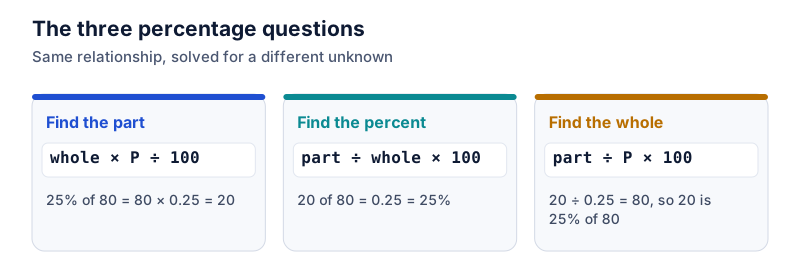
Find the part: what is P% of a number?
You know the percentage and the whole. Turn the percentage into a decimal and multiply.
A jacket costs $80 and the store takes 25% off. The discount is 0.25 × 80 = $20. The same method gives a 15% tip on a $46 bill: 0.15 × 46 = $6.90.
The question usually contains the word “of” right after the percentage: “25% of 80”, “15% of the bill”.
Try it: 25% of 80
Open in calculatorFind the percentage: X is what percent of Y?
You know the part and the whole. Divide the part by the whole, then multiply by 100.
You answered 20 questions right out of 80. That’s 20 ÷ 80 = 0.25, or 25%. A team that won 17 of its 23 games won 17 ÷ 23 = 0.739…, or about 73.9%.
Look for phrasing like “what percent”, “what share” or “what proportion”. The number after “of” is the whole and goes on the bottom of the fraction.
Try it: 17 is what percent of 23?
Open in calculatorFind the whole: X is P% of what?
You know the part and the percentage, but not the total. Divide the part by the percentage as a decimal.
A deposit of $20 is 25% of the price. The price is 20 ÷ 0.25 = $80. If 36 students is 15% of a school year group, the year group has 36 ÷ 0.15 = 240 students.
This shape is easy to miss because it often hides in a sentence: “I’ve saved $1,200, which is 40% of my goal.” The goal is 1,200 ÷ 0.4 = $3,000.
Try it: 1,200 is 40% of what?
Open in calculatorA quick test for which one you have
Read the question and mark the two numbers you were given.
| You know | You want | Do this |
|---|---|---|
| percent and whole | part | whole × percent ÷ 100 |
| part and whole | percent | part ÷ whole × 100 |
| part and percent | whole | part ÷ percent × 100 |
If you’re unsure, put your answer back into the relationship. If 25% of 80 is 20, then 20 ÷ 80 should be 25%, and 20 ÷ 0.25 should be 80. All three checks use the same numbers.
Questions that look similar but aren’t
Two kinds of question use percentages but need a different formula.
Percentage change compares an old value with a new one. If rent goes from $1,200 to $1,290, the change is $90, and the percentage is 90 ÷ 1,200 = 7.5%. The “whole” here is the old value, not the new one. The guide on percentage increase covers this.
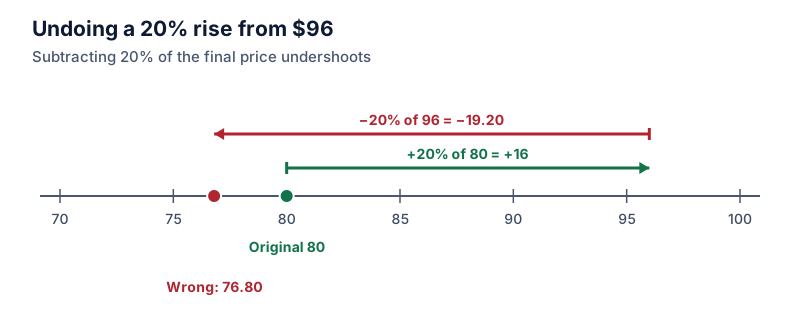
Reverse percentages start from a number that already includes a change. A price of $96 after a 20% markup did not start at $76.80 (that’s 96 minus 20% of 96). It started at 96 ÷ 1.2 = $80. See reverse percentages for why subtracting the percentage gives the wrong answer.
For the methods in more depth, see how to find a percentage of a number and what percent is X of Y.
Questions
Is there one formula for all percentage problems?
Yes: part = percent × whole, with the percent written as a decimal. The three formulas in this guide are that one equation rearranged for whichever number you don’t know.
Why do I divide by 100?
Percent means “per hundred”, so 25% is 25 ÷ 100 = 0.25. Dividing by 100 turns the percentage into a number you can multiply with. Moving the decimal point two places left does the same thing.
The calculator links in this guide are checked against the PercentSwift calculator every time the site is built. How we calculate explains the rounding rules. If you spot a mistake, email hello@percentswift.com.