How to calculate percentage increase
Subtract the old value from the new one, divide by the old value, and multiply by 100. Worked examples with prices, rent and scores, plus a quick way to check the answer.
Percentage increase = (new − old) ÷ old × 100. If a price goes from $120 to $150, the increase is 30, and 30 ÷ 120 = 0.25, so it rose 25%. Always divide by the old value.
On this page
To find a percentage increase, work out how much the value went up, then express that as a percentage of where it started.
percentage increase = (new − old) ÷ old × 100
A concert ticket went from $120 last year to $150 this year. The increase is 150 − 120 = $30. As a share of the old price: 30 ÷ 120 = 0.25, so the price rose 25%.
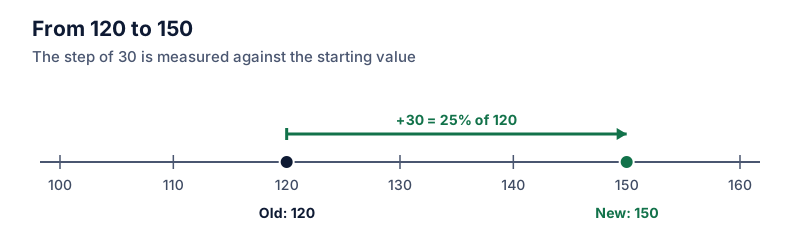
Try it: $120 to $150
Open in calculatorStep by step
- Subtract the old value from the new value to get the change.
- Divide the change by the old value.
- Multiply by 100 to turn the decimal into a percentage.
The old value goes on the bottom because the question is “how much did it grow compared with what it was?”
Worked examples
Rent. Monthly rent goes from $1,450 to $1,537. The change is $87, and 87 ÷ 1,450 = 0.06, a 6% increase.
Test scores. A student’s score goes from 64 to 72. The change is 8, and 8 ÷ 64 = 0.125, so 12.5%. (If the scores are already percentages, the change is also 8 percentage points. See percentage points vs percent.)
Website visitors. Monthly visitors grow from 18,400 to 23,000. The change is 4,600, and 4,600 ÷ 18,400 = 0.25, a 25% increase.
Try it: 18,400 to 23,000 visitors
Open in calculatorSmall prices. A coffee goes from $3.80 to $4.25. The change is $0.45, and 0.45 ÷ 3.80 = 0.1184…, about 11.8%.
Check your answer
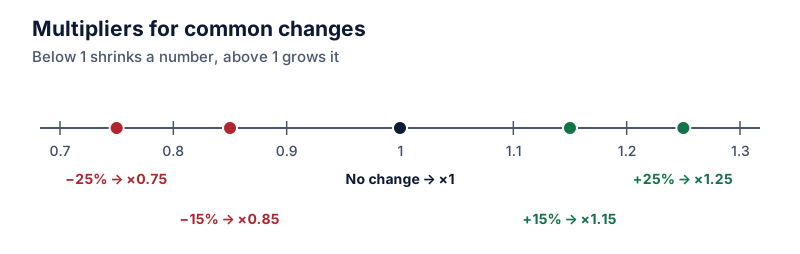
Multiply the old value by (1 + the increase as a decimal). You should get the new value. For the ticket: 120 × 1.25 = 150. For rent: 1,450 × 1.06 = 1,537.
Increases over 100%
If a value more than doubles, the increase is over 100%. A stock bought at $15 and now worth $48 has risen (48 − 15) ÷ 15 = 2.2, or 220%. Don’t confuse that with “the new price is 320% of the old one”, which is also true. One measures the growth and the other compares the two prices directly.
Mistakes to avoid
Dividing by the new value. That gives 30 ÷ 150 = 20% for the ticket example, which understates the increase.
Adding increases from separate periods. Prices up 10% one year and 10% the next have risen 21% in total, not 20%. See successive percentage changes.
Reporting a percentage of a percentage without saying so. If an interest rate goes from 2% to 3%, it rose 1 percentage point and 50%. Say which one you mean.
Related calculations
To add a known percentage to a number (what’s $1,450 plus 6%?), see increasing or decreasing by a percentage. For falls, see how to calculate percentage decrease. For pay rises specifically, see salary raise percentage.
Questions
What if the new value is smaller?
Then the result is negative, which means a decrease. The guide on percentage decrease covers that case.
How do I calculate a percentage increase in Excel?
With the old value in A2 and the new value in B2, use =(B2-A2)/A2 and format the cell as a percentage.
The calculator links in this guide are checked against the PercentSwift calculator every time the site is built. How we calculate explains the rounding rules. If you spot a mistake, email hello@percentswift.com.