How to calculate a pay raise percentage
How to calculate a raise as a percentage, your new pay after a percentage raise, hourly-to-annual conversions, and whether a raise beats inflation.
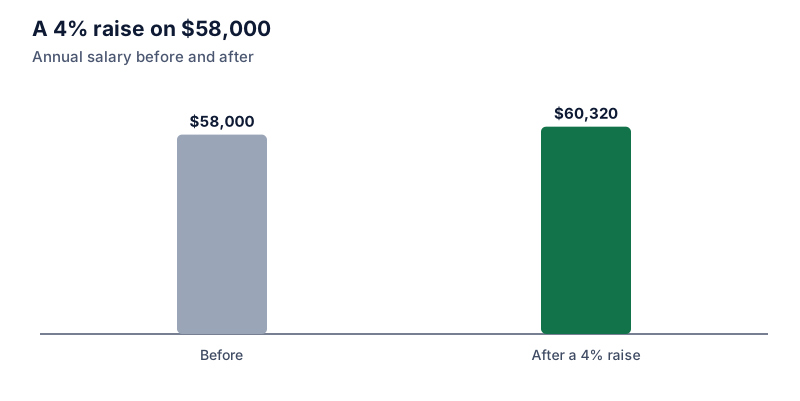
Raise % = (new pay − old pay) ÷ old pay × 100. Going from $58,000 to $60,320 is a $2,320 raise, which is 4%. To find new pay from a percentage, multiply: $58,000 × 1.04 = $60,320. To see whether you’re better off, compare against inflation: a 4% raise with 3% inflation is about a 1% real raise.
On this page
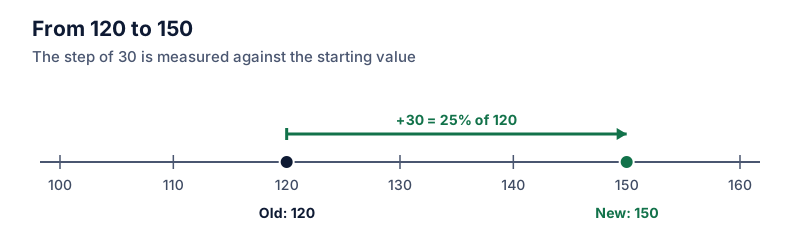
A raise can be described as a dollar amount or as a percentage of your old pay. Converting between the two is a percentage increase calculation.
Raise percentage from two salaries
raise % = (new salary − old salary) ÷ old salary × 100
Your salary goes from $58,000 to $60,320. The raise is $2,320, and 2,320 ÷ 58,000 = 0.04, so 4%.
Try it: $58,000 to $60,320
Open in calculatorNew salary from a raise percentage
Multiply your current pay by 1 plus the raise as a decimal. A 4% raise on $58,000 is 58,000 × 1.04 = $60,320.
Try it: $58,000 plus 4%
Open in calculatorHourly pay
The same formula works for hourly rates. From $24.50 to $25.75 an hour is a $1.25 raise: 1.25 ÷ 24.50 = 5.1%.
To see it in annual terms, multiply by paid hours. At 2,080 hours a year (40 hours × 52 weeks), the old rate is $50,960 and the new rate is $53,560, an extra $2,600 a year. The percentage is the same 5.1% either way.
Try it: $24.50 to $25.75 an hour
Open in calculatorDoes the raise beat inflation?
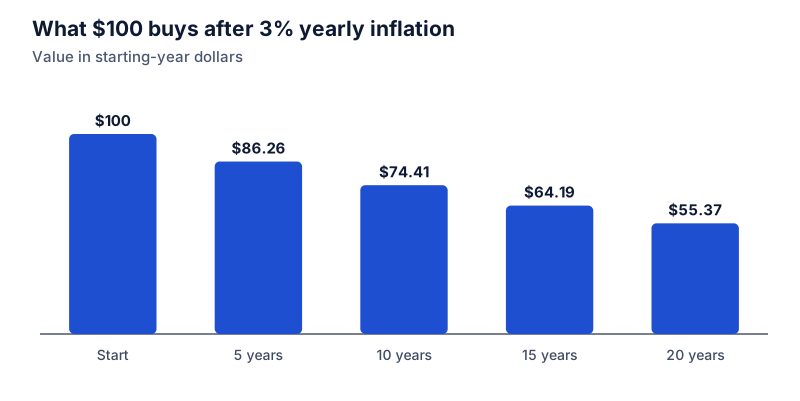
A raise only increases what you can buy if it’s bigger than the rise in prices. To find the real raise:
real raise = (1 + raise) ÷ (1 + inflation) − 1
A 4% raise with 3% inflation: 1.04 ÷ 1.03 = 1.0097, a real raise of about 0.97%. Subtracting (4 − 3 = 1%) is a close shortcut when both numbers are small. With a 2% raise and 5% inflation, your real pay falls by about 2.9% (1.02 ÷ 1.05 = 0.9714).
See inflation and purchasing power for more on this.
Raises over several years
Raises compound. Three years of 3%, 4% and 3.5% raises add up to more than 10.5%: 1.03 × 1.04 × 1.035 = 1.1087, a 10.87% increase overall. The guide on successive percentage changes explains the multiplier method.
Comparing offers
When a new job offers a higher salary, the percentage tells you how big the jump is relative to your current pay. Going from $58,000 to $67,000 is a 15.5% increase. But include benefits: a lower retirement match or higher health insurance costs can cancel part of it. Add up the full value of each package before comparing percentages.
Take-home pay rises by a different percentage
Because of progressive tax rates and fixed deductions, a 4% gross raise doesn’t mean 4% more in your paycheck. It could be a little less or a little more, depending on your tax bracket and how deductions are calculated. Compare paychecks before and after if you want the exact figure.
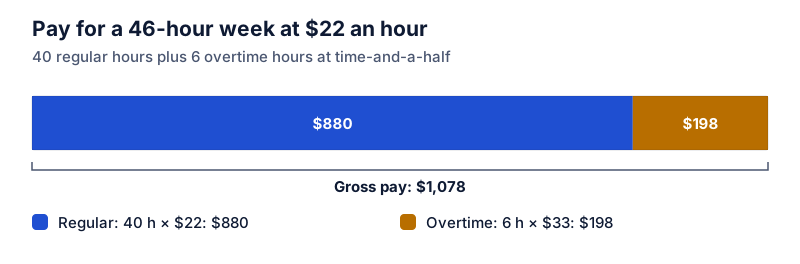
For overtime and premium rates, see overtime pay percentage. For the general method, see how to calculate percentage increase.
Questions
How do I convert an hourly raise to an annual amount?
Multiply the hourly increase by your paid hours per year. Full time at 40 hours a week for 52 weeks is 2,080 hours, so $1.25 an hour more is $2,600 a year.
Is a raise calculated on gross or take-home pay?
Raises are normally quoted on gross pay. Your take-home pay will rise by a different percentage because of taxes and deductions.
The calculator links in this guide are checked against the PercentSwift calculator every time the site is built. How we calculate explains the rounding rules. If you spot a mistake, email hello@percentswift.com.