How to calculate percentage decrease
Percentage decrease is the drop divided by the starting value, times 100. Examples, why decreases can't pass 100%, and why a decrease and the matching increase aren't the same size.
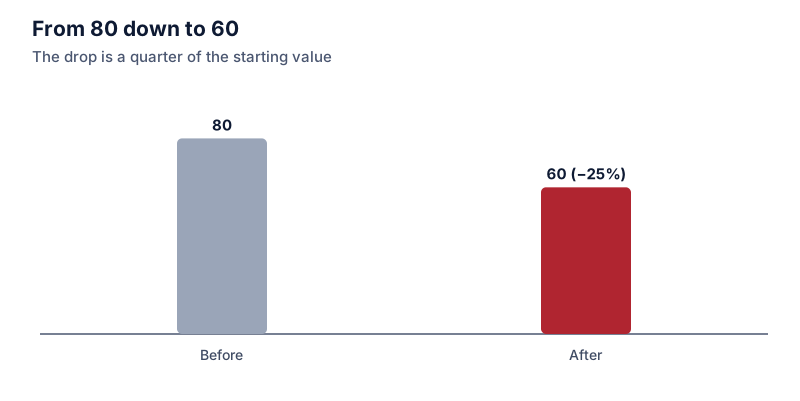
Percentage decrease = (old − new) ÷ old × 100. A price that falls from $80 to $60 drops by $20, and 20 ÷ 80 = 0.25, so it fell 25%. Divide by the starting value, not the new one.
On this page
A percentage decrease measures how far something fell, as a share of where it started.
percentage decrease = (old − new) ÷ old × 100
A pair of headphones drops from $80 to $60. The drop is $20, and 20 ÷ 80 = 0.25. That’s a 25% decrease.
Try it: $80 down to $60
Open in calculatorStep by step
- Subtract the new value from the old one to get the size of the drop.
- Divide by the old value.
- Multiply by 100.
You can also use the general percentage change formula, (new − old) ÷ old × 100. It gives −25% for the same example. The minus sign tells you it went down.
Examples
Energy use. A household used 920 kWh in January and 690 kWh in April. The drop is 230 kWh, and 230 ÷ 920 = 0.25, a 25% decrease.
Weight. Someone goes from 94 kg to 87 kg. The drop is 7 kg, and 7 ÷ 94 = 0.0745, about a 7.4% decrease.
Price cut. A car’s list price falls from $32,500 to $29,900. The drop is $2,600, and 2,600 ÷ 32,500 = 0.08, an 8% decrease.
Try it: $32,500 to $29,900
Open in calculatorDecreases stop at 100%
Something that falls to zero has dropped 100%. It can’t drop further unless the quantity can be negative. If you calculate a decrease bigger than 100% for a price, a count or a weight, you’ve probably divided by the wrong number.
A decrease and an increase of the same size don’t cancel
If a price falls 25% from $80 to $60, getting back to $80 takes a rise of 20 ÷ 60 = 33.3%. The amount is the same $20, but the base is smaller, so the percentage is larger.
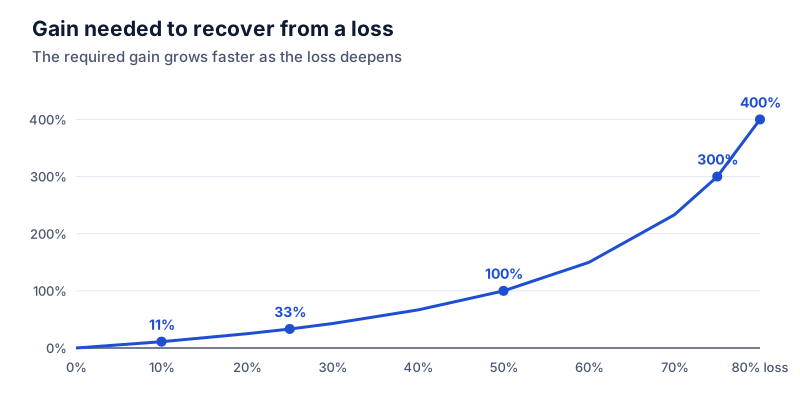
This is why a stock that loses 50% has to gain 100% to recover. The guide on recovering from a percentage loss has a full table.
Taking a percentage off a number
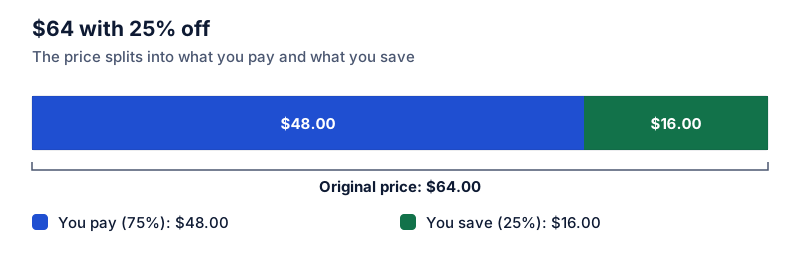
If you already know the percentage and want the result (what’s $80 minus 25%?), multiply by 1 minus the percentage as a decimal: 80 × 0.75 = $60. The calculator’s “Subtract %” mode does this.
Try it: 80 minus 25%
Open in calculatorFor sale prices, the discount guide covers the shopping version, including stacked coupons. For the reverse problem (the price is now $60 after 25% off, what was it before?), divide by 0.75 instead. See reverse percentages.
Mistakes to avoid
Dividing by the new value is the most common one. For the headphones, 20 ÷ 60 gives 33.3%, which answers “how much more was the old price than the new one?” That’s a real question, but it isn’t the decrease.
The other is subtracting percentages that come from different bases. A 30% drop followed by a 20% drop is a 44% drop overall (0.7 × 0.8 = 0.56), not 50%. See successive percentage changes.
Questions
Should a percentage decrease be written as negative?
Either “a 25% decrease” or “−25%” is fine. Don’t combine them: “a −25% decrease” would mean an increase.
Can something decrease by more than 100%?
Only if it can go below zero, like a temperature or a bank balance. A price or a count can fall at most 100%, to zero.
The calculator links in this guide are checked against the PercentSwift calculator every time the site is built. How we calculate explains the rounding rules. If you spot a mistake, email hello@percentswift.com.