How to calculate a discount: sale price and savings
To find a sale price, multiply the original price by 1 minus the discount. Two methods, mental shortcuts for common discounts, and how to check what you'll pay.
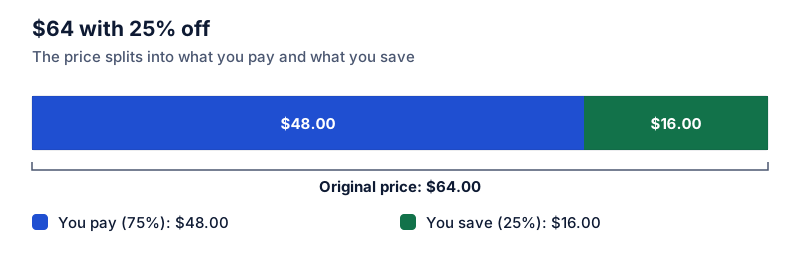
Multiply the price by the discount as a decimal to get the saving, then subtract it. Or multiply the price by what’s left: 25% off means you pay 75%. A $64 item at 25% off saves $16 and costs $48.
On this page
There are two ways to work out a sale price. Both give the same answer, so use whichever is quicker for the numbers in front of you.
Method 1: find the saving, then subtract it
- Convert the discount to a decimal: 25% → 0.25.
- Multiply by the price to get the saving: 0.25 × $64 = $16.
- Subtract: $64 − $16 = $48.
This tells you how much you save, which is useful if you’re deciding whether a deal is worth it.
Method 2: pay what’s left
If you get 25% off, you pay 100% − 25% = 75%. Multiply the price by 0.75: $64 × 0.75 = $48.
sale price = price × (1 − discount ÷ 100)
This is one step instead of two, which makes it the better choice on a calculator or in a spreadsheet.
Try it: $64 with 25% off
Open in calculatorShortcuts for common discounts
| Discount | You pay | Quick method |
|---|---|---|
| 10% | 90% | move the decimal point one place left and subtract |
| 20% | 80% | find 10%, double it, subtract |
| 25% | 75% | divide by 4, subtract |
| 30% | 70% | find 10%, triple it, subtract |
| 50% | 50% | halve the price |
| 75% | 25% | divide by 4 |
For a $45 shirt at 30% off: 10% is $4.50, so 30% is $13.50, and you pay $31.50.
Examples
Furniture. A $1,250 sofa at 15% off: 1,250 × 0.85 = $1,062.50. You save $187.50.
Electronics. A $399.99 tablet at 20% off: 399.99 × 0.8 = $319.992, which rounds to $319.99.
Try it: $399.99 with 20% off
Open in calculatorClearance. A $28 item at 70% off: you pay 30%, so 28 × 0.3 = $8.40.
When there’s more than one discount
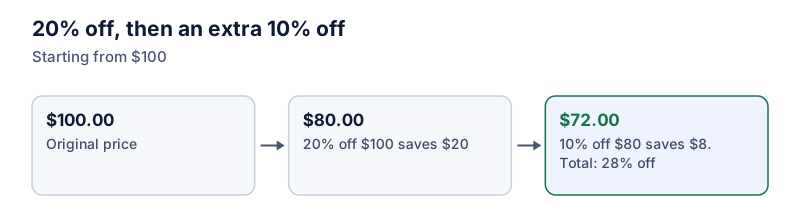
“Take an extra 10% off sale prices” doesn’t add to the original discount. An item that’s 30% off and then an extra 10% off is 0.7 × 0.9 = 0.63, so you pay 63%, a 37% total discount, not 40%. See stacked discounts for the full method.
Try it: 30% off, then an extra 10% off $100
Open in calculatorTax and discounts together
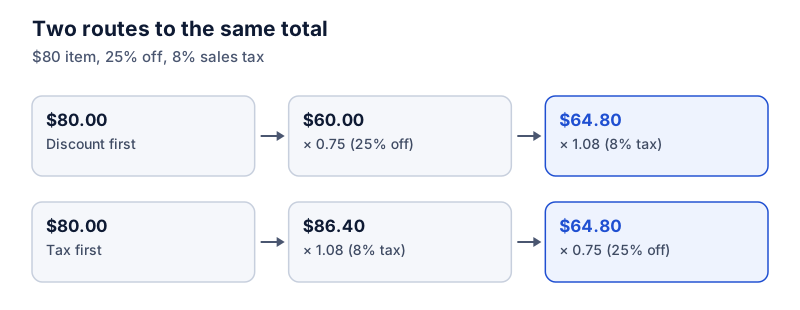
Where sales tax is added at the register, it’s usually charged on the discounted price. For percentage discounts the order doesn’t change the total, as discount first or tax first explains.
Working backward
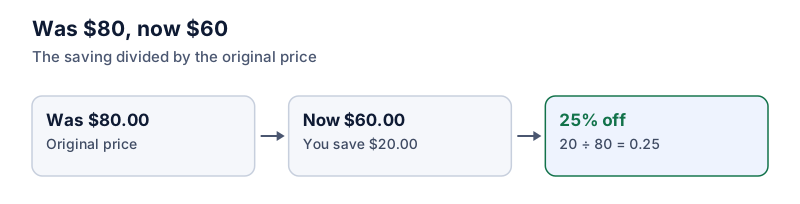
If you know the sale price and the percentage off and want the original price, divide instead: a $48 sale price at 25% off came from 48 ÷ 0.75 = $64. If you know both prices and want the percentage, see discount percentage from two prices.
Questions
Is 25% off the same as paying 75%?
Yes. The discount and the amount you pay always add up to 100% of the original price.
How do I calculate a discount on a phone calculator?
Type the price, then × 0.75 for 25% off (or × 0.8 for 20% off, and so on). The result is the sale price.
The calculator links in this guide are checked against the PercentSwift calculator every time the site is built. How we calculate explains the rounding rules. If you spot a mistake, email hello@percentswift.com.