Compound interest: how percentage growth builds on itself
Compound interest pays interest on earlier interest, so growth speeds up over time. A year-by-year table, the formula, compounding frequency, and the rule of 72 with its limits.
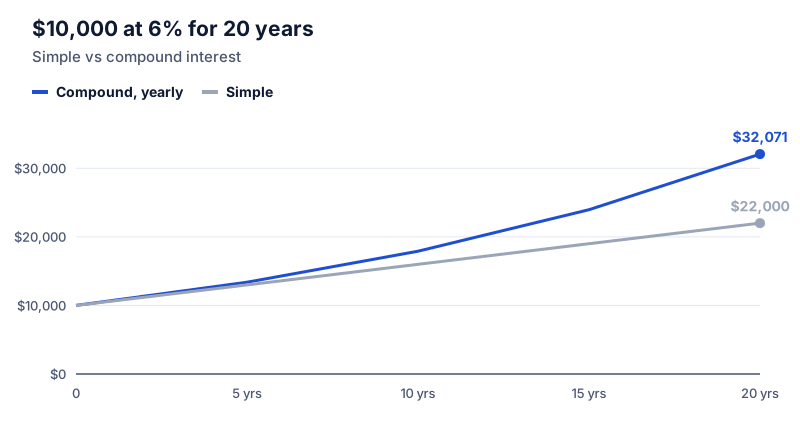
Final amount = principal × (1 + rate)^years. $10,000 at 6% compounded yearly grows to $13,382.26 after 5 years and $32,071.35 after 20. Each year’s interest is added to the balance and earns interest itself, which is why the growth curve bends upward.
On this page
Compound interest is interest that earns interest. Each period, the interest is added to the balance, and the next period’s interest is calculated on that bigger balance.
A = P × (1 + r)^t
Where A is the final amount, P the principal, r the rate per period as a decimal, and t the number of periods
Year by year
$10,000 at 6% a year, compounded yearly:
| Year | Start | Interest (6%) | End |
|---|---|---|---|
| 1 | $10,000.00 | $600.00 | $10,600.00 |
| 2 | $10,600.00 | $636.00 | $11,236.00 |
| 3 | $11,236.00 | $674.16 | $11,910.16 |
| 4 | $11,910.16 | $714.61 | $12,624.77 |
| 5 | $12,624.77 | $757.49 | $13,382.26 |
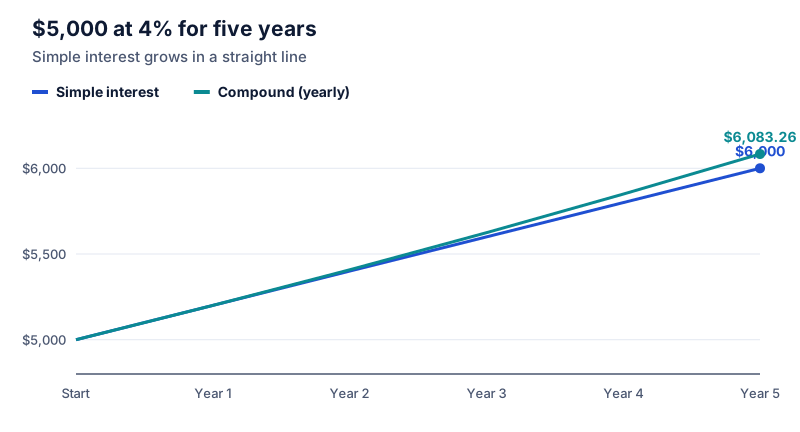
The interest grows every year even though the rate doesn’t change, because it’s 6% of a larger number.
Try it: Three years at 6% on $10,000
Open in calculatorThe long run
Over 20 years, $10,000 at 6% becomes 10,000 × 1.06^20 = $32,071.35. With simple interest, it would be $22,000.
Compounding frequency
Interest can compound yearly, quarterly, monthly or daily. For more frequent compounding, divide the annual rate by the number of periods and multiply the time:
A = P × (1 + r ÷ n)^(n × t)
Where n is the number of compounding periods per year
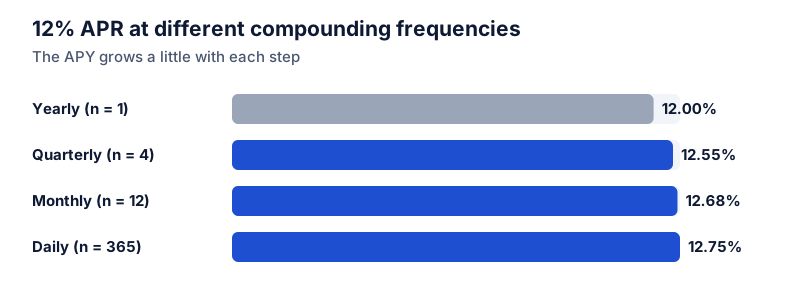
6% compounded monthly: each month adds 0.5%. Over a year, 1.005^12 = 1.0617, so the effective annual rate is 6.17%. That effective rate is what an APY shows. See APR vs APY.
Try it: Three months at 0.5% a month
Open in calculatorThe rule of 72
To estimate how long it takes money to double, divide 72 by the annual percentage rate.
| Rate | Rule of 72 | Exact |
|---|---|---|
| 2% | 36 years | 35.0 years |
| 6% | 12 years | 11.9 years |
| 9% | 8 years | 8.0 years |
| 24% | 3 years | 3.2 years |
It’s a good mental shortcut for typical savings and investment rates. For very high rates, like credit card interest, it underestimates the time slightly.
The same math works against you
Credit card debt compounds too. A $3,000 balance at 24% a year, compounded monthly (2% a month), grows to 3,000 × 1.02^12 = $3,804.73 after a year if nothing is paid. Paying only the minimum keeps a large share of that growth.
Inputs that matter most
Time and rate drive the result. Starting earlier has a large effect because the last years of compounding add the most. Fees reduce the effective rate: a 1% annual fee on a 6% return leaves roughly 5%, and over 20 years that’s the difference between $32,071 and $26,533 on $10,000.
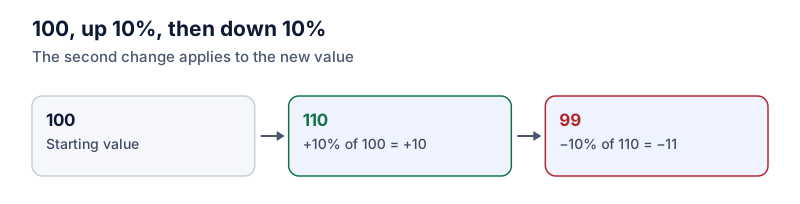
For the general idea of chaining percentage changes, see successive percentage changes. For the non-compounding version, see simple interest.
Questions
How accurate is the rule of 72?
Very close for rates between about 4% and 12%. At 6%, it says 12 years; the exact answer is 11.9. At very low or very high rates it drifts further off.
Does more frequent compounding make a big difference?
Less than people expect. 6% compounded monthly is equivalent to 6.17% a year, and daily compounding gives about 6.18%. The rate and the time matter much more.
The calculator links in this guide are checked against the PercentSwift calculator every time the site is built. How we calculate explains the rounding rules. If you spot a mistake, email hello@percentswift.com.