How to calculate your savings rate
Your savings rate is the money you save divided by your income, times 100. Which income to use, what counts as saving, and how to keep the number comparable over time.
Savings rate = money saved ÷ income × 100. If you take home $4,200 a month and save $630, your savings rate is 15%. Decide once whether you use take-home or gross income and what counts as saving, then stick to it so the number is comparable month to month.
On this page
Your savings rate tells you what share of your income you keep. It’s one number that captures both how much you earn and how much you spend.
savings rate = money saved ÷ income × 100
You take home $4,200 a month and move $630 into savings. Your savings rate is 630 ÷ 4,200 = 15%.
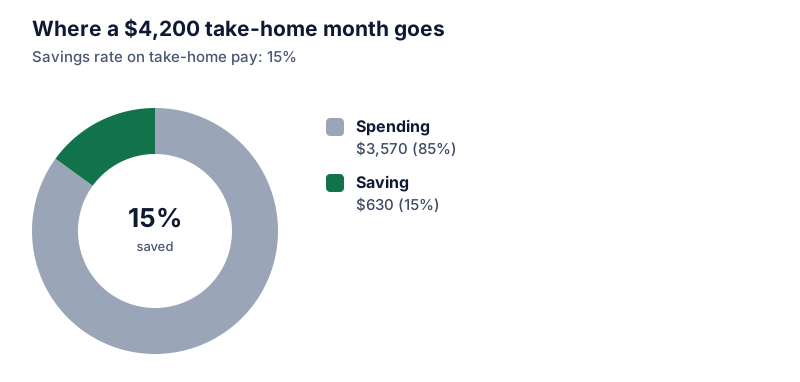
Try it: $630 saved of $4,200 take-home
Open in calculatorTake-home or gross income?
Either works, but they give different numbers, so choose one and label it.
Take-home (net) income is what reaches your bank account after taxes and payroll deductions. It’s simple to track and matches what you can actually spend.
Gross income is your pay before deductions. Using it lets you include savings taken out before your paycheck arrives, like workplace retirement contributions.
Same person, gross pay of $5,500 a month:
- Counting only the $630 moved to savings: 630 ÷ 5,500 = 11.5%
- Adding a $275 pre-tax retirement contribution: 905 ÷ 5,500 = 16.5%
Try it: $905 saved of $5,500 gross
Open in calculatorIf you use gross income, include pre-tax savings in the top number. If you use take-home income, leave them out of both. Mixing the two makes the rate look lower or higher than it is.
What counts as saving
Typically included:
- transfers to savings or investment accounts
- retirement contributions (if you’re using gross income)
- extra mortgage or loan principal, if you choose to count debt payoff
Usually not included:
- money set aside for a known expense soon, like next month’s insurance bill (that’s spending, delayed)
- interest or investment gains (that’s growth, not saving from income)
Track it over several months
Income and spending vary month to month, especially with irregular pay or annual bills. A three-month or yearly figure is more useful than any single month. Add up the savings and income over the period, then divide. Don’t average monthly percentages, because months with higher income should count more. The guide on averaging percentages explains why.
Increasing your savings rate
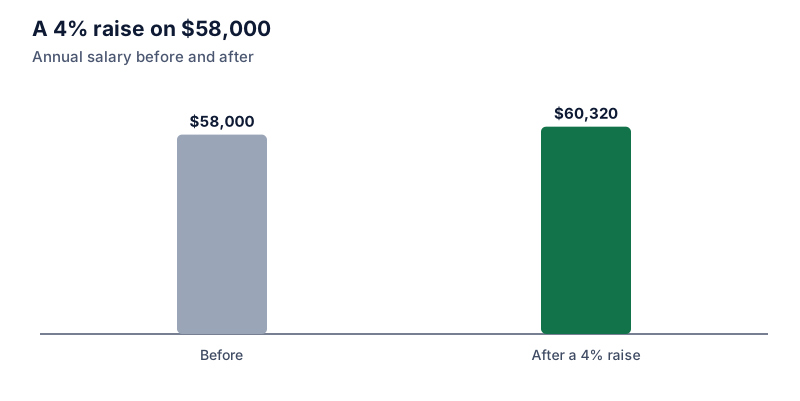
The rate goes up when income rises and spending doesn’t, or when spending falls. One approach is to save part of every raise: if your take-home pay rises $300 a month and you save $150 of it, your rate on the example above goes from 15% to 780 ÷ 4,500 = 17.3%.
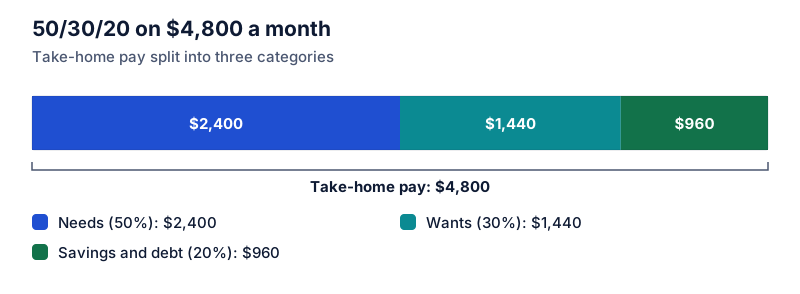
For a framework that splits income into spending categories, see the 50/30/20 budget. For how raises are calculated, see salary raise percentage.
Questions
Should paying off debt count as saving?
Extra principal payments beyond the minimum increase your net worth, so some people count them. Interest doesn’t. Whatever you choose, apply it the same way every month.
What is a good savings rate?
It depends on your income, age, goals and costs. A common rule of thumb is to aim for at least 15–20% of income for long-term goals, but treat any rule as a starting point, not a verdict.
The calculator links in this guide are checked against the PercentSwift calculator every time the site is built. How we calculate explains the rounding rules. If you spot a mistake, email hello@percentswift.com.