Portfolio allocation percentages and how to rebalance
Work out each holding as a percentage of your portfolio, see how far it has drifted from your target, and calculate the trades needed to rebalance.
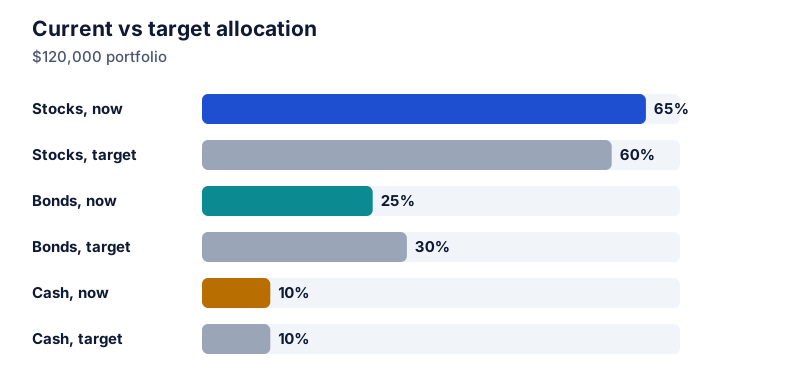
Divide each holding’s value by the portfolio total to get its allocation. To rebalance, multiply the total by each target percentage and compare with what you hold. A $120,000 portfolio at 65% stocks with a 60% target holds $78,000 in stocks against a $72,000 target, so $6,000 needs to move.
On this page
An allocation is just a set of percentages of a total. Working it out takes two steps: add everything up, then divide each part by the total.
Step 1: find your current allocation
| Holding | Value | Share |
|---|---|---|
| Stocks | $78,000 | 65% |
| Bonds | $30,000 | 25% |
| Cash | $12,000 | 10% |
| Total | $120,000 | 100% |
Stocks: 78,000 ÷ 120,000 = 0.65, or 65%.
Try it: $78,000 of $120,000 in stocks
Open in calculatorStep 2: compare with your target
Suppose your target is 60% stocks, 30% bonds and 10% cash. Stocks are 5 percentage points over target, bonds 5 points under.
Step 3: work out the trades
Multiply the total by each target percentage to get target dollar amounts:
| Holding | Target | Target value | Current value | Change |
|---|---|---|---|---|
| Stocks | 60% | $72,000 | $78,000 | sell $6,000 |
| Bonds | 30% | $36,000 | $30,000 | buy $6,000 |
| Cash | 10% | $12,000 | $12,000 | none |
Try it: 60% of $120,000
Open in calculatorThe sells and buys always balance, because the total doesn’t change.
Rebalancing with new money
If you’re adding $10,000, calculate targets on the new total of $130,000:
- Stocks: 60% × 130,000 = $78,000. You hold $78,000, so add nothing.
- Bonds: 30% × 130,000 = $39,000. Add $9,000.
- Cash: 10% × 130,000 = $13,000. Add $1,000.
No selling needed, and the portfolio lands exactly on target.
How drift happens
Allocations move as investments grow at different rates. If stocks rise 20% in a year and bonds 2%, a 60/40 portfolio of $100,000 becomes $72,000 in stocks and $40,800 in bonds. Stocks are now 72,000 ÷ 112,800 = 63.8%.
Net worth allocation
The same method works for your whole balance sheet: home equity, retirement accounts, cash, and other assets each as a share of total assets. Debts are usually listed separately and subtracted to get net worth. Percentages of net worth can exceed 100% for one asset when you have significant debt, so many people calculate shares of total assets instead.
Rounding
Allocations often don’t add to exactly 100% after rounding. If you show 33.3%, 33.3% and 33.3%, the total is 99.9%. That’s expected; see why percentages don’t add to 100. For larger tables of shares, see percentage of total in a table.
Questions
How often should I rebalance?
Common approaches are once a year, or whenever an asset class drifts more than a set number of points (often 5) from target. Rebalancing more often adds trading costs and, in taxable accounts, possibly taxes.
Can I rebalance without selling?
Yes. Direct new contributions to the underweight assets until the allocation is back on target. This avoids selling and is often the cheapest method.
The calculator links in this guide are checked against the PercentSwift calculator every time the site is built. How we calculate explains the rounding rules. If you spot a mistake, email hello@percentswift.com.