Budget percentages: the 50/30/20 split worked through
The 50/30/20 rule splits take-home pay into needs, wants and savings. How to turn it into dollar amounts, check your own split, and adjust it when the numbers don't fit.
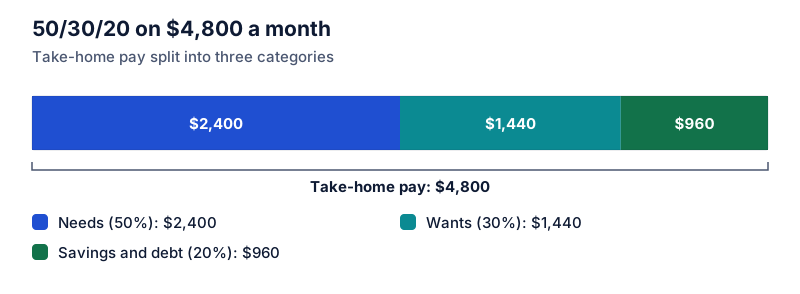
Multiply your take-home pay by 0.5, 0.3 and 0.2. On $4,800 a month that’s $2,400 for needs, $1,440 for wants and $960 for savings and debt payoff. To check your own budget, divide each category’s spending by your take-home pay.
On this page
The 50/30/20 budget divides take-home pay into three parts:
- 50% for needs: housing, utilities, groceries, insurance, minimum debt payments, transport to work
- 30% for wants: eating out, entertainment, travel, hobbies, subscriptions
- 20% for savings and extra debt payments
It’s a guideline, not a law. Its main use is as a quick check on whether one category is crowding out the others.
From percentages to dollars
Multiply your monthly take-home pay by each share. With $4,800 a month:
| Category | Share | Amount |
|---|---|---|
| Needs | 50% | $2,400 |
| Wants | 30% | $1,440 |
| Savings and debt | 20% | $960 |
Try it: 30% of $4,800 for wants
Open in calculatorChecking your actual split
Work backward from what you spend. Add up a typical month in each category and divide by take-home pay.
Suppose your $4,800 month actually looks like this: needs $2,880, wants $1,200, savings $720.
- Needs: 2,880 ÷ 4,800 = 60%
- Wants: 1,200 ÷ 4,800 = 25%
- Savings: 720 ÷ 4,800 = 15%
Try it: $2,880 of $4,800 on needs
Open in calculatorNeeds are 10 points over the guideline and savings are 5 points under. That tells you where to look: housing and transport are usually the biggest needs, and they’re hard to change quickly, so the realistic adjustment might be moving $240 from wants to savings to reach 20%.
Deciding what’s a need
The split is only useful if you’re honest about categories. A phone plan is a need; the most expensive phone plan might be part need and part want. Groceries are a need; takeout is a want. When something is mixed, put the basic version in needs and the extra in wants.
When the rule doesn’t fit
On a low income, needs can take 70% or more, and that’s arithmetic, not a failure. On a high income, 50% for needs might be far more than necessary, and saving more than 20% makes sense. Other common splits are 60/20/20 and 70/20/10. Pick one that fits and track whether you’re moving toward it.
Irregular income
If your pay varies, base the budget on a lower-than-average month and treat anything above it as extra for savings or irregular costs. Calculate your percentages over a quarter rather than a single month.
The 20% category connects to your savings rate. If you’re applying for a loan, lenders look at a different ratio based on gross income: see debt-to-income ratio.
Questions
Is the 50/30/20 rule based on gross or take-home pay?
Take-home pay, after taxes. Some versions subtract workplace retirement contributions first; others count them toward the 20%.
What if my rent alone is more than 50%?
That’s common in expensive cities. Use the split as a reference point and adjust: a 60/20/20 or 65/15/20 budget can still keep savings on track.
The calculator links in this guide are checked against the PercentSwift calculator every time the site is built. How we calculate explains the rounding rules. If you spot a mistake, email hello@percentswift.com.