Overtime pay: time and a half and other pay rate percentages
Time-and-a-half means 150% of your hourly rate. At $22 an hour, overtime is $33, and 46 hours pays $1,078. How to check overtime on a paycheck, double time, and what share of your pay came from overtime.
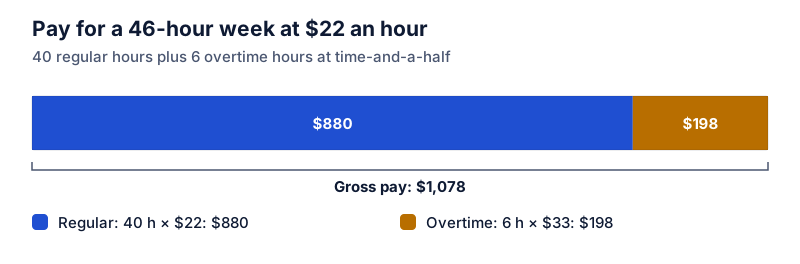
Overtime rate = hourly rate × overtime multiplier. Time-and-a-half is 150%: $22 × 1.5 = $33 an hour. For 46 hours with 40 regular: 40 × $22 = $880, plus 6 × $33 = $198, for $1,078 before deductions.
On this page
If your paycheck includes overtime, it’s worth checking the math. The calculation is a percentage of your hourly rate.
Overtime rate
overtime rate = hourly rate × multiplier
Where time-and-a-half is 1.5 (150%), double time is 2 (200%)
At $22 an hour, time-and-a-half is 150% of $22:
Try it: 150% of $22
Open in calculator$33 an hour. The extra 50%, $11, is the overtime premium.
A week with overtime
You worked 46 hours, and overtime applies after 40.
- Regular pay: 40 × $22 = $880.
- Overtime pay: 6 × $33 = $198.
- Gross pay: $880 + $198 = $1,078.
Double time
At 200% the rate is $22 × 2 = $44.
Try it: 200% of $22
Open in calculatorHow much of your pay was overtime?
Try it: $198 of $1,078
Open in calculatorAbout 18.4% of the week’s gross pay came from overtime, while overtime was 6 of 46 hours (13%).
Checking a paycheck
- Find the regular and overtime hours on the pay stub.
- Multiply each by its rate and add them.
- Compare with gross pay before deductions. Taxes and other deductions come out after this.
Some pay stubs show overtime as “straight time” for all hours plus a separate “premium” line for the extra half: 46 × $22 = $1,012, plus 6 × $11 = $66, which also gives $1,078.
Rules vary
Who qualifies for overtime, when it starts (weekly or daily hours), and which pay counts toward the regular rate depend on your location, job type and contract. In the US, federal rules apply to nonexempt employees, and many states have their own additions. Check your employer’s policy or local labor authority for your situation.
Related
For changes to your base pay, see salary raise percentage. For pay tied to sales, see sales commission. For how much of your time is billable, see utilization rate.
Questions
Is overtime based on hours per week or per day?
It depends on where you work and your contract. In the US, federal rules for nonexempt employees use hours over 40 in a workweek, and some states add daily overtime. Other countries set their own rules. Check your employer’s policy and local labor rules.
Do bonuses affect the overtime rate?
Under some rules, certain bonuses and shift premiums must be included in the regular rate used for overtime. If your pay includes extras, the overtime rate may be higher than your base rate × 1.5.
The calculator links in this guide are checked against the PercentSwift calculator every time the site is built. How we calculate explains the rounding rules. If you spot a mistake, email hello@percentswift.com.