How inflation shrinks purchasing power: the percentage math
When prices rise 25%, your money loses 20% of its buying power, not 25%. How to calculate purchasing power after inflation, over one year or many.
Purchasing power after inflation = amount ÷ (1 + inflation). If prices rise 25%, $100 buys what $80 used to (100 ÷ 1.25), a 20% loss of purchasing power. Over several years, multiply the yearly inflation factors first: 3% a year for 10 years raises prices 34.4% and cuts purchasing power by 25.6%.
On this page
Inflation means prices go up. The flip side is that each dollar buys less. These are two descriptions of the same event, but they aren’t the same percentage.
Price rise vs loss of purchasing power
Suppose a basket of groceries costs $100, and prices rise 25%. The same basket now costs $125.
How much can your original $100 buy? 100 ÷ 125 = 0.8 of the basket. You’ve lost 20% of your purchasing power, not 25%.
purchasing power = amount ÷ (1 + inflation ÷ 100)
loss of purchasing power = inflation ÷ (100 + inflation) × 100
Try it: What $100 is worth in old prices after 25% inflation
Open in calculatorThis is a reverse percentage: you’re undoing the price rise to express today’s money in yesterday’s prices.
Over several years
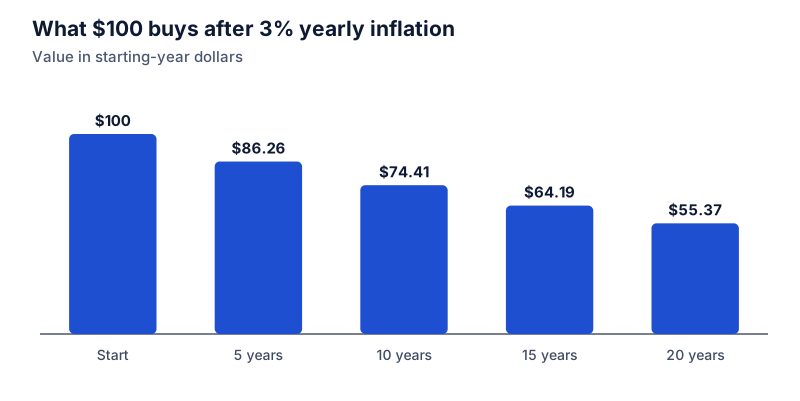
Inflation compounds. At 3% a year for 10 years, prices rise by a factor of 1.03^10 = 1.3439, a 34.4% increase. $100 then buys what 100 ÷ 1.3439 = $74.41 bought at the start. That’s a 25.6% loss of purchasing power.
Try it: $100 after a 34.3916% rise in prices
Open in calculatorWhen the yearly rates differ, multiply them. 2%, 6% and 4% over three years: 1.02 × 1.06 × 1.04 = 1.1244, so prices rose 12.4% and $1,000 now buys what $889.33 did.
Real vs nominal
A nominal figure is in today’s dollars. A real figure is adjusted for inflation. If your savings grew from $10,000 to $10,400 in a year (4% nominal) while prices rose 3%, your real return was 1.04 ÷ 1.03 − 1 = 0.97%.
The same logic applies to wages. A raise below the inflation rate is a real pay cut. See salary raise percentage.
Using a price index
Statistics agencies publish a consumer price index (CPI) that tracks the cost of a typical basket of goods. To adjust an amount between two dates:
value then in today’s money = amount × (CPI now ÷ CPI then)
If the index was 240 in one year and 300 later, prices rose 300 ÷ 240 = 1.25, or 25%. $50 back then is equivalent to $62.50 now. The guide on index numbers explains how these indexes work.
Inflation rates vs price levels
When inflation falls from 6% to 3%, prices are still rising, just more slowly. Prices only fall when inflation is negative (deflation). A drop in the inflation rate doesn’t bring back the purchasing power already lost.
Why this matters for savings
Cash held at 0% interest loses purchasing power every year that inflation is positive. Over 20 years at 3%, $100 in cash buys what $55.37 bought at the start. To keep its value, money needs to earn at least the inflation rate after tax. The guide to compound interest shows how growth and inflation work on the same multiplier principle.
Questions
Why isn't the loss the same as the inflation rate?
Inflation is measured against old prices, and purchasing power is measured against your money. A 25% price rise means each dollar buys 1 ÷ 1.25 = 0.8 of what it did, a 20% loss.
Where do I find inflation figures?
National statistics agencies publish consumer price indexes. In the US that’s the Bureau of Labor Statistics’ CPI. Use the change in the index between two dates.
The calculator links in this guide are checked against the PercentSwift calculator every time the site is built. How we calculate explains the rounding rules. If you spot a mistake, email hello@percentswift.com.