Percent off vs dollar off: which coupon saves more?
A percentage coupon beats a fixed-dollar coupon once your total passes a break-even point. How to find it, plus minimum spends and combining both.
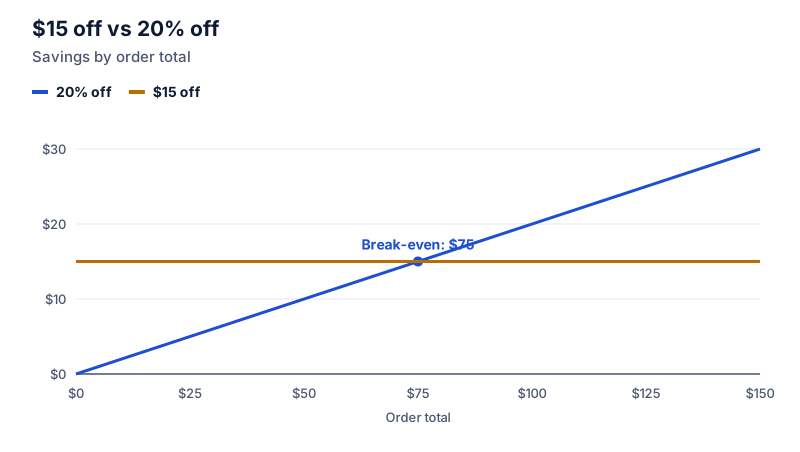
Divide the dollar discount by the percentage (as a decimal) to find the break-even total. For $15 off vs 20% off: 15 ÷ 0.20 = $75. Below $75 the $15 coupon saves more; above $75 the 20% coupon does.
On this page
A fixed-dollar coupon saves the same amount whatever you spend. A percentage coupon saves more as the total grows. Somewhere between, they’re worth the same.
Finding the break-even total
break-even total = dollar discount ÷ (percent ÷ 100)
$15 off or 20% off? 15 ÷ 0.20 = $75. At exactly $75, both save $15. Spend less and the $15 coupon is better. Spend more and 20% wins.
Try it: 20% off a $75 order
Open in calculatorExamples
$10 off vs 15% off. Break-even: 10 ÷ 0.15 = $66.67. On a $50 order, $10 off saves more ($10 vs $7.50). On a $90 order, 15% saves more ($13.50 vs $10).
$25 off vs 10% off. Break-even: 25 ÷ 0.10 = $250. Unless you’re spending over $250, take the $25.
$5 off vs 5% off. Break-even: $100. For most grocery runs, the $5 is better.
Try it: 15% off a $90 order
Open in calculatorMinimum spends
Dollar coupons often come with a minimum: “$15 off orders of $50 or more.” That splits the range into three parts, using the 20% vs $15 example:
| Order total | Better coupon |
|---|---|
| under $50 | 20% (the $15 doesn’t apply) |
| $50 to $75 | $15 off |
| over $75 | 20% off |
If you’re just under a minimum, it can be worth adding a small item you’d buy anyway. Adding $4 to a $46 basket to unlock $15 off is a good trade; adding $30 of things you don’t need isn’t.
Using both
When a store allows a percentage coupon and a dollar coupon together, the order affects the total. On a $100 order with 20% off and $15 off:
- Percentage first: $100 × 0.8 = $80, then − $15 = $65
- Dollar first: $100 − $15 = $85, then × 0.8 = $68
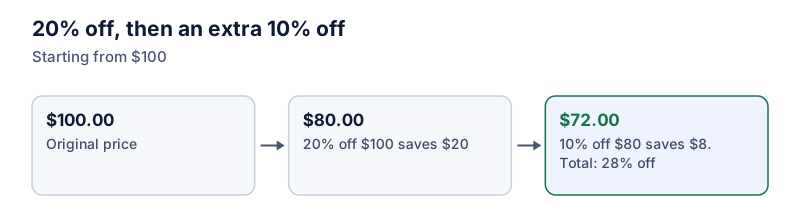
Percentage first saves you $3 more. The store’s terms usually decide the order, but it’s worth knowing. The stacked discounts guide covers combining two percentages.
Caps and exclusions
Percentage coupons often have a maximum (“20% off, up to $40”). With a cap, the percentage coupon stops growing once you hit it: 20% up to $40 maxes out at a $200 order. Check exclusions too. If half your basket is excluded brands, apply the percentage only to the eligible part.
Converting a dollar coupon to a percentage
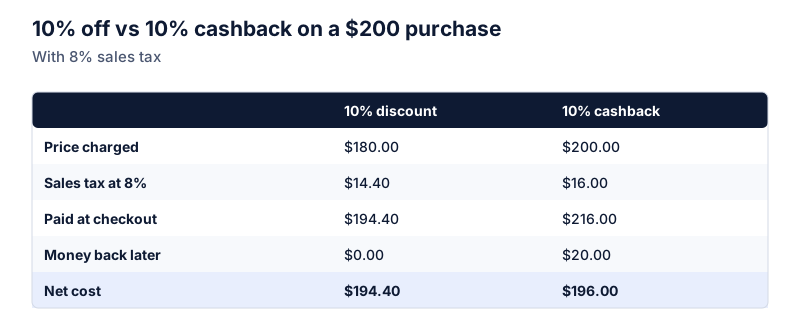
To compare a dollar coupon with other percentage deals, divide it by your total. $15 off a $60 order is 15 ÷ 60 = 25% off. The same coupon on $120 is only 12.5%. For more on that calculation, see discount percentage from two prices. Cashback offers are a third kind of deal, covered in cashback vs discount.
Questions
What if the dollar coupon has a minimum spend?
Below the minimum it’s worth nothing, so the percentage coupon wins there. Between the minimum and the break-even total, the dollar coupon wins.
Can I use both?
If the store allows it, apply the percentage first if you can choose. The dollar amount is then taken off a smaller total, and the percentage applies to the larger one.
The calculator links in this guide are checked against the PercentSwift calculator every time the site is built. How we calculate explains the rounding rules. If you spot a mistake, email hello@percentswift.com.