Cashback vs discount: comparing percentage rewards
A 10% discount and 10% cashback look identical, but they rarely are. How delays, store credit, sales tax and spending caps change what a cashback offer is worth.
On a plain cash purchase with no tax, 10% off and 10% cashback cost the same. In practice the discount usually wins: cashback paid as store credit is worth less (10% back as credit is about 9.1% off), sales tax is charged on the full price, and cashback can be delayed, capped or never claimed.
On this page
A discount lowers the price you pay. Cashback returns some money after you’ve paid the full price. With the same percentage, they can look interchangeable. Usually they aren’t.
The simple case: they match
A $200 purchase with 10% off costs $180. With 10% cashback you pay $200 and get $20 back, so the net cost is also $180. If there’s no tax, the cashback is paid in cash, and you’re sure to receive it, the two offers are equal.
Try it: 10% of $200
Open in calculatorSales tax tips it toward the discount
Sales tax is charged on the price at checkout. A discount lowers that price, so you pay less tax. Cashback doesn’t, because it arrives later.
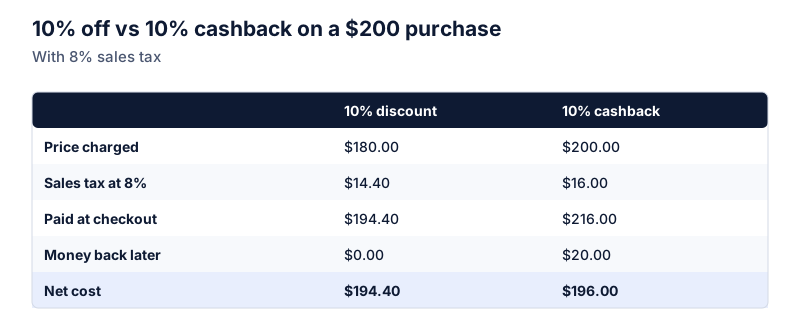
The difference is the tax on the cashback amount: 8% of $20 = $1.60. Small on one purchase, but it’s consistent.
Store credit is worth less than cash
“10% back in store credit” means you get $20 to spend at the same store. You only get the value if you spend it, and once you do, you’ve spent $220 in total to get $20 off. That’s 20 ÷ 220 = 9.1% off, not 10%.
Try it: $20 credit as a share of $220 spent
Open in calculatorIf the credit expires or you’d never have shopped there again, it’s worth even less, possibly nothing.
Other things that reduce cashback
- Delays. Some programs pay weeks or months later.
- Caps. “10% cashback up to $15” is only 7.5% on a $200 purchase.
- Claiming. Mail-in rebates and some portal offers need forms, receipts or tracking. Many people never claim them.
- Returns. If you return an item, cashback is usually reversed, sometimes in ways that are hard to follow.
- Minimum payouts. Some sites only pay out once your balance passes a threshold.
When cashback can be better
Cashback is sometimes offered on top of a discount, for example a cashback card used to pay a sale price. Then the two stack. A 20% sale paid with a 2% cashback card gives you 0.8 × 0.98 = 0.784, so a combined saving of about 21.6%.
Cashback can also beat a slightly larger discount if it applies to more of the basket. A 5% cashback on the whole basket can be worth more than 10% off that only applies to a few items in it.
Comparing offers fairly
- Convert everything to net cost: what you’ll actually be out of pocket after money comes back.
- Discount store credit to the effective rate, or to zero if you’re unlikely to use it.
- Include tax.
- Apply caps.
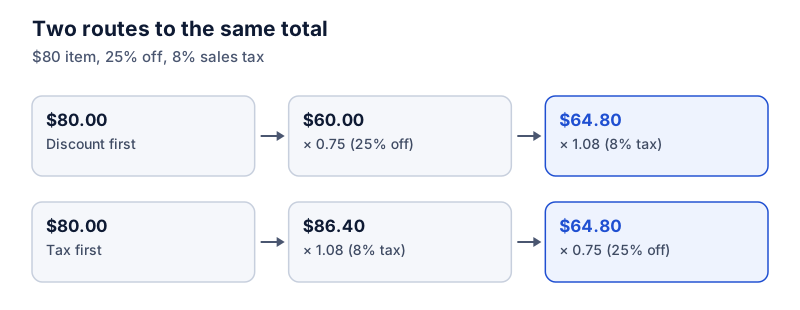
For fixed-dollar coupons, see percent off vs dollar off. For tax on discounted prices, see discount first or tax first.
Questions
Is cashback taxable income?
In many countries, cashback on your own purchases is treated as a rebate rather than income, but rules differ. Check the rules where you live if the amounts are large.
Is a cashback credit card the same as a discount?
It’s similar, as long as you pay the balance in full. If you carry a balance, interest charges will quickly outweigh a 1–2% reward.
The calculator links in this guide are checked against the PercentSwift calculator every time the site is built. How we calculate explains the rounding rules. If you spot a mistake, email hello@percentswift.com.