How to work out the discount percentage from the original and sale price
Subtract the sale price from the original, divide by the original, and multiply by 100. Worked price-tag examples and the mistake that makes discounts look bigger.
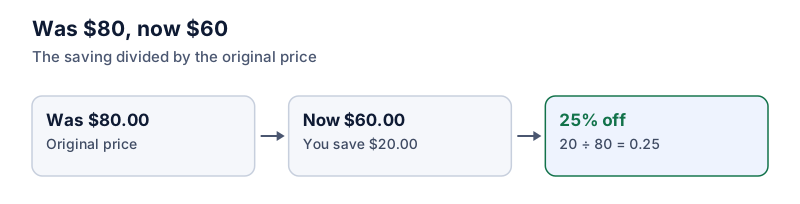
Discount % = (original − sale) ÷ original × 100. A tag reading “was $80, now $60” is (80 − 60) ÷ 80 = 25% off. Divide by the original price, not the sale price.
On this page
When a price tag shows a “was” price and a “now” price, you can work out the discount yourself.
discount % = (original − sale) ÷ original × 100
A jacket was $80 and is now $60. The saving is $20, and 20 ÷ 80 = 0.25, so it’s 25% off.
Try it: Was $80, now $60
Open in calculatorAnother way: the share you pay
Divide the sale price by the original price to see what fraction you’re paying, then subtract from 100%. $60 ÷ $80 = 0.75, so you pay 75% and save 25%. This is handy when the prices are awkward to subtract in your head.
Examples
Shoes. Was $129.99, now $89.99. The saving is $40, and 40 ÷ 129.99 = 0.3077, about 30.8% off.
TV. Was $649, now $499. The saving is $150, and 150 ÷ 649 = 0.2311, about 23.1% off.
Try it: Was $649, now $499
Open in calculatorGroceries. Was $5.49, now $3.99. The saving is $1.50, and 1.50 ÷ 5.49 = 0.2732, about 27.3% off.
The common mistake
Dividing the saving by the sale price gives a bigger number. For the jacket, 20 ÷ 60 = 33%. That would be right if the question were “how much more did it cost before?”, but a discount is always measured against the original price.
Checking “up to 70% off” claims
Signs like “up to 70% off” mean at least one item is discounted that much. Most items usually aren’t. Calculating the real discount on the things you actually want is the only way to know what the sale is worth to you.
It’s also worth asking whether the “was” price was ever charged. In many places, rules about reference prices require the original price to have been offered for a reasonable period, but enforcement varies. Comparing with other stores tells you more than the tag does.
When the discount is in dollars
If a coupon takes a fixed $15 off a $60 item, the percentage discount is 15 ÷ 60 = 25%. On a $100 item, the same coupon is only 15%. The guide on percent off vs dollar off compares the two types.
Related calculations
To go from a discount percentage to a sale price, see how to calculate a discount. To recover the original price from a sale price and a percentage, see original price before a discount. For deals like “buy one, get one free”, see multibuy deals as a percentage.
Questions
Why not divide by the sale price?
The discount is a percentage of the original price. Dividing by the sale price answers a different question: how much more the original cost than the sale price.
What if the store rounds the discount?
Stores often round to a whole percentage or a price ending in .99. Your calculation will show the exact figure, which can differ slightly from the tag.
The calculator links in this guide are checked against the PercentSwift calculator every time the site is built. How we calculate explains the rounding rules. If you spot a mistake, email hello@percentswift.com.