Buy one, get one free and other multibuy deals as a percentage
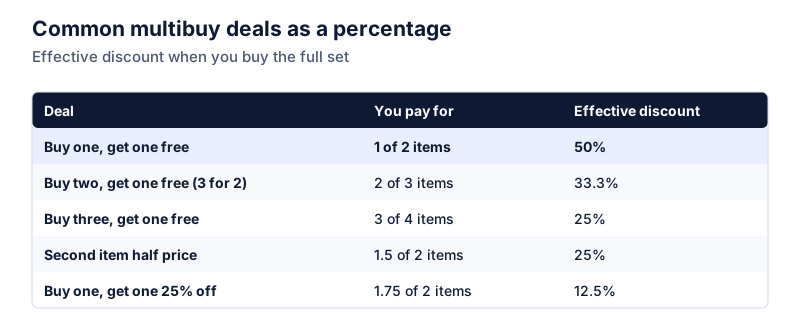
Buy one get one free is 50% off, buy two get one free is 33.3% off, and half-price second item is 25% off. How to convert any multibuy deal into a percentage.
Divide what you pay by what the items would normally cost, and subtract from 100%. Buy one get one free = 50% off the pair. Buy two get one free (3 for 2) = 33.3% off. Second item half price = 25% off. These only apply if you wanted all the items.
On this page
Multibuy offers are discounts in disguise. Converting them to a percentage makes them easy to compare with a straight sale or a deal at another store.
The method
effective discount = (normal total − what you pay) ÷ normal total × 100
Add up what the items would cost at full price, work out what you actually pay, and compare.
Buy one, get one free
Two items at $10 would cost $20. You pay $10. (20 − 10) ÷ 20 = 50% off.
Try it: Two $10 items for $10
Open in calculatorBuy two, get one free (3 for 2)
Three items at $6 would cost $18. You pay $12. (18 − 12) ÷ 18 = 33.3% off.
Second item half price
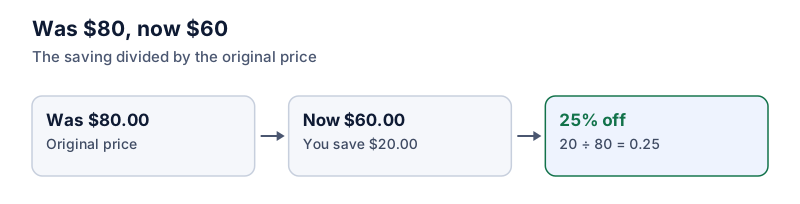
Two items at $30 would cost $60. You pay $30 + $15 = $45. (60 − 45) ÷ 60 = 25% off. Half price on one item is a quarter off the pair.
Try it: Two $30 items, second half price
Open in calculator“3 for $10” deals
If an item normally costs $4.29, three would cost $12.87. Paying $10 is (12.87 − 10) ÷ 12.87 = 22.3% off. If the normal price is $3.49, three cost $10.47 and the deal saves only 4.5%. Check the single price before assuming a bundle is a bargain.
Mixed prices
When items have different prices, stores usually give away the cheapest. Buy one, get one free on a $24 and an $18 item: the full total is $42, you pay $24, so the discount is 18 ÷ 42 = 42.9%, less than the headline 50%.
The catch: only if you’d buy them all
A multibuy is only a discount on things you wanted. If you need one bottle of shampoo and buy two to get the second free, you’ve spent the full price of one bottle on a spare. That can still be sensible for things you’ll use, like toilet paper or canned food. For perishables or things you were only half interested in, compare the per-item price with what you’d normally pay for the one you need.
Comparing with a straight discount
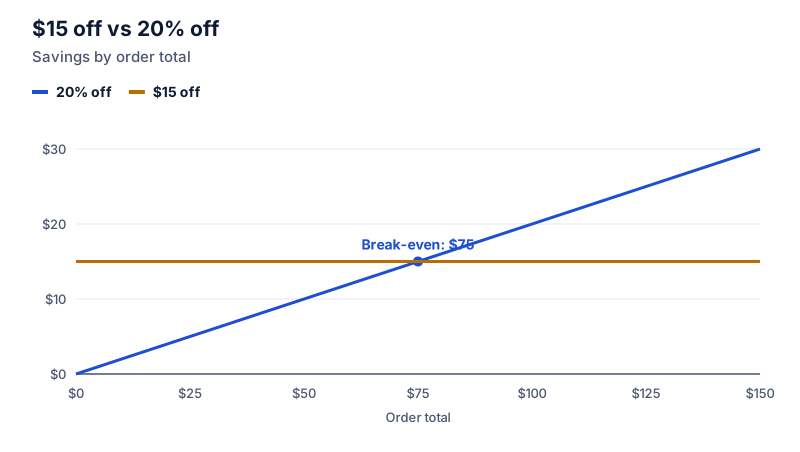
Once a multibuy is expressed as a percentage, it can be compared directly. “Buy two, get one free” (33.3%) beats “30% off everything” if you want three items, and loses if you only want one or two.
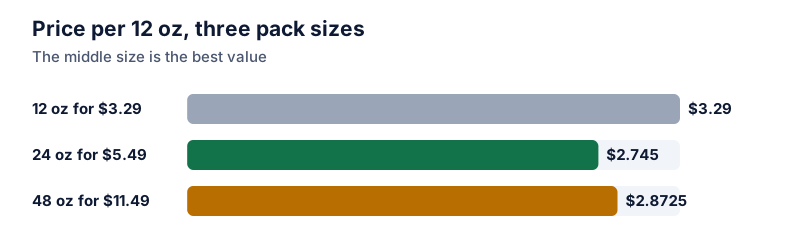
To compare deals that change the pack size rather than the price, look at the unit price instead. See unit price comparison. For deals expressed as a was/now price, see discount percentage from two prices.
Questions
Is BOGO free better than 50% off?
Only if you want two. 50% off one item gives the same per-item price without buying a second.
What if the items have different prices?
Most deals make the cheapest item free. Add up the full prices, subtract the cheapest, and compare with the full total.
The calculator links in this guide are checked against the PercentSwift calculator every time the site is built. How we calculate explains the rounding rules. If you spot a mistake, email hello@percentswift.com.