Combined sales tax rates: state, county and city
When state, county and city sales taxes apply, add the rates to get the combined rate, then multiply once. 6% + 1.5% + 1% = 8.5%, so tax on $200 is $17. Why the rates add rather than compound.
Add the separate rates to get the combined rate: 6% state + 1.5% county + 1% city = 8.5%. Then calculate tax once on the price: $200 × 0.085 = $17, for a total of $217. Each rate applies to the same price, so they add and don’t compound.
On this page
In many US locations, the sales tax you pay is several taxes stacked together: a state rate plus county, city, and sometimes special district rates. Your receipt usually shows one combined rate. Here’s how the pieces fit.
Add the rates
combined rate = state rate + county rate + city rate + district rates
Where all rates are percentages of the same price
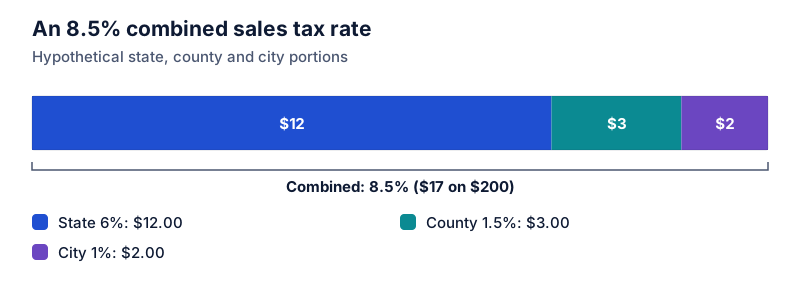
Using hypothetical rates: 6% + 1.5% + 1% = 8.5%.
Then calculate once
On a $200 purchase:
- Combined rate as a decimal: 0.085.
- Tax: $200 × 0.085 = $17.00.
- Total: $217.00.
Try it: $200 at a combined 8.5% rate
Open in calculatorYou get the same answer by working out each portion separately ($12 + $3 + $2 = $17), because each rate is applied to the same $200.
Why the rates don’t compound
Compounding would mean applying the county tax to the price plus state tax, and so on. Sales taxes aren’t stacked that way: each one is a percentage of the selling price. So the rates simply add. That’s different from successive percentage changes like discounts, which do multiply. For more on that difference, see successive percentage changes.
A bigger purchase
On a $1,299 laptop at 8.5%: $1,299 × 0.085 = $110.415, which rounds to $110.42, for a total of $1,409.42.
Try it: $1,299 at 8.5%
Open in calculatorWorking backwards
If you know the total and the combined rate, divide by 1 + the rate: $217 ÷ 1.085 = $200. See removing sales tax from a total.
If you only know the total and the price, the combined rate is tax ÷ price × 100: $17 ÷ $200 × 100 = 8.5%.
Things to check
- Which location applies. For deliveries, the rate is often based on the delivery address, not the seller’s.
- Caps and exemptions. Some local taxes apply only up to a certain amount per item, or not to certain goods.
- Rate changes. Local rates change more often than state rates, sometimes at the start of a quarter.
Rules differ by state, so use your state revenue department’s published rates when you need an exact figure. For the basic calculation, see how to calculate sales tax. Income tax works very differently, with rates applied to slices of income: see effective vs marginal tax rate.
Questions
How do I find the combined rate for an address?
Most state revenue departments publish rate tables or lookup tools by address or ZIP code. Rates can differ within a single ZIP code, so an address lookup is more reliable.
Can a combined rate have three decimal places?
Yes. District taxes are sometimes fractions such as 0.125% or 0.375%, which produce combined rates like 8.875%. The calculator accepts any number of decimals.
The calculator links in this guide are checked against the PercentSwift calculator every time the site is built. How we calculate explains the rounding rules. If you spot a mistake, email hello@percentswift.com.