Effective tax rate vs marginal tax rate
Moving into a higher tax bracket only taxes the income above the threshold at the higher rate. How to calculate tax by bracket and the effective rate, with a worked example using simple hypothetical brackets.
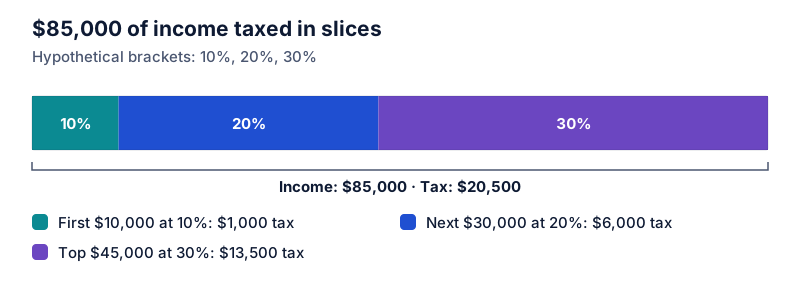
Your marginal rate is the rate on your last dollar of income; your effective rate is total tax ÷ total income. With hypothetical brackets of 10%, 20% and 30%, $85,000 of taxable income owes $20,500. The marginal rate is 30%, but the effective rate is 24.1%.
On this page
“If I earn more, I’ll move into a higher bracket and lose money.” It’s a common worry, and it’s based on a misunderstanding of how bracket systems work. The brackets below are simple made-up numbers, not any country’s actual rates.
How brackets work
In a progressive system, each rate applies only to the slice of income inside its bracket:
| Taxable income slice | Rate |
|---|---|
| $0 to $10,000 | 10% |
| $10,000 to $40,000 | 20% |
| Above $40,000 | 30% |
Worked example: $85,000
Tax each slice at its own rate:
- First $10,000 × 10% = $1,000
- Next $30,000 × 20% = $6,000
- Remaining $45,000 × 30% = $13,500
Total tax: $20,500.
Marginal rate
The marginal rate is the rate on the next dollar you earn. Here it’s 30%: an extra $1,000 of income would add $300 of tax.
Effective rate
effective rate = total tax ÷ income × 100
Where income should be the same measure used for the brackets
Try it: $20,500 of tax on $85,000
Open in calculatorSo $85,000 of income pays about 24.1% in total, well below the 30% marginal rate.
Crossing a threshold
Someone at $40,000 owes $1,000 + $6,000 = $7,000. A raise to $41,000 adds $1,000 taxed at 30%, so tax becomes $7,300. Take-home pay goes up by $700. The effective rate rises only a little:
Try it: $7,300 of tax on $41,000
Open in calculatorFrom 17.5% ($7,000 ÷ $40,000) to about 17.8%.
Which rate to use when
- Marginal rate for decisions about extra income or deductions: overtime, a side job, a retirement contribution.
- Effective rate for describing your overall tax burden or comparing years.
Real tax systems
Actual systems add deductions, credits, other taxes such as payroll taxes, and different rules for different income types. The bracket logic above still holds, but for your own numbers, use your tax authority’s current tables or a tax professional.
For related pay calculations, see salary raise percentage and sales commission. Sales taxes, which use a single combined rate, are covered in combined sales tax rates.
Questions
Can a raise ever reduce my take-home pay because of brackets?
Not through income tax brackets alone, because only the extra income is taxed at the higher rate. Some benefits and credits phase out as income rises, which can create unusual effects, but that’s a separate issue.
Is the effective rate based on gross income or taxable income?
Either can be used, so say which. Dividing by taxable income (after deductions) gives a higher figure than dividing by gross income.
The calculator links in this guide are checked against the PercentSwift calculator every time the site is built. How we calculate explains the rounding rules. If you spot a mistake, email hello@percentswift.com.