How to calculate sales tax on a purchase
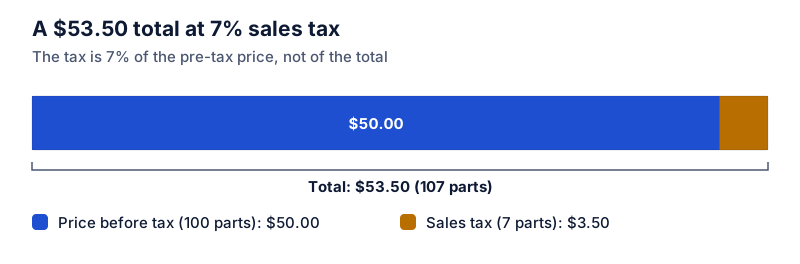
Sales tax = price × rate ÷ 100, and the total is price × (1 + rate ÷ 100). Worked examples at 7.25% and 8.875%, rounding to the cent, and why your receipt can differ by a penny.
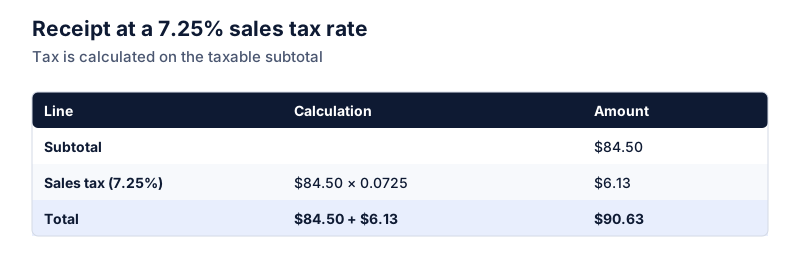
Multiply the price by the tax rate as a decimal. At 7.25%, tax on $84.50 is $84.50 × 0.0725 = $6.13 (rounded to the cent), and the total is $90.63. To get the total in one step, multiply by 1.0725.
On this page
Sales tax is a percentage of the price, added at the register. Working it out takes one multiplication.
The formula
sales tax = price × rate ÷ 100
Where rate is the combined sales tax rate in percent
total = price × (1 + rate ÷ 100)
Where 1 + rate ÷ 100 is the tax multiplier
Worked example
You’re buying items with a subtotal of $84.50, and the sales tax rate is 7.25%.
- Convert the rate to a decimal: 7.25 ÷ 100 = 0.0725.
- Multiply: $84.50 × 0.0725 = $6.12625.
- Round to the cent: $6.13.
- Add: $84.50 + $6.13 = $90.63.
Try it: $84.50 plus 7.25% tax
Open in calculatorOne step with a multiplier
Multiplying by 1.0725 gives the total directly: $84.50 × 1.0725 = $90.63. This is handy for comparing prices across stores or for a spreadsheet column.
A rate with three decimals
Some combined rates have three decimal places, such as 8.875%. On $250: $250 × 0.08875 = $22.1875, which rounds to $22.19, for a total of $272.19.
Try it: $250 plus 8.875% tax
Open in calculatorQuick mental estimate
Round the rate to something easy. At about 8%, take 10% of the price and subtract a fifth of that: 10% of $84.50 is $8.45, a fifth of that is about $1.69, so 8% is about $6.76. The real 7.25% tax is a bit less. More shortcuts are in percentages in your head.
Things that change the tax
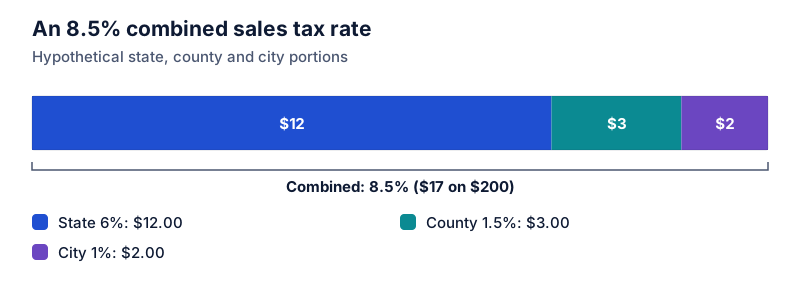
- Combined rates. The rate you pay is often a state rate plus county, city or district rates. See combined sales tax rates.
- Exempt items. Many places tax some categories (groceries, clothing, medicine) at a lower rate or not at all. A mixed basket needs each part taxed at its own rate.
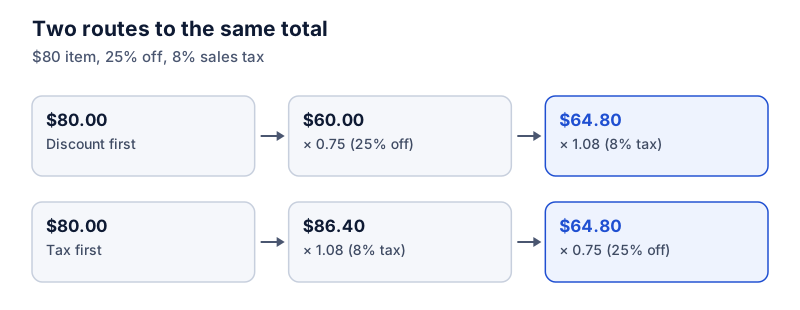
- Discounts. Tax normally applies to the price after a store discount. See discounts and sales tax order.
- Rounding. Some registers round tax per item, so a long receipt can differ from your calculation by a few cents.
Rates and rules vary by location and change over time, so check the rate with your state or local tax authority if you need an exact figure.
Going the other way
If you have a receipt total and want the price before tax, don’t subtract the rate from the total. Divide instead: see how to remove sales tax from a total.
Questions
Is sales tax charged on the price before or after a discount?
Usually on the price you actually pay, so after a store discount. Manufacturer coupons can be treated differently in some places. The order matters less than you’d think for percent discounts, as explained in our guide to discounts and sales tax.
Why does my receipt show a different tax amount than my calculation?
Stores may round tax per item instead of on the subtotal, and some items may be taxed at a different rate or not at all. Those differences are usually a cent or two per item.
The calculator links in this guide are checked against the PercentSwift calculator every time the site is built. How we calculate explains the rounding rules. If you spot a mistake, email hello@percentswift.com.