Reverse percentage calculator
Enter the value after the change, choose whether it went up or down, and enter the percentage. The calculator divides by the right multiplier and checks the answer for you.
Find the original value before a percentage change
Settings
Original value
138 after a 15% increase means the original value was 120.
- Change in units
- +18
- Multiplier that was applied
- × 1.15
Formula
Original = Final ÷ (1 + Percentage ÷ 100)
Steps
- Write the change as a multiplier: 1 + 15 ÷ 100 = 1.15
- Divide the final value by it: 138 ÷ 1.15 = 120
- Check: 120 × 1.15 = 138
- Don't subtract the percentage from the final value: that uses the wrong base and gives a different answer.
Recent calculations
Exact decimal arithmetic, calculated in your browser.
Examples
Each one loads into the calculator above.
Why you can’t just subtract the percentage
Suppose a price went up 15% to $138. Taking 15% off $138 gives $117.30, but the real original price was $120. The 15% was calculated on $120, and 15% of $138 is a larger amount, so subtracting it removes too much.
The method
Turn the change into a multiplier: 1 + the percentage for an increase, 1 − the percentage for a decrease. Then divide the final value by it.
- After a 15% increase: 138 ÷ 1.15 = 120
- After a 30% decrease: 63 ÷ 0.70 = 90
- After a 4% raise: 54,080 ÷ 1.04 = 52,000
Then check by multiplying: 120 × 1.15 = 138.
Common uses
You can use it to find a price before sales tax or VAT from a receipt total, the original price of a sale item, a salary before a raise, or last year’s figure from this year’s figure and its growth rate. For tax specifically, the tax calculator and the VAT calculator also show the tax amount and handle rounding to cents.
Limits
A decrease of 100% leaves zero, and every starting value gives zero after a 100% cut, so there’s no way back. The calculator refuses decreases of 100% or more and explains why.
The second tab answers a related but different question: if 18 is 40% of a total, what is the total? There’s no before-and-after change there, just a part and its share of a whole.
Questions people ask
Guides that use this calculator
 Percentage basics
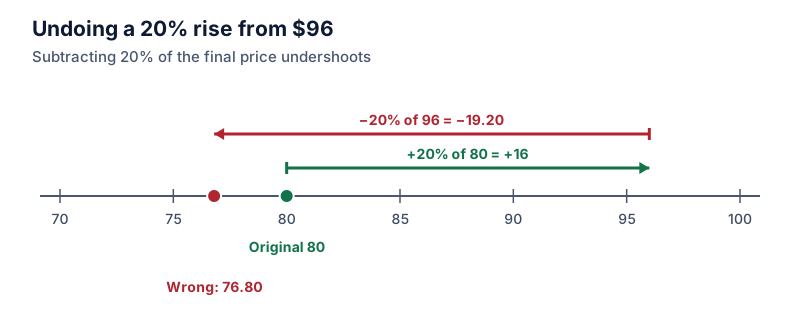
Reverse percentages: how to find the original number
To undo a percentage change, divide by the multiplier instead of subtracting the percentage. Why the obvious method fails, and how to check your answer.
 Discounts and shopping
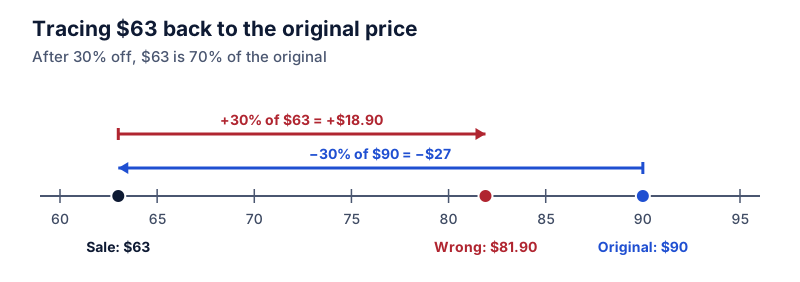
How to find the original price from a sale price
Divide the sale price by the share you paid. If $63 is the price after 30% off, the original was 63 ÷ 0.70 = $90. Why adding 30% back gives the wrong answer.
 Personal finance
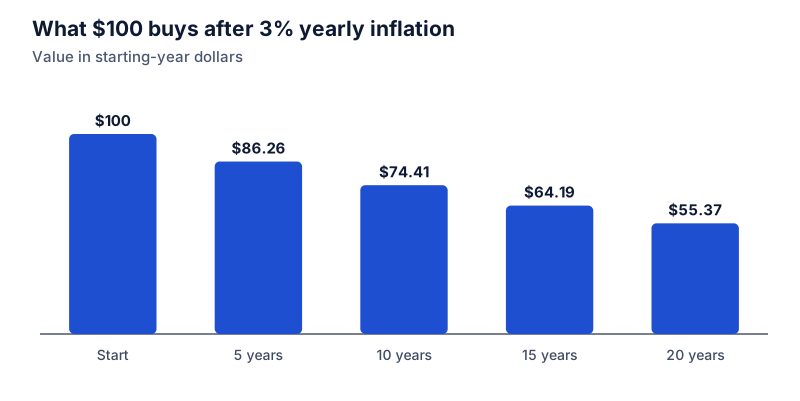
How inflation shrinks purchasing power: the percentage math
When prices rise 25%, your money loses 20% of its buying power, not 25%. How to calculate purchasing power after inflation, over one year or many.