Year-over-year vs month-over-month growth: how to calculate and read them
Year-over-year compares a month with the same month a year earlier; month-over-month compares it with the month before. Both calculated on one dataset, with seasonality and compounding explained.
Month-over-month (MoM) growth = (this month − last month) ÷ last month × 100. Year-over-year (YoY) growth = (this month − same month last year) ÷ same month last year × 100. YoY removes seasonal swings; MoM shows short-term direction but is noisy.
On this page
Both measures are percentage changes. The difference is which earlier value you compare against.
MoM growth = (this month − previous month) ÷ previous month × 100
YoY growth = (this month − same month last year) ÷ same month last year × 100
One dataset, two answers
A shop’s sales in thousands of dollars:
| Nov | Dec | |
|---|---|---|
| 2024 | 130 | 160 |
| 2025 | 141 | 172 |
December 2025, month over month: (172 − 141) ÷ 141 = 0.2199, up 22%.
December 2025, year over year: (172 − 160) ÷ 160 = 0.075, up 7.5%.
Try it: Dec 2024 to Dec 2025 (YoY)
Open in calculator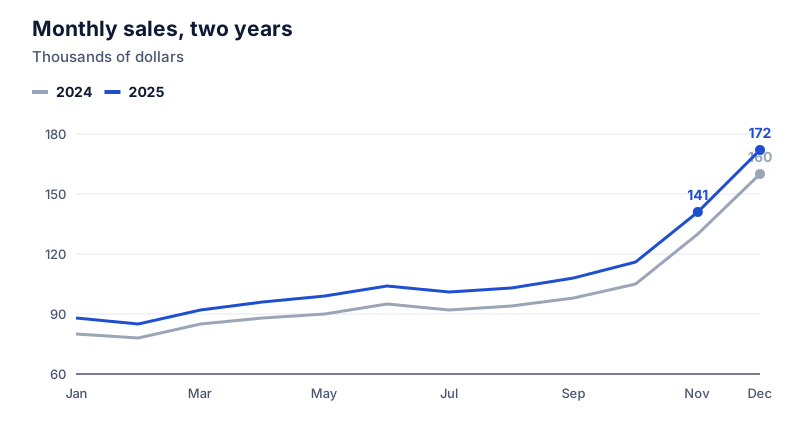
The MoM figure looks impressive, but December is always the busiest month for this shop. Last year’s November-to-December jump was (160 − 130) ÷ 130 = 23%. Most of the 22% is seasonal, not growth.
Seasonality
Many series have regular patterns through the year: retail sales peak in December, heating bills in winter, travel in summer. MoM comparisons pick up these swings and can mislead. January 2025 sales of 88 were down 45% on December 2024, but up 10% on January 2024. The shop didn’t collapse in January; it was a normal post-holiday month.
Try it: Jan 2024 to Jan 2025 (YoY)
Open in calculatorYoY compares like with like, so seasonal effects cancel out. That’s why economic statistics such as inflation and retail sales are usually quoted year over year.
When MoM is better
MoM reacts faster. If something changed last month, a price cut, a new product, a supply problem, MoM shows it right away, while YoY blends it with eleven months of history. Use MoM for spotting turning points, and use seasonally adjusted data if you have it.
Compounding monthly rates
Monthly growth rates compound. A steady 2% a month isn’t 24% a year. It’s 1.02^12 − 1 = 26.8%. Going the other way, 12% annual growth works out to about 0.95% a month, not 1%: the twelfth root of 1.12 is about 1.0095.
Don’t multiply a single month’s growth by 12 to get an annual rate. A strong month is often followed by a weak one, and the compounding makes the error bigger.
Practical tips
- Label which comparison you’re using. “Sales up 22%” with no period is ambiguous.
- Use YoY for headline figures in seasonal businesses.
- Look at several months of MoM figures rather than one.
- Watch for calendar effects: a month with an extra weekend, or Easter moving between March and April, can shift a YoY figure.
- If last year’s value was unusual (a one-off spike or a closure), YoY growth will be distorted. Mention it.
For growth over several years, use the compound annual rate described in investment return and CAGR. To compare growth for things of different sizes, see absolute vs relative change, and for tracking a series against a fixed starting point, see index numbers.
Questions
How do I turn a monthly growth rate into a yearly one?
Compound it: (1 + monthly rate)^12 − 1. A steady 1% a month is 1.01^12 − 1 = 12.68% a year, not 12%.
What is year-to-date (YTD) growth?
It compares the total so far this year with the total for the same months last year. It’s less noisy than a single month’s YoY figure.
The calculator links in this guide are checked against the PercentSwift calculator every time the site is built. How we calculate explains the rounding rules. If you spot a mistake, email hello@percentswift.com.