Absolute vs relative change: comparing growth of different sizes
Absolute change is the difference in units; relative change is that difference as a percentage of the start. How one change can look big or small depending on which you report.
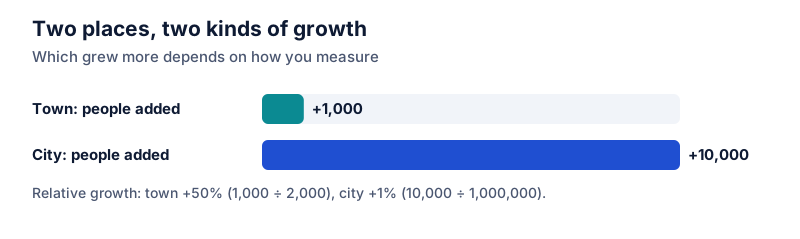
Absolute change = new − old, in the original units. Relative change = (new − old) ÷ old × 100, in percent. A town that grows from 2,000 to 3,000 people gained 1,000 (absolute) or 50% (relative). A city that grows from 1,000,000 to 1,010,000 gained 10,000 but only 1%.
On this page
Every change between two numbers can be described in two ways.
absolute change = new − old
relative change = (new − old) ÷ old × 100
The absolute change is in the original units: dollars, people, kilograms. The relative change is a percentage of the starting value.
The same change, two impressions
A town grows from 2,000 to 3,000 residents. A city grows from 1,000,000 to 1,010,000.
| Absolute | Relative | |
|---|---|---|
| Town | +1,000 people | +50% |
| City | +10,000 people | +1% |
Which grew more? The city added more people. The town grew faster. Both statements are true, and which one matters depends on the question. If you’re planning school places, the absolute number matters. If you’re asking how quickly a place is changing, the relative number does.
Try it: Town: 2,000 to 3,000
Open in calculatorHow this gets used to mislead
Choosing between absolute and relative change is one of the easiest ways to make a number sound bigger or smaller.
- “Sales up 200%!” can mean 3 units became 9.
- “Only a 0.5% price rise” on a $40,000 car is $200.
- “Risk doubles” might mean 1 in 100,000 became 2 in 100,000.
Small starting values make relative changes look large. Large starting values make relative changes look small. When you read a percentage, ask what the starting value was. When you write one, include it.
Comparing growth of different sizes
Relative change is the fairer comparison when the starting values differ a lot. A small business growing revenue from $200,000 to $260,000 (+30%) is growing faster than a large one going from $50 million to $55 million (+10%), even though the large one added far more dollars.
Try it: $50M to $55M
Open in calculatorAbsolute change is fairer when what matters is the total effect. A 10% cut to a $5 billion budget removes $500 million; a 50% cut to a $2 million program removes $1 million.
Rates and percentages
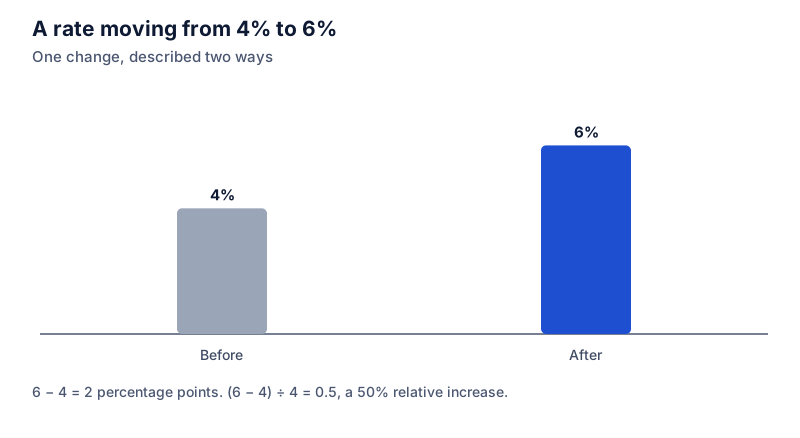
When the numbers are already rates, the absolute change is in percentage points. An unemployment rate going from 4% to 5% rose 1 point (absolute) or 25% (relative). The guide on percentage points vs percent covers this in detail.
Per-capita and per-unit changes
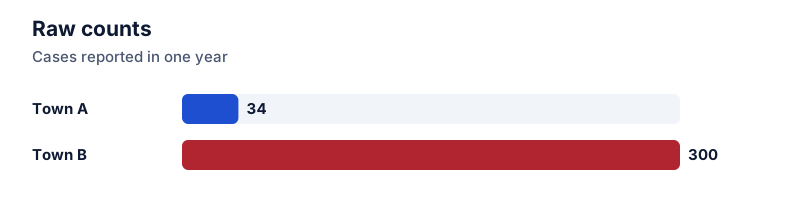
Sometimes neither raw measure is right, and you need to compare rates instead. If crimes in a city went from 500 to 550 but the population grew by 20%, the crime rate per 1,000 people actually fell. See rates per 100 and per 1,000.
Good practice
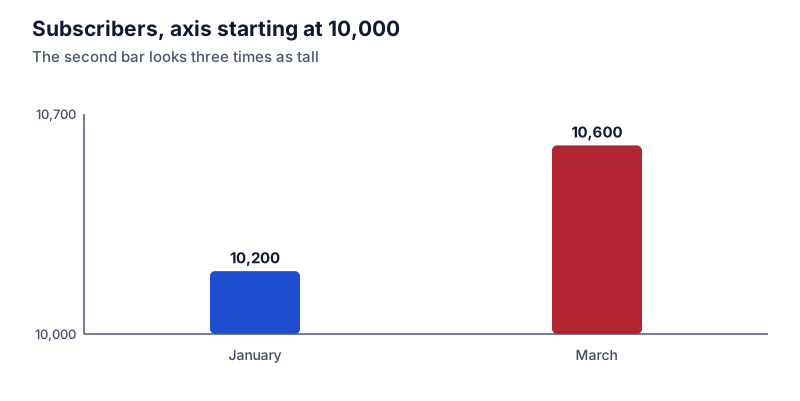
Give all three: the starting and ending values, the absolute change, and the relative change. “Visitors rose from 12,000 to 15,000, an increase of 3,000 (25%).” It costs a few extra words and removes most room for misreading. Charts have their own version of this problem, covered in misleading percentage charts.
Questions
Which one should I report?
Usually both. Give the two values, the change in units, and the percentage. Readers can then judge size and speed for themselves.
Is percentage-point change absolute or relative?
Absolute. When both values are percentages, the difference in points is the absolute change. The percent change between them is the relative change.
The calculator links in this guide are checked against the PercentSwift calculator every time the site is built. How we calculate explains the rounding rules. If you spot a mistake, email hello@percentswift.com.