Unit price comparisons: how much cheaper is the bigger pack?
Divide each price by its quantity, then compare the unit prices as a percentage. A worked example with three pack sizes, including one where buying bigger costs more.
Divide each price by its size to get a unit price, then compare: (bigger unit price − smaller) ÷ bigger × 100 tells you the percentage saving. Don’t assume the largest pack is cheapest per unit; check.
On this page
Shelf prices compare packs of different sizes, so the cheapest sticker isn’t always the best deal. The unit price puts them on the same footing.
unit price = price ÷ quantity
saving = (higher unit price − lower unit price) ÷ higher unit price × 100
A worked example
Peanut butter in three sizes:
| Size | Price | Price per oz | Price per 12 oz |
|---|---|---|---|
| 12 oz | $3.29 | $0.2742 | $3.29 |
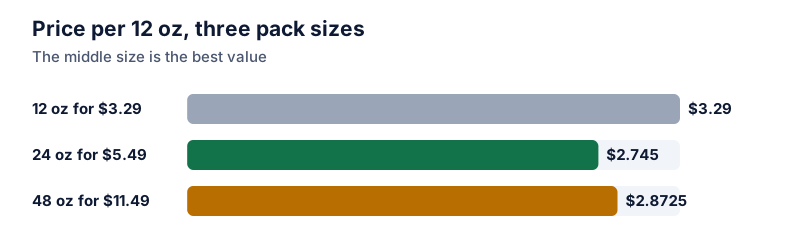
| 24 oz | $5.49 | $0.2288 | $2.745 |
| 48 oz | $11.49 | $0.2394 | $2.8725 |
Comparing per 12 oz (the size of the smallest jar) avoids long decimals.
24 oz vs 12 oz: from $3.29 to $2.745 per 12 oz is a drop of (3.29 − 2.745) ÷ 3.29 = 16.6%. The 24 oz jar is about 16.6% cheaper per ounce.
Try it: $3.29 vs $2.745 per 12 oz
Open in calculator48 oz vs 24 oz: from $2.745 to $2.8725 is an increase of 4.6%. The biggest jar costs more per ounce than the middle one.
Bulk isn’t always cheaper
Bigger packs are often cheaper per unit, but not always. Common reasons:
- The smaller size is on sale and the bigger one isn’t.
- The bigger pack is positioned as a “value” size and priced on that assumption.
- Different brands or formulations sit side by side.
Shelf labels in many stores show a unit price. They help, but check that both labels use the same unit (per oz vs per lb, or per count vs per weight).
Converting units
- 1 lb = 16 oz
- 1 kg = 1,000 g
- 1 liter = 1,000 ml
- 1 gallon (US) = 128 fl oz
A $4.80 2-lb bag is $2.40 per pound, or $0.15 per ounce. A $0.99 6-oz bag is $0.165 per ounce. The 2-lb bag is (0.165 − 0.15) ÷ 0.165 = 9.1% cheaper per ounce.
Multibuys and unit price
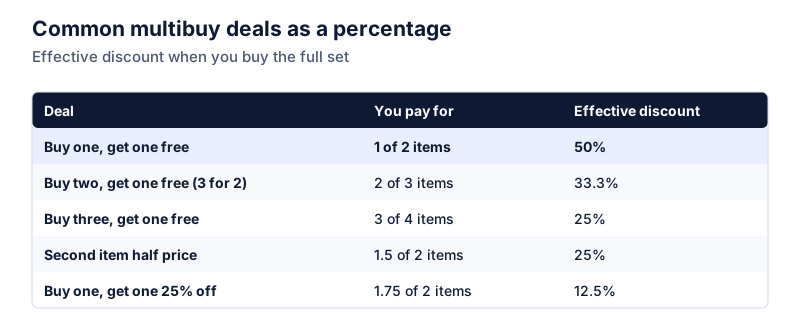
“2 for $6” on 12-oz packs gives 24 oz for $6, or $3 per 12 oz. Compare that with the 24-oz pack’s $2.745 and the single pack is still worse value, even on the deal. Multibuy deals as a percentage covers these offers.
When pack sizes shrink
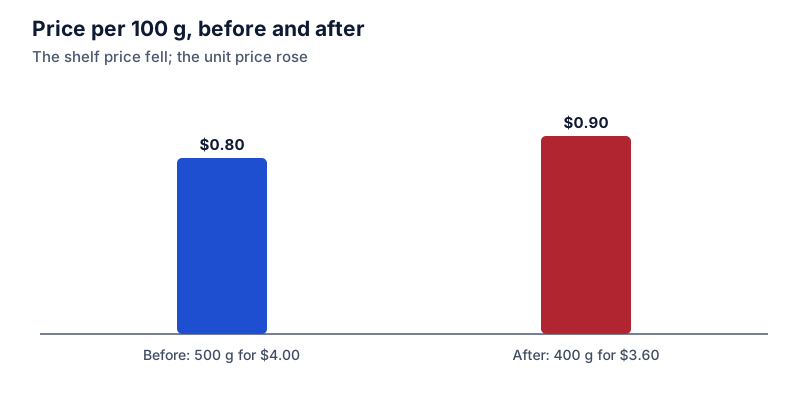
If a product’s size drops but the price stays the same, its unit price rises. A 16-oz bag at $4 is $0.25 per ounce. Shrink it to 14 oz at the same $4 and it’s $0.2857 per ounce, a 14.3% price increase you won’t see on the shelf tag. See shrinkflation for how to calculate it.
Practical limits
A lower unit price only saves money if you use what you buy. Waste, storage space, and how long the product lasts all count. For things that keep well and that you use steadily, the unit price is the best guide. For perishables, buy the size you’ll finish.
Questions
Why do shelf labels use different units?
Stores sometimes show unit prices per ounce for one product and per pound for another, or per count versus per weight. Convert to the same unit before comparing.
Is the bigger pack always better if the unit price is lower?
Only if you’ll use it. Food that spoils or products you’ll stop buying make the saving disappear.
The calculator links in this guide are checked against the PercentSwift calculator every time the site is built. How we calculate explains the rounding rules. If you spot a mistake, email hello@percentswift.com.