How to scale a recipe up or down by a percentage
Scale a recipe by multiplying every ingredient by the same factor: 150% means × 1.5, 75% means × 0.75. Worked example, converting servings to a percentage, and what not to scale directly.
Multiply each ingredient by the scale factor. To make 150% of a recipe, multiply by 1.5: 250 g of flour becomes 375 g. To find the factor from servings, divide the servings you want by the servings the recipe makes: 6 ÷ 4 = 1.5. Cooking times and pan sizes don’t scale the same way.
On this page
A recipe serves 4 and you need 6. Or you want a smaller batch. Scaling is percentage arithmetic: multiply every ingredient by the same factor.
Find the scale factor
scale factor = servings wanted ÷ servings in recipe
Where as a percentage, multiply by 100
From 4 to 6 servings: 6 ÷ 4 = 1.5, or 150%. From 4 to 3: 3 ÷ 4 = 0.75, or 75%.
Scale up by 50%
Increasing a recipe by 50% means multiplying by 1.5. For 250 g of flour:
Try it: 250 g increased by 50%
Open in calculator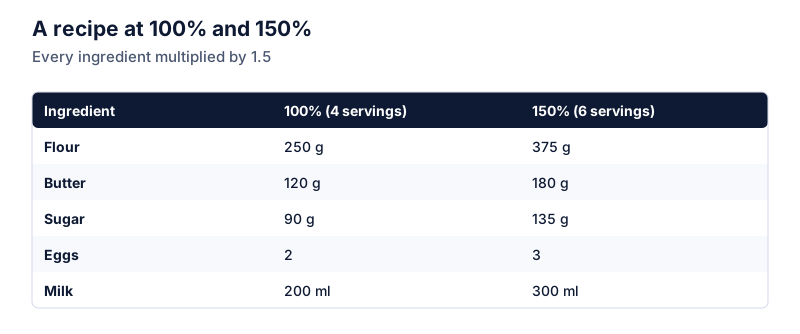
Do the same for every ingredient, including salt, spices and leavening.
Scale down by 25%
Reducing a recipe to 75% means multiplying by 0.75:
Try it: 250 g decreased by 25%
Open in calculatorSo 250 g of flour becomes 187.5 g. A kitchen scale handles that easily. In cups or spoons, round to the nearest practical measure.
Measure by weight if you can
Scaling “1 cup” by 1.5 is easy, but “⅓ cup” by 0.75 is ¼ cup, which takes a moment to work out. Converting to grams first makes any factor simple, and weights are more accurate for flour.
Converting a percentage to servings
If a recipe for 8 is 100%, then 25% serves 2, 50% serves 4 and 125% serves 10. To find the percentage for a target number of servings, use servings wanted ÷ servings in recipe × 100.
What doesn’t scale directly
- Pan size. The area of a round pan grows with the square of its width. Going from an 8-inch to a 10-inch round pan increases the area by about 56%, so a 150% batch fits a 10-inch pan at roughly the same depth.
- Cooking time. It depends on thickness, not total amount. Check doneness rather than scaling the time.
- Seasoning. Some cooks scale salt and strong spices slightly less, then adjust to taste.
- Yeast and leavening. Usually scale fine for small changes. For very large batches, bakers sometimes use a little less.
Baker’s percentages
Bakers often write recipes with every ingredient as a percentage of the flour weight. A dough with 500 g of flour and 350 g of water is 70% hydration. Scaling is then just choosing a new flour weight. To work out these shares, see percentages, fractions and decimals and finding a percentage of a number. For more on increasing or decreasing by a percentage, see increase or decrease by a percentage.
Questions
How do I scale an odd number of eggs?
Beat the eggs and measure by weight or volume. A large egg is roughly 50 g without the shell. For 1.5 eggs, beat 2 and use three-quarters of the mixture, or round to the nearest whole egg if the recipe is forgiving.
Does baking time change when I scale a recipe?
Often, but not in proportion. A larger cake in a deeper pan takes longer, while the same batter split into more pans may take the same time. Check doneness rather than multiplying the time.
The calculator links in this guide are checked against the PercentSwift calculator every time the site is built. How we calculate explains the rounding rules. If you spot a mistake, email hello@percentswift.com.