Percentages, fractions and decimals: how to convert between them
How to convert between percentages, fractions and decimals in every direction, with a table of common equivalents and how to handle repeating decimals.
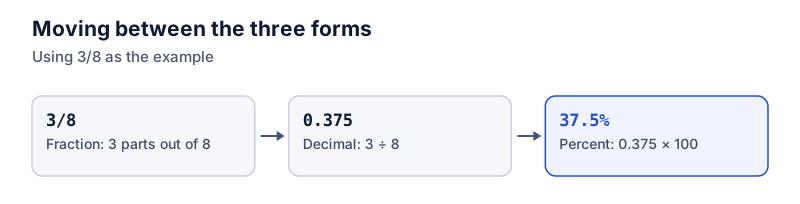
Percent to decimal: divide by 100 (45% = 0.45). Decimal to percent: multiply by 100 (0.45 = 45%). Fraction to percent: divide top by bottom, then multiply by 100 (3/8 = 0.375 = 37.5%). Percent to fraction: put it over 100 and simplify (45% = 45/100 = 9/20).
On this page
Percentages, fractions and decimals are three ways of writing the same amount. 1/4, 0.25 and 25% all describe the same share. Which one you use depends on the task: decimals are easiest to multiply with, fractions are easiest to picture, and percentages are easiest to compare.
Percent to decimal, and back
Divide by 100 to go from percent to decimal. Multiply by 100 to go back. In practice that means moving the decimal point two places.
- 45% → 0.45
- 7% → 0.07
- 120% → 1.2
- 0.8% → 0.008
- 0.375 → 37.5%
Single-digit percentages trip people up most. 7% is 0.07, not 0.7. If you write 0.7, you’ve written 70%.
Fraction to percent
Divide the top number by the bottom, then multiply by 100.
3/8: 3 ÷ 8 = 0.375, so 37.5%. 5/16: 5 ÷ 16 = 0.3125, so 31.25%. 7/12: 7 ÷ 12 = 0.58333…, so about 58.33%.
This is the same calculation as “3 is what percent of 8?”, so the calculator’s part-and-whole mode does it directly.
Try it: 3/8 as a percentage
Open in calculatorPercent to fraction
Write the percentage over 100, then simplify by dividing top and bottom by the same number.
- 45% = 45/100 = 9/20 (divide both by 5)
- 12.5% = 12.5/100 = 125/1,000 = 1/8
- 64% = 64/100 = 16/25
If the percentage has a decimal, multiply top and bottom by 10 until it’s a whole number, then simplify.
Decimal to fraction
Read the place value. 0.6 is six tenths, 6/10 = 3/5. 0.35 is thirty-five hundredths, 35/100 = 7/20. 0.125 is 125 thousandths, which simplifies to 1/8.
Common equivalents
| Fraction | Decimal | Percent |
|---|---|---|
| 1/2 | 0.5 | 50% |
| 1/3 | 0.333… | 33.33…% |
| 2/3 | 0.666… | 66.66…% |
| 1/4 | 0.25 | 25% |
| 3/4 | 0.75 | 75% |
| 1/5 | 0.2 | 20% |
| 1/6 | 0.1666… | 16.66…% |
| 1/8 | 0.125 | 12.5% |
| 1/10 | 0.1 | 10% |
| 1/20 | 0.05 | 5% |
| 1/25 | 0.04 | 4% |
Learning the eighths and the thirds makes a lot of mental math faster. If you know 1/8 is 12.5%, then 3/8 is 37.5% and 5/8 is 62.5%.
Repeating decimals
Fractions with a 3, 6, 7, 9 or 11 in the bottom (after simplifying) usually give decimals that never end. 1/3 is 0.333… and 1/7 is 0.142857142857…
You have to round these at some point. How far depends on the use: one decimal place (33.3%) is enough for a chart, but if you’re going to multiply by it, keep more digits or use the fraction instead. 1/3 of 900 is exactly 300, but 33.3% of 900 is 299.7.
Try it: 33.3% of 900 (rounded one-third)
Open in calculatorFor more on using these conversions to find a share of a number, see three ways to find a percentage of a number. For shortcuts that rely on these equivalents, see percentages in your head.
Questions
How do I write 1/3 as a percentage?
1 ÷ 3 = 0.333…, which is 33.333…%. It never ends, so it’s usually written as 33⅓% or rounded to 33.3%.
What is 0.5% as a decimal?
0.005. Divide by 100 by moving the decimal point two places left: 0.5 → 0.05 → 0.005.
The calculator links in this guide are checked against the PercentSwift calculator every time the site is built. How we calculate explains the rounding rules. If you spot a mistake, email hello@percentswift.com.