How to calculate sales commission, including tiered rates
How to calculate sales commission at a flat rate, with tiered (graduated) rates, and with retroactive tiers, all worked on the same $62,000 of sales.
Flat commission = sales × rate: 8% of $62,000 is $4,960. Tiered commission applies each rate only to the sales within its band: 5% on the first $25,000, 8% on the next $25,000 and 10% above $50,000 gives $4,450. Retroactive tiers apply the top rate reached to all sales: 10% of $62,000 = $6,200.
On this page
Commission plans come in a few common shapes. The calculation for each is a percentage of a number, applied in a different way.
Flat rate
commission = sales × rate
$62,000 of sales at 8%: 0.08 × 62,000 = $4,960.
Try it: 8% of $62,000
Open in calculatorTiered (graduated) rates
Each rate applies only to the sales within its band, the same way income tax brackets work.
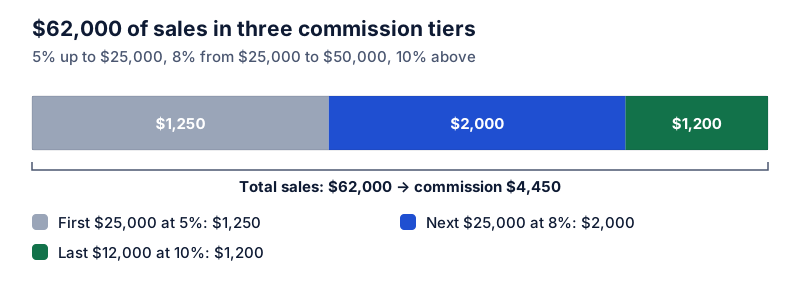
Plan: 5% on the first $25,000, 8% on sales from $25,000 to $50,000, 10% on anything above $50,000.
| Band | Sales in band | Rate | Commission |
|---|---|---|---|
| $0 – $25,000 | $25,000 | 5% | $1,250 |
| $25,000 – $50,000 | $25,000 | 8% | $2,000 |
| Over $50,000 | $12,000 | 10% | $1,200 |
| Total | $62,000 | $4,450 |
Try it: Top tier: 10% of $12,000
Open in calculatorThe effective rate is 4,450 ÷ 62,000 = 7.18%, lower than the 10% top rate because most sales earned less.
Retroactive tiers
Some plans pay the highest tier reached on all sales. Under the same rates, crossing $50,000 means 10% on the full $62,000: $6,200.
Retroactive plans create a big jump at each threshold. At $49,999 of sales, commission is 8% × 49,999 = $4,000; at $50,000 it becomes 10% × 50,000 = $5,000. One dollar of sales adds $1,000 of commission. That’s a strong incentive near the end of a period, and it’s why plans should be read carefully.
Draws against commission
A draw is an advance paid regularly and deducted from commission earned. If the draw is $3,000 a month and commission earned is $4,450, the payout is $1,450. If commission falls short of the draw, the plan says whether the difference is carried forward (recoverable draw) or forgiven (non-recoverable).
Checking a commission statement
- Confirm which sales count: booked, invoiced, or paid.
- Confirm the base: revenue, revenue minus discounts, or gross margin.
- Recalculate each tier separately.
- Look for clawbacks and draws.
Commission as a share of pay
If base salary is $40,000 and annual commission is $26,000, commission is 26,000 ÷ 66,000 = 39.4% of total pay. This “pay mix” is often described as a ratio like 60/40.
Tiered rates work like marginal tax rates, and the effective-rate idea is the same. For other pay calculations, see overtime pay percentage. If commission is paid on margin, see how to calculate profit margin.
Questions
Is commission calculated on revenue or profit?
Either, depending on the plan. Commission on gross margin is common where discounting is possible, because it stops salespeople from giving away profit to close deals.
How are returns handled?
Many plans claw back commission on returned or canceled sales, either by deducting it from a later payout or by paying commission only after the return window closes.
The calculator links in this guide are checked against the PercentSwift calculator every time the site is built. How we calculate explains the rounding rules. If you spot a mistake, email hello@percentswift.com.