Relative risk vs absolute risk in health headlines
“Cuts your risk by 50%” can mean going from 2 in 1,000 to 1 in 1,000. How to convert relative risk to absolute risk, why percentage points matter, and what number needed to treat means.
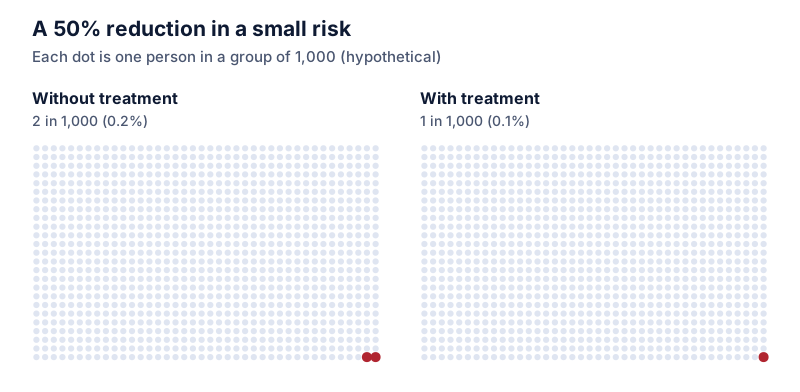
Relative risk reduction compares the new risk to the old one; absolute risk reduction is the plain difference. If a risk drops from 0.2% to 0.1%, the relative reduction is 50% but the absolute reduction is 0.1 percentage points, or 1 person in 1,000. Always ask for the starting risk.
On this page
“New drug cuts heart attack risk in half.” “Eating X raises cancer risk by 20%.” Headlines like these usually report relative risk. To judge how much a change matters to a person, you also need the absolute risk. The example below uses made-up numbers to keep the arithmetic clear.
Two ways to describe the same result
In a hypothetical trial, 2 of every 1,000 untreated people have a heart attack over five years, compared with 1 of every 1,000 treated people.
Relative risk reduction compares the change to the starting risk:
(0.2% − 0.1%) ÷ 0.2% × 100 = 50%
Where 0.2% is the risk without treatment
Absolute risk reduction is the difference in risk:
0.2% − 0.1% = 0.1 percentage points
Where 0.1 percentage points is 1 person in 1,000
Try it: Risk falling from 0.2% to 0.1%
Open in calculatorBoth are correct. “Halves your risk” and “prevents 1 heart attack per 1,000 people” describe the same result, but they leave very different impressions.
Number needed to treat
Another way to state the absolute effect is the number of people who need the treatment for one of them to benefit:
NNT = 1 ÷ absolute risk reduction
Where the reduction is written as a decimal (0.1% = 0.001)
Here, 1 ÷ 0.001 = 1,000. A thousand people would take the drug for five years to prevent one heart attack. Side effects, cost and inconvenience apply to all 1,000.
The same relative change, different baselines
A 50% relative reduction means very different things depending on the starting risk:
| Starting risk | New risk | Absolute reduction | NNT |
|---|---|---|---|
| 0.2% | 0.1% | 0.1 points | 1,000 |
| 2% | 1% | 1 point | 100 |
| 20% | 10% | 10 points | 10 |
For a high-risk group, the same treatment might be clearly worthwhile. For a low-risk group, it might not be.
Questions to ask about a risk headline
- Risk of what, and over what time period?
- What’s the starting risk for people like me?
- What’s the change in percentage points, or per 1,000 people?
- How many people need the treatment, or need to avoid the exposure, for one to benefit?
Health decisions depend on much more than these numbers, so talk to a clinician about your own situation. The arithmetic just helps you read the claim.
Related reading
The distinction between percent and percentage points is covered in percentage points vs percent. Rates per 1,000 are explained in rates per 100 and per 1,000, and the general idea in absolute vs relative change.
Questions
Is relative risk ever the more useful number?
Yes. Relative risk tends to be similar across groups with different starting risks, so it’s useful for applying a study’s result to your own situation. You then multiply it by your own baseline risk to get the absolute change.
What does a relative risk of 1.3 mean?
The risk in the exposed group is 1.3 times the risk in the comparison group, which is a 30% relative increase. Whether that matters depends on the baseline: 1.3 × 1% is 1.3%, an increase of 0.3 percentage points.
The calculator links in this guide are checked against the PercentSwift calculator every time the site is built. How we calculate explains the rounding rules. If you spot a mistake, email hello@percentswift.com.