Percentages over 100%: what they mean and when they make sense
A percentage above 100% is correct whenever the part can exceed the whole or a value more than doubles. Here's how to tell when it signals a mistake.
Percentages over 100% are fine when you’re comparing a value to a reference it can exceed, such as growth, targets or one price against another. They signal an error when the whole is a true maximum, like a test score, a share of a group or a probability.
On this page
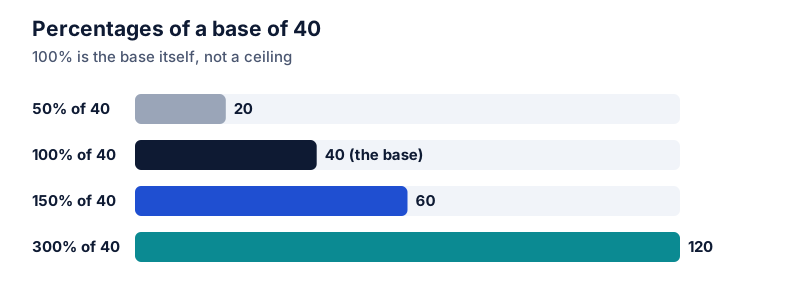
A percentage is a comparison with a reference value, the “whole”. Nothing stops the thing you’re measuring from being bigger than the reference. When it is, the percentage is over 100%.
When over 100% makes sense
Growth. A town’s population went from 8,000 to 20,000. Today’s population is 250% of what it was. The increase was 150%.
Targets. A salesperson with a quota of $50,000 sold $62,000, which is 124% of quota.
Try it: $62,000 against a $50,000 target
Open in calculatorComparing two things. A house costs $540,000 in one city and $360,000 in another. The first is 150% of the second.
Ratios that aren’t shares. A company’s debt can be 180% of its annual revenue. A recipe might call for flour at 100% and water at 70% (bakers’ percentages, where every ingredient is compared to the flour weight).
In all of these, the reference is a convenient yardstick, not a maximum.
When over 100% means an error
Some wholes really are maximums. If you get more than 100% in these cases, check which number you divided by.
- Test scores: you can’t score 52 out of 50 (unless there are bonus marks).
- Share of a group: no more than 100% of students can be in the class.
- Probability: nothing is more than 100% likely.
- Completion: a task can’t be more than 100% done.
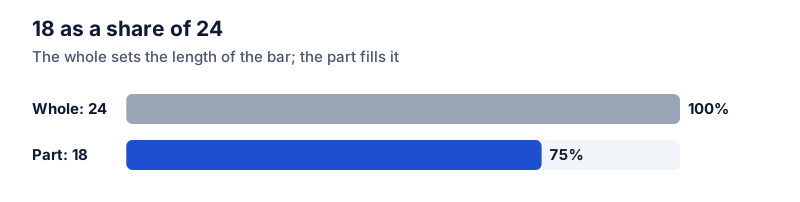
The usual cause is swapping the part and the whole. If 24 of 30 students passed, the pass rate is 24 ÷ 30 = 80%. Dividing the other way, 30 ÷ 24 = 125%, answers a different question that doesn’t mean anything here.
“Percent of” versus “percent more than”
The most common confusion with large percentages is between these two:
| Phrase | Meaning | 50 becomes |
|---|---|---|
| 100% of 50 | the same | 50 |
| 200% of 50 | double | 100 |
| 100% more than 50 | double | 100 |
| 200% more than 50 | triple | 150 |
| 300% of 50 | triple | 150 |
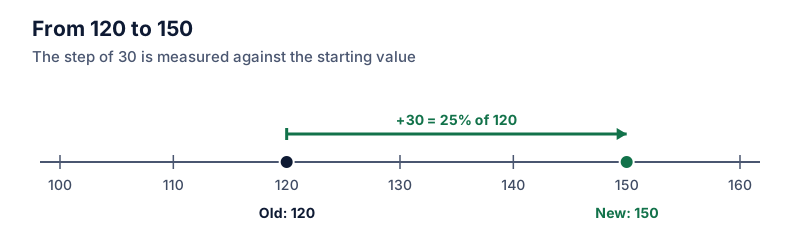
“X% of” includes the original. “X% more than” or “an X% increase” is added on top. So “300% of” and “200% more than” are the same thing. When you read a growth claim, check which one the writer means.
Try it: 50 to 150 as a percentage change
Open in calculatorDecreases can’t go past 100%
A value can increase by any percentage, but it can only decrease by 100% before it reaches zero. A price can’t fall by 150% (unless it goes negative, which happens with a few things like temperatures in Celsius or account balances). If you see “costs cut by 200%”, the writer has probably confused a decrease with a ratio: maybe the old cost was 200% of the new one, which is a 50% decrease.
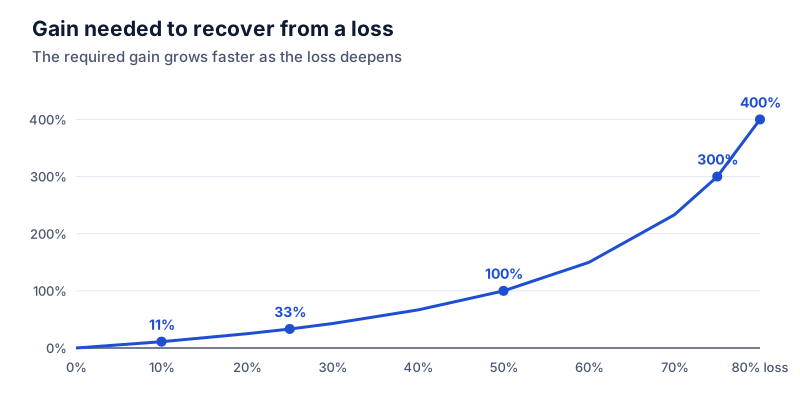
This asymmetry also explains why losses are hard to recover from. A 50% drop needs a 100% gain to get back to where you started. The guide on recovering from a percentage loss works through that.
Questions
Is 200% of a number the same as a 200% increase?
No. 200% of 50 is 100, double the number. A 200% increase on 50 adds 100, giving 150, which is triple the number.
Can someone give 110% effort?
Only as a figure of speech. Effort measured against your maximum can’t exceed 100% of that maximum.
The calculator links in this guide are checked against the PercentSwift calculator every time the site is built. How we calculate explains the rounding rules. If you spot a mistake, email hello@percentswift.com.