How to set a price for a target profit margin
To hit a target margin, divide the cost by 1 minus the margin. Why multiplying cost by 1 plus the margin falls short, and how discounts eat into margin.
Price = cost ÷ (1 − target margin). For a $40 cost and a 30% margin, the price is 40 ÷ 0.7 = $57.14. Multiplying the cost by 1.3 gives $52, which is only a 23.1% margin, because margin is measured on the price, not the cost.
On this page
If you know what something costs you and what margin you want, the selling price follows from one formula.
price = cost ÷ (1 − margin ÷ 100)
Example
Cost: $40. Target margin: 30%. Price = 40 ÷ (1 − 0.30) = 40 ÷ 0.70 = $57.14.
Check: profit is $17.14, and 17.14 ÷ 57.14 = 30%.
Try it: Cost $40, target margin 30%
Open in calculator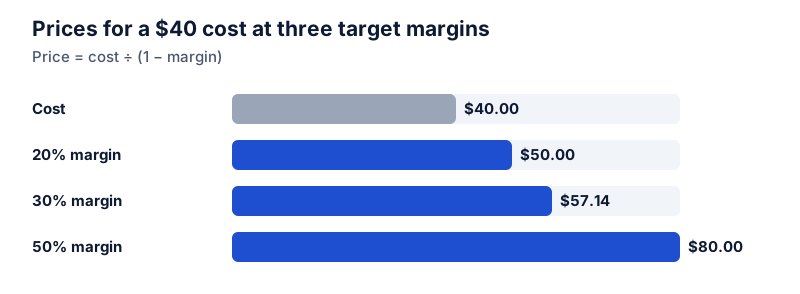
Why cost × (1 + margin) undershoots
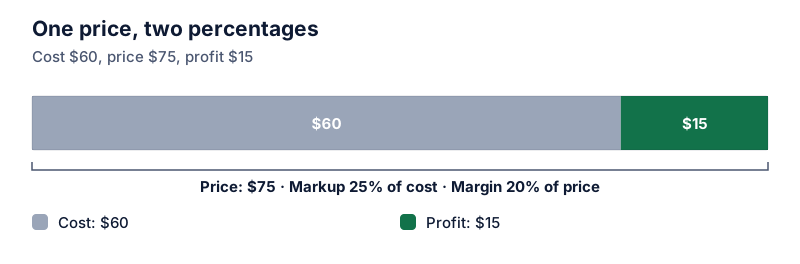
Adding 30% to the cost gives $52. That’s a 30% markup. The profit, $12, is 23.1% of the $52 price, not 30%. Margin is a share of the price, so the price has to be high enough that 30% of it covers the profit.
For low margins the gap is small. For high margins it’s large: a 50% margin needs a price of $80 (double the cost), while cost × 1.5 gives only $60.
Quick reference: divide the cost by
| Target margin | Divide cost by | Equivalent markup |
|---|---|---|
| 10% | 0.90 | 11.1% |
| 20% | 0.80 | 25% |
| 25% | 0.75 | 33.3% |
| 30% | 0.70 | 42.9% |
| 40% | 0.60 | 66.7% |
| 50% | 0.50 | 100% |
| 60% | 0.40 | 150% |
Another example
A café’s cost for a sandwich, including ingredients and packaging, is $4.20. It wants a 65% gross margin on food. Price: 4.20 ÷ 0.35 = $12.00.
A wholesaler buys an item at $12.50 and wants a 35% margin: 12.50 ÷ 0.65 = $19.23.
Try it: Cost $12.50, target margin 35%
Open in calculatorDiscounts and margin
A discount comes straight out of margin. Take the $80 item with a 50% margin on a $40 cost. A 20% discount brings the price to $64. Profit falls from $40 to $24, and margin falls to 24 ÷ 64 = 37.5%.
Try it: Cost $40, discounted price $64
Open in calculatorIf you plan to run regular sales, set the list price so the sale price still meets your minimum margin. To keep a 30% margin after a 20% discount, the sale price must be at least $57.14, so the list price must be at least 57.14 ÷ 0.8 = $71.43.
What to include in cost
The answer is only as good as the cost figure. For a product margin, include everything it takes to get one unit to the customer: purchase price, shipping in, packaging, payment fees and any per-unit commission. Leave out fixed costs like rent, which belong in operating margin, unless you’re setting prices to cover them per unit.
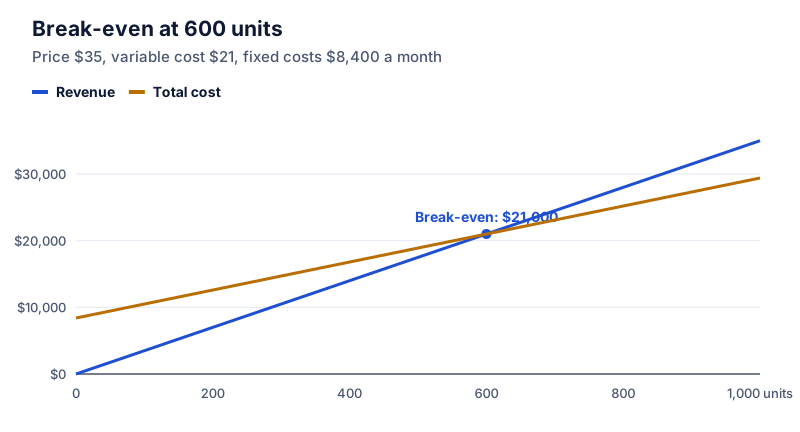
For the difference between markup and margin, see markup vs margin. For how fixed costs set a sales target, see contribution margin and break-even.
Questions
How do I set a price for a target markup instead?
Multiply the cost by 1 plus the markup. A 30% markup on $40 is 40 × 1.3 = $52.
Should I round the price?
Usually, to a price that looks natural, like $57 or $57.99. Rounding up keeps you at or above the target margin; rounding down puts you slightly below it.
The calculator links in this guide are checked against the PercentSwift calculator every time the site is built. How we calculate explains the rounding rules. If you spot a mistake, email hello@percentswift.com.