Contribution margin ratio and break-even sales
Contribution margin ratio = (price − variable cost) ÷ price. Use it to find break-even sales: fixed costs ÷ contribution margin ratio. A worked example with a target profit.
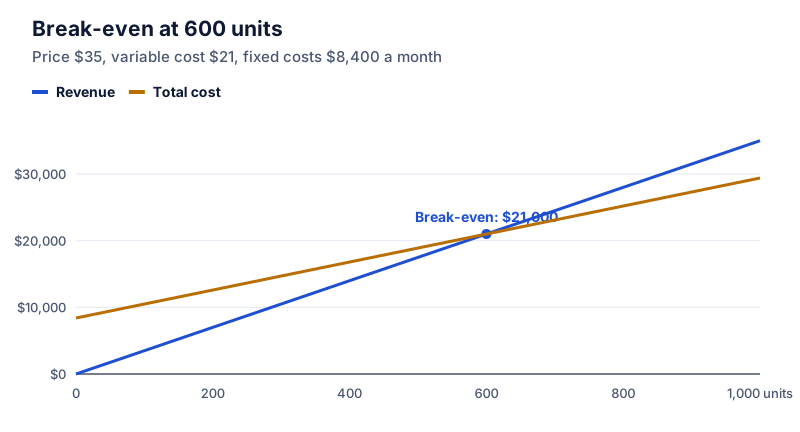
Contribution margin ratio = (price − variable cost per unit) ÷ price. A product selling for $35 with $21 of variable cost has a $14 contribution margin, a 40% ratio. Break-even revenue = fixed costs ÷ ratio: with $8,400 of monthly fixed costs, that’s $21,000, or 600 units.
On this page
Each sale has to cover its own variable costs before it can help pay for rent, salaries and everything else. Contribution margin measures how much each sale has left for that.
contribution margin per unit = price − variable cost per unit
contribution margin ratio = contribution margin ÷ price × 100
Worked example
A product sells for $35. Variable costs per unit (materials, packaging, card fees, shipping) are $21. Contribution margin: $14. Ratio: 14 ÷ 35 = 40%.
Try it: Price $35, variable cost $21
Open in calculatorThe calculator’s margin mode gives the same 40% when you enter variable cost as the cost.
Break-even sales
Fixed costs are $8,400 a month.
break-even revenue = fixed costs ÷ contribution margin ratio
break-even units = fixed costs ÷ contribution margin per unit
Break-even revenue: 8,400 ÷ 0.40 = $21,000. Break-even units: 8,400 ÷ 14 = 600 units. Check: 600 × $35 = $21,000.
Sales needed for a target profit
Add the target profit to fixed costs. To make $3,000 a month: (8,400 + 3,000) ÷ 0.40 = $28,500 in sales, or 11,400 ÷ 14 ≈ 815 units (814.3, rounded up).
What a price change does
Cut the price 10% to $31.50, with variable costs still $21. Contribution margin drops to $10.50, a ratio of 33.3%. Break-even units rise to 8,400 ÷ 10.50 = 800, a third more than before. A small discount on a product with modest contribution can require a large jump in volume.
Try it: Price cut to $31.50
Open in calculatorSeveral products
If you sell several products, use a weighted contribution margin ratio based on your sales mix: total contribution margin ÷ total revenue. Break-even revenue is fixed costs divided by that blended ratio. If the mix shifts toward lower-margin products, break-even revenue rises even if total sales don’t change.
Margin of safety
Once you know break-even, you can see how far above it you are. With actual monthly sales of $26,000, the margin of safety is (26,000 − 21,000) ÷ 26,000 = 19.2%. Sales could fall by about a fifth before the business stops covering its costs.
For margins that include all product costs, see how to calculate profit margin. For pricing to a target margin, see price for a target margin, and for the difference between margin and markup, see markup vs margin.
Questions
How is contribution margin different from gross margin?
Gross margin subtracts cost of goods sold, which can include some fixed production costs. Contribution margin subtracts only variable costs, the ones that rise and fall with each unit sold.
What counts as a variable cost?
Costs that scale with each sale: materials, packaging, payment processing fees, sales commissions, shipping. Rent, salaries and software subscriptions are usually fixed in the short run.
The calculator links in this guide are checked against the PercentSwift calculator every time the site is built. How we calculate explains the rounding rules. If you spot a mistake, email hello@percentswift.com.