Markup vs margin: the difference and how to convert between them
Markup is profit divided by cost; margin is profit divided by price. The same sale gives different percentages. Conversion formulas both ways and a lookup table.
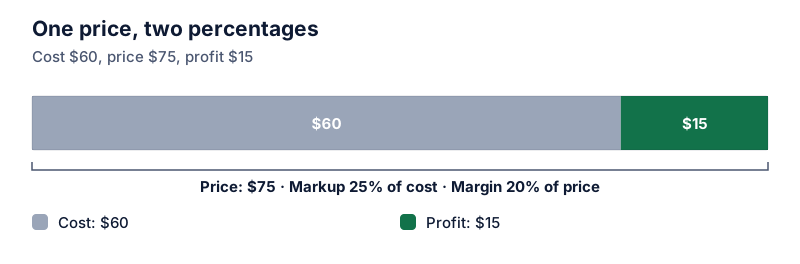
Markup = profit ÷ cost × 100. Margin = profit ÷ price × 100. A product bought for $60 and sold for $75 has a $15 profit: a 25% markup but a 20% margin. To convert: margin = markup ÷ (1 + markup) and markup = margin ÷ (1 − margin), using decimals.
On this page
Markup and margin both describe profit as a percentage. The difference is the base.
markup = (price − cost) ÷ cost × 100
margin = (price − cost) ÷ price × 100
Same sale, two answers
You buy a product for $60 and sell it for $75. Profit: $15.
- Markup: 15 ÷ 60 = 25%
- Margin: 15 ÷ 75 = 20%
Try it: Cost $60, price $75
Open in calculatorThe calculator shows both: the margin as the main answer and the markup underneath.
Why the mix-up costs money
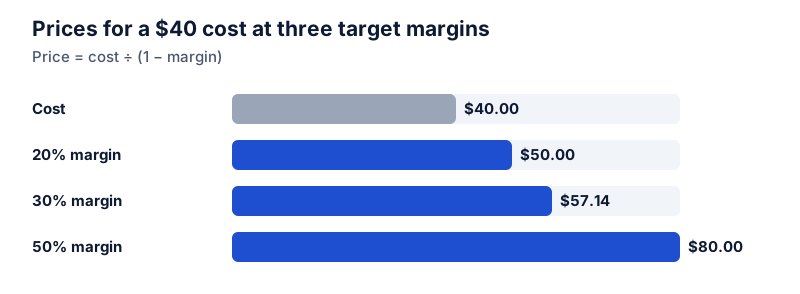
Suppose you want a 30% margin and price items by adding 30% to cost. A $40 item becomes $52. Profit is $12, and 12 ÷ 52 = 23.1%. You’re 7 points short of the margin you wanted. To get 30% margin, the price has to be $57.14. The target margin guide explains the formula.
Try it: A 30% markup on $40 gives this margin
Open in calculatorConverting between them
Use decimals in these formulas (25% = 0.25).
margin = markup ÷ (1 + markup)
markup = margin ÷ (1 − margin)
A 25% markup: 0.25 ÷ 1.25 = 0.20, a 20% margin. A 40% margin: 0.40 ÷ 0.60 = 0.667, a 66.7% markup.
Lookup table
| Markup | Margin |
|---|---|
| 10% | 9.1% |
| 25% | 20% |
| 33.3% | 25% |
| 50% | 33.3% |
| 66.7% | 40% |
| 100% | 50% |
| 150% | 60% |
| 200% | 66.7% |
| 300% | 75% |
A 100% markup (doubling the cost, often called “keystone” pricing in retail) is a 50% margin.
Which one discounts affect
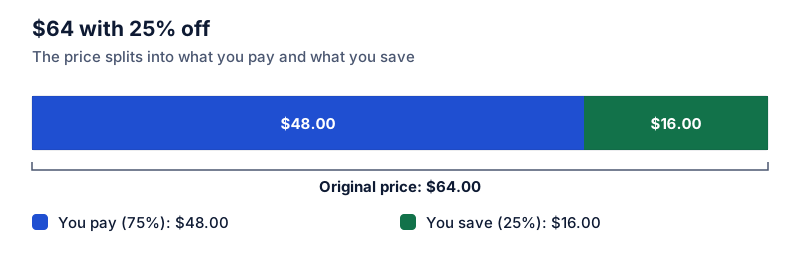
A discount comes off the price, so it eats into margin directly. If your margin is 20% and you discount 20%, you’re selling at cost. With markup the same discount looks less drastic on paper (25% markup minus 20% discount sounds like it leaves something), which is why it helps to think in margin when planning sales.
When people say “margin” but mean markup
In conversation, “margin” is sometimes used loosely for any profit percentage. If a supplier or colleague quotes a margin, check which base they used. Asking “is that on cost or on price?” settles it.
For the full business picture (gross, operating and net margins), see how to calculate profit margin. For a related trap with discounts, see how to calculate a discount.
Questions
Which one should I use?
Either, as long as everyone knows which. Retail pricing often starts from markup on cost, while financial reports and most business analysis use margin. Label the number.
Can margin be over 100%?
No. Profit can’t exceed the price, so margin is always below 100%. Markup has no ceiling: selling a $10 item for $50 is a 400% markup and an 80% margin.
The calculator links in this guide are checked against the PercentSwift calculator every time the site is built. How we calculate explains the rounding rules. If you spot a mistake, email hello@percentswift.com.