Percentage change vs percentage difference: which one to use
Use percentage change when one value is clearly the starting point, and percentage difference when neither is. The same pair of numbers worked both ways.
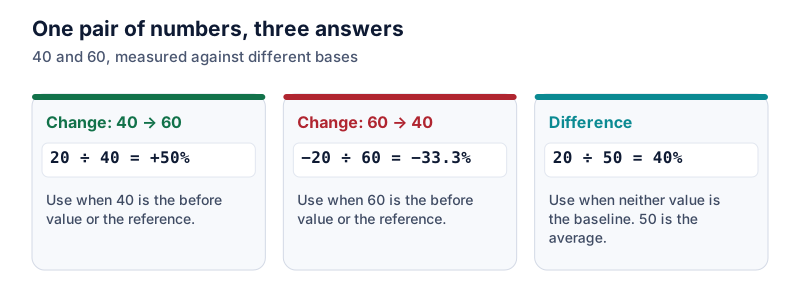
If one number is the baseline (before, expected, reference), use percentage change: divide the difference by that baseline. If the two numbers are on equal footing, use percentage difference: divide the absolute difference by their average. For 40 and 60, the change from 40 is 50%, from 60 it’s −33.3%, and the difference is 40%.
On this page
Both formulas compare two numbers. The question is whether one of them is the reference point.
percentage change = (new − old) ÷ |old| × 100
percentage difference = |A − B| ÷ ((A + B) ÷ 2) × 100
Use percentage change when there’s a baseline
A baseline is the number you measure against. Clues that you have one:
- There’s a before and an after (last year vs this year, old price vs new price).
- One number is a target, budget, forecast or accepted value.
- The question says “compared with”, “relative to” or “than”.
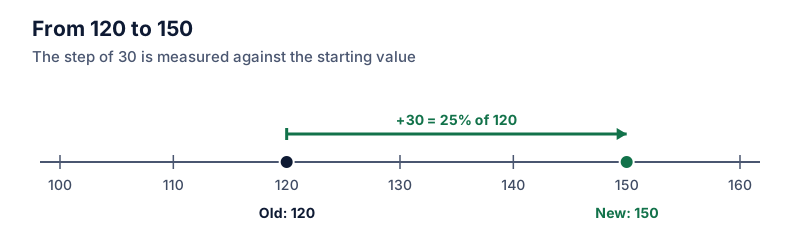
Sales went from 40 units to 60 units. 40 is the starting point, so the change is (60 − 40) ÷ 40 = +50%.
Use percentage difference when there isn’t
When two numbers are on equal footing, picking either one as the base would be arbitrary, and the answer would change depending on which you chose. The percentage difference avoids that by dividing by the average.
Two labs measure the same sample. One reads 40 mg, the other 60 mg. Neither is the “real” value. The difference is 20, the average is 50, and 20 ÷ 50 = 40%.
Try it: Percentage difference between 40 and 60
Open in calculatorOther examples: comparing the price of the same item at two stores, the heights of two people, the populations of two cities, or two quotes from contractors when you aren’t treating either as the reference.
The same pair, worked every way
| Comparison | Formula | Result |
|---|---|---|
| Change from 40 to 60 | 20 ÷ 40 | +50% |
| Change from 60 to 40 | −20 ÷ 60 | −33.3% |
| Difference between 40 and 60 | 20 ÷ 50 | 40% |
The percentage difference always lands between the two percentage changes (ignoring sign). That’s because the average is between the two numbers.
Try it: Change from 60 to 40
Open in calculatorWhen it matters
For values close together, the three answers are similar. 100 and 104 give a change of 4% one way, 3.85% the other way, and a difference of 3.92%.
For values far apart, they diverge. 10 and 30 give +200% one way, −66.7% the other, and a difference of 100%. Choosing the wrong formula here changes the story.
A quick rule
Ask: “Would it make sense to say one number went to the other, or is one of them the standard?” If yes, use percentage change and divide by the starting or standard value. If no, use percentage difference.
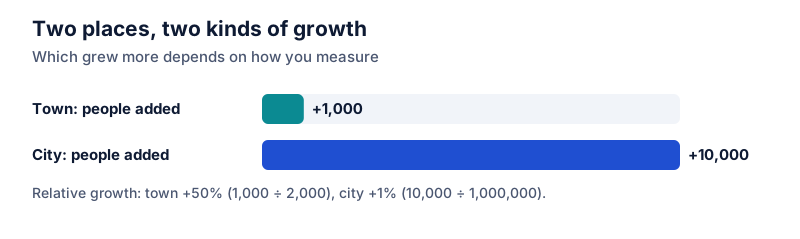
When in doubt in a report, give the two numbers and the absolute difference alongside any percentage, so readers can see what was compared. For more on describing changes clearly, see absolute vs relative change. The percent error guide covers the case where one value is the accepted standard.
Questions
Is percentage difference ever negative?
No. It uses the absolute difference, so it’s always zero or positive.
What about percent error?
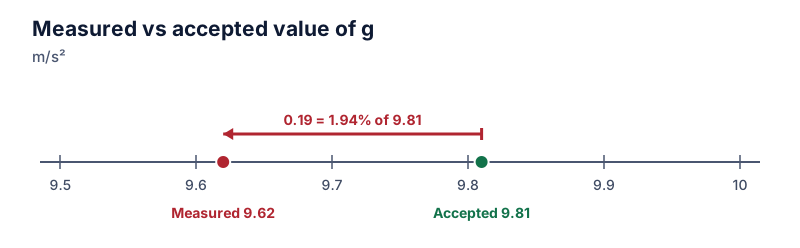
Percent error is a percentage change with the accepted or true value as the baseline. See the percent error guide.
The calculator links in this guide are checked against the PercentSwift calculator every time the site is built. How we calculate explains the rounding rules. If you spot a mistake, email hello@percentswift.com.