Percent error: the formula and how to use it in lab reports
Percent error = |measured − accepted| ÷ accepted × 100. How to use it in a lab report, why the absolute value is used, and how it differs from percentage difference.
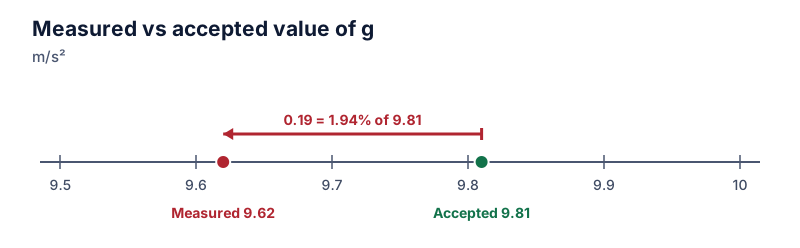
Percent error = |measured − accepted| ÷ |accepted| × 100. If you measure g as 9.62 m/s² and the accepted value is 9.81 m/s², the error is 0.19 ÷ 9.81 = 1.94%. Divide by the accepted value, not by your measurement.
On this page
Percent error tells you how far a measurement is from the accepted (or theoretical) value, as a share of that accepted value.
percent error = |measured − accepted| ÷ |accepted| × 100
Worked example
You measure the acceleration due to gravity as 9.62 m/s². The accepted value is 9.81 m/s².
- Difference: 9.62 − 9.81 = −0.19
- Absolute value: 0.19
- Divide by the accepted value: 0.19 ÷ 9.81 = 0.01937
- Multiply by 100: 1.94%
Try it: 0.19 as a percentage of 9.81
Open in calculatorWhy the absolute value?
Percent error usually describes the size of the error, not its direction. Measuring 10.00 m/s² (0.19 too high) gives the same 1.94% error as 9.62 m/s² (0.19 too low). If your course wants the direction, it will ask for “signed percent error”, and you skip the absolute value: 9.62 gives −1.94%.
Why divide by the accepted value?
The accepted value is the reference you’re judging against. Dividing by your measurement would make the error depend on how wrong you were, which is circular. It also gives a different number: 0.19 ÷ 9.62 = 1.98%.
Percent error vs percentage difference
Use percent error when one value is accepted as correct (a known constant, a manufacturer’s specification, a theoretical prediction).
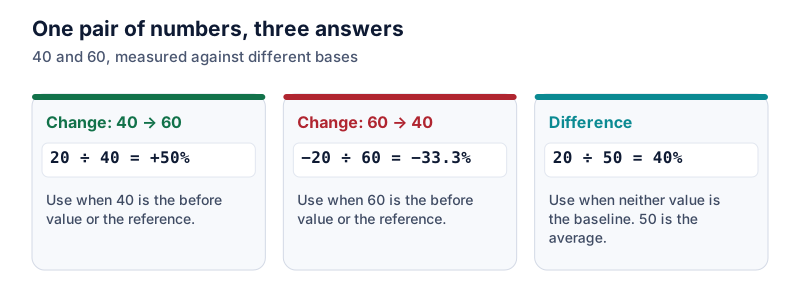
Use percentage difference when you’re comparing two measurements and neither is the reference, such as two lab groups measuring the same thing. It divides by the average of the two values. See percentage change vs percentage difference.
Try it: Two groups’ measurements: 9.62 and 9.71
Open in calculatorWriting it up
A typical lab report sentence: “Our measured value of g was 9.62 m/s², a percent error of 1.94% from the accepted value of 9.81 m/s².” Then discuss likely sources of error: reaction time with a stopwatch, air resistance, measuring the drop height.
Keep the rounding sensible. If your measurement has three significant figures, reporting the error as 1.936799% suggests more precision than you have. Two or three significant figures (1.9% or 1.94%) is usually right.
When the accepted value is zero
Percent error is undefined if the accepted value is zero, because you’d divide by zero. Report the absolute error instead (for example, “the reading was 0.03 V when it should have been 0 V”).
Other examples
Density. Measured 2.65 g/cm³, accepted 2.70: |2.65 − 2.70| ÷ 2.70 = 1.85%.
Boiling point. Measured 98.6 °C, accepted 100.0 °C: 1.4 ÷ 100 = 1.4%. (Percent error on a temperature in Celsius is a convention that’s commonly used in labs, even though Celsius zero is arbitrary.)
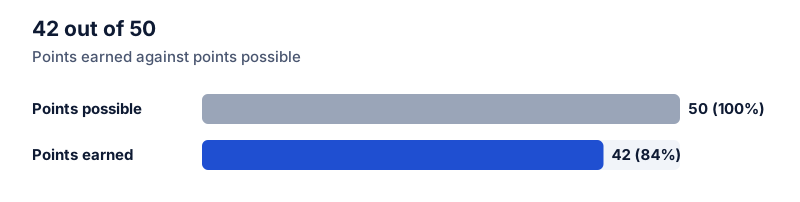
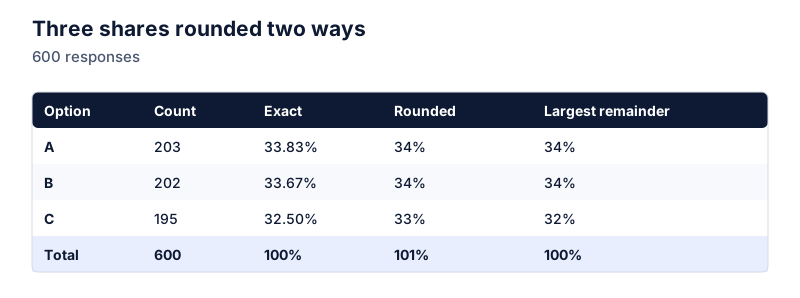
For more on dividing by the right base, see test score percentage, and for why rounded percentages can disagree, see why percentages don’t add to 100.
Questions
Can percent error be negative?
With the absolute value, no. Some courses drop the absolute value to show the direction of the error. Then a negative result means your measurement was too low.
What counts as a good percent error?
It depends on the experiment and the equipment. In a school lab, a few percent is often reasonable. Your instructor or lab manual is the best guide.
The calculator links in this guide are checked against the PercentSwift calculator every time the site is built. How we calculate explains the rounding rules. If you spot a mistake, email hello@percentswift.com.