How to calculate percentage change with negative numbers
When the starting value is negative, the standard percentage change formula flips the sign. The absolute-value fix, what it means, and when to report the change in units instead.
Divide by the absolute value of the starting number: (new − old) ÷ |old| × 100. A loss that shrinks from −50 to −25 is then a 50% improvement, and a move from −50 to +25 is a 150% improvement. When the sign changes, many analysts give the change in units instead.
On this page
The usual formula for percentage change divides by the starting value. That works when the start is positive. When it’s negative, the sign of the answer comes out backward.
A company lost $50,000 last year and $25,000 this year. Things improved. But the plain formula gives:
(−25,000 − (−50,000)) ÷ −50,000 = 25,000 ÷ −50,000 = −50%
A negative result suggests things got worse, which is the opposite of what happened.
The absolute-value fix
Divide by the size of the starting value, ignoring its sign:
percentage change = (new − old) ÷ |old| × 100
Now the loss shrinking from −50,000 to −25,000 is 25,000 ÷ 50,000 = +50%. The sign matches the direction of the move: up is positive, down is negative.
Try it: A loss shrinking from −50,000 to −25,000
Open in calculatorCrossing zero
From −50 to +25 is a move of +75. Divided by |−50|, that’s +150%.
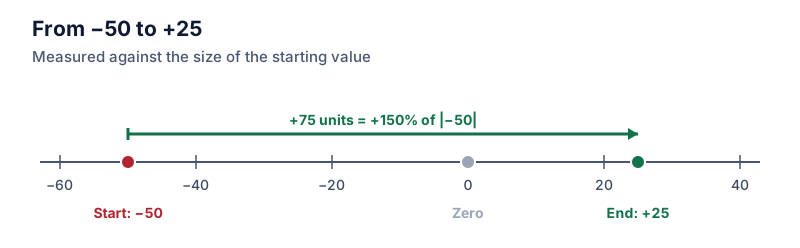
The number is correct under the convention, but it’s hard to interpret. Did the result get 150% better? Better than what? Readers tend to find “swung from a $50,000 loss to a $25,000 profit, a $75,000 improvement” clearer than any percentage.
Try it: −50 to +25
Open in calculatorGetting worse from a negative start
From −40 to −60 is a move of −20. Divided by 40, that’s −50%. The loss grew by half, and the minus sign says it moved down.
When to skip the percentage
Many analysts give the change in units, not percent, when:
- the starting value is negative,
- the sign flips between the two values, or
- the starting value is very close to zero, which makes the percentage huge and unstable.
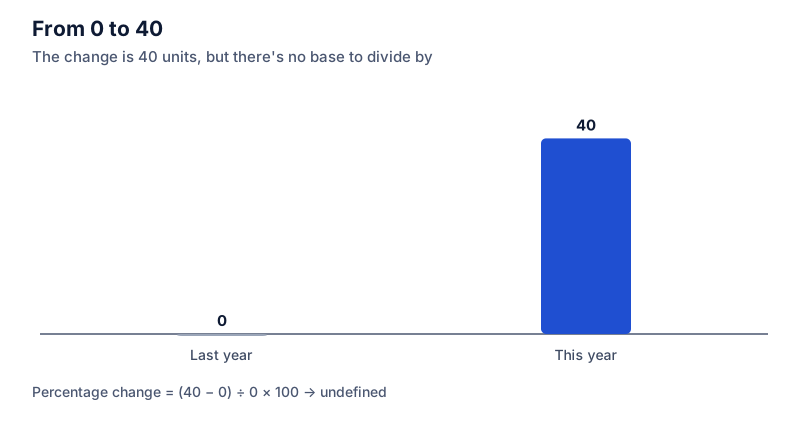
Company earnings reports often do this, writing “n/m” (not meaningful) in the percentage column when a loss turns into a profit. See percentage change from zero for the related problem when the start is exactly zero.
Where negative values come up
- Profit and loss, net income, cash flow
- Temperatures in Celsius or Fahrenheit
- Account balances and net worth
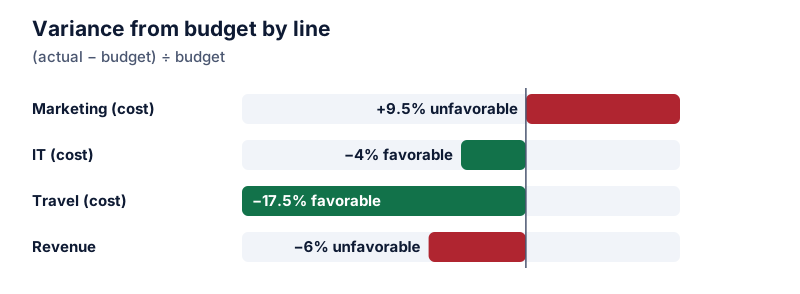
- Budget variances (over or under budget) — see budget variance percentage
- Changes that are themselves differences, like a trade balance
Temperatures are a special case
Going from −10 °C to 10 °C is not a meaningful “200% increase”, because zero on the Celsius scale is arbitrary. Percentages only make sense for quantities where zero means none of the thing. For temperature, report the change in degrees.
In a spreadsheet
With the old value in A2 and the new value in B2, use =(B2-A2)/ABS(A2). Without ABS, any negative start flips the sign. The standard percentage increase formula works the same way for positive starting values.
Questions
Is the absolute-value method standard?
It’s the most common convention, and spreadsheet guides usually recommend it, but it isn’t universal. Some analysts refuse to give a percentage when the sign changes. Say which method you used.
What if both values are negative and the number gets more negative?
From −40 to −60 is a change of −20 units. Divided by |−40|, that’s −50%: the position got 50% worse.
The calculator links in this guide are checked against the PercentSwift calculator every time the site is built. How we calculate explains the rounding rules. If you spot a mistake, email hello@percentswift.com.