How to calculate market share
Market share = company sales ÷ total market sales × 100. Revenue share vs unit share, describing share changes in points, and relative market share.
Market share = a company’s sales ÷ total sales in the market × 100. A company with $42 million of sales in a $100 million market has a 42% share. Changes in share are best described in percentage points: from 38% to 42% is a gain of 4 points.
On this page
market share = company’s sales ÷ total market sales × 100
A market has $100 million in annual sales. Company A sold $42 million. Its share is 42 ÷ 100 = 42%.
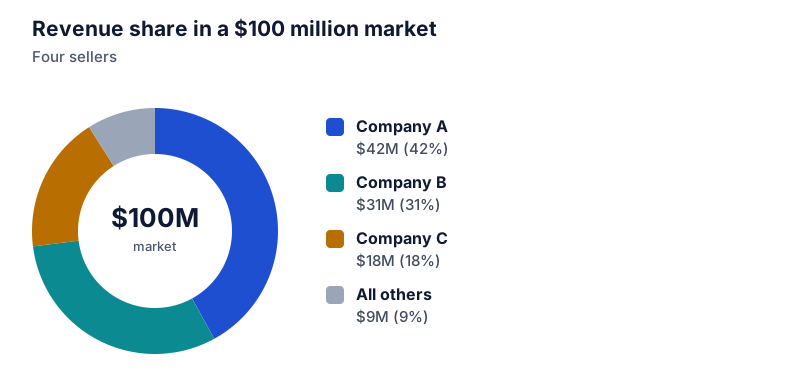
Try it: $42M of a $100M market
Open in calculatorRevenue share vs unit share
Market share can be measured in money or in units, and the two can differ a lot. If Company A sold 1.2 million of the 4 million units sold in the market, its unit share is 1.2 ÷ 4 = 30%, while its revenue share is 42%. Company A sells fewer, more expensive items than average.
Try it: 1.2M of 4M units
Open in calculatorPremium brands usually have a higher revenue share than unit share; budget brands the reverse. Say which one you’re quoting.
Defining the market
The answer depends on what you count as “the market.” A coffee chain might have 40% of specialty coffee shops in a city but 8% of all coffee sold there, including supermarkets. Be explicit about the product category, geography and time period.
Changes in share
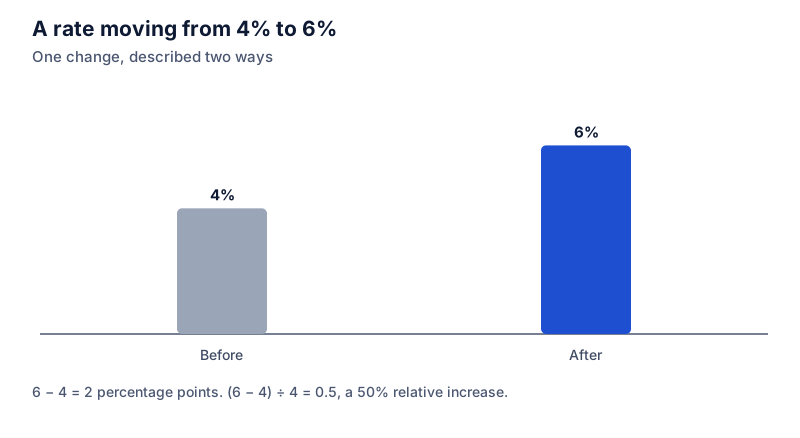
Shares are percentages, so changes in share are usually given in percentage points. Company A going from 38% to 42% gained 4 points. Relative to its old share, that’s a 10.5% increase.
Try it: Share from 38% to 42%
Open in calculatorA company can grow its sales and still lose share, if the market grows faster. Sales up 10% in a market that grew 15% means share fell.
Relative market share
Relative market share compares a company with its largest competitor:
relative share = company’s share ÷ largest competitor’s share
Company A versus B: 42 ÷ 31 = 1.35. A value above 1 means you’re the market leader. For Company B, the largest competitor is A: 31 ÷ 42 = 0.74.
Concentration
A quick way to describe how concentrated a market is: add the shares of the top few firms. Here the top three hold 42 + 31 + 18 = 91%. Analysts also use the Herfindahl-Hirschman Index, which adds the squares of each firm’s share, so larger firms weigh more.
A table of shares
When you have sales for every company, list each as a percentage of the total. Because of rounding, the shares might add to 99.9% or 100.1%. See percentage of total in a table for how to handle that, and percentage points vs percent for describing changes.
Questions
Where do I get total market size?
Industry associations, government statistics, public company reports and market research firms. Estimates from different sources often disagree, so note which one you used.
Can market shares add up to more than 100%?
Not if they come from the same total. If they do, the figures probably come from different sources or define the market differently.
The calculator links in this guide are checked against the PercentSwift calculator every time the site is built. How we calculate explains the rounding rules. If you spot a mistake, email hello@percentswift.com.