Discount first or tax first? Calculating the final price at the till
With a percentage discount and a percentage sales tax, the final price is the same whichever you apply first. Fixed-dollar coupons are different. Worked examples at the till.
For a percentage discount and a percentage tax, the order doesn’t matter: $80 with 25% off and 8% tax is $64.80 either way, because multiplication can be done in any order. With a fixed-dollar coupon, order matters, and where the coupon reduces the taxable price, taking it off before tax gives a lower total.
On this page
At the register you might have a discount and sales tax on the same purchase. Does it matter which is applied first?
Percentage discount and percentage tax: no
A $80 jacket, 25% off, with 8% sales tax.
Discount first: $80 × 0.75 = $60, then $60 × 1.08 = $64.80.
Tax first: $80 × 1.08 = $86.40, then $86.40 × 0.75 = $64.80.
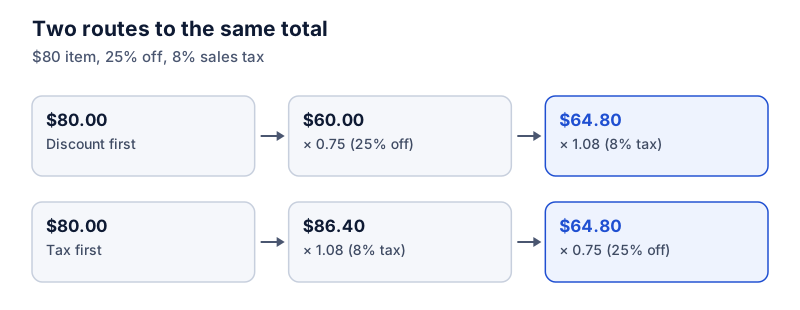
Both are $80 × 0.75 × 1.08. Multiplication gives the same result in any order, so the total is the same.
Try it: Step 1: $80 with 25% off
Open in calculatorTry it: Step 2: $60 plus 8% tax
Open in calculatorThe tax amount does differ between the two routes in the middle ($4.80 on the sale price vs $6.40 on the full price before the discount), but the final total doesn’t.
Fixed-dollar coupons: yes
A $10-off coupon is subtracted, not multiplied, so the order changes the result.
Coupon before tax: ($80 − $10) × 1.08 = $75.60.
Coupon after tax: $80 × 1.08 − $10 = $76.40.
The difference is the tax on the coupon amount: 8% of $10 = $0.80. In the US, whether a coupon reduces the taxable price depends on the state and on the type of coupon (store coupons and manufacturer coupons are often treated differently). The receipt shows which method was used.
Percentage discount plus a fixed coupon
With 25% off and a $10 coupon on the same $80 item, the order of those two also matters:
- Percentage, then coupon: $80 × 0.75 − $10 = $50, then tax: $54.00
- Coupon, then percentage: ($80 − $10) × 0.75 = $52.50, then tax: $56.70
Store terms usually specify the order. Percentage first is better for you. The percent off vs dollar off guide covers this in more depth.
A quick way to estimate the total
Multiply the price by the discount multiplier and the tax multiplier together. For 25% off with 8% tax: 0.75 × 1.08 = 0.81. Your total is about 81% of the sticker price. For 20% off with 6% tax: 0.8 × 1.06 = 0.848, about 85%.
Rounding
Registers usually round tax to the cent after the discount. Very occasionally that makes a one-cent difference between the two orders. It’s a rounding effect, not a different method.
For the basics of each step, see how to calculate a discount and how to calculate sales tax.
Questions
Is sales tax charged on the original price or the sale price?
For a store’s own price reductions, tax is normally charged on the reduced price. Treatment of coupons, especially manufacturer coupons, varies by state, so the receipt is the final word.
Does this apply to VAT?
In VAT countries, shelf prices usually include VAT already, so a percentage discount on the shelf price reduces the VAT in proportion. The order question rarely comes up for shoppers.
The calculator links in this guide are checked against the PercentSwift calculator every time the site is built. How we calculate explains the rounding rules. If you spot a mistake, email hello@percentswift.com.