How to calculate progress toward a goal
Goal progress = (current − start) ÷ (target − start) × 100. It works for goals that go up, like savings, and goals that go down, like cutting costs. Worked examples for both, plus common mistakes.
Progress = (current − start) ÷ (target − start) × 100. Saving $4,500 toward $12,000 from zero is 37.5%. Cutting monthly spending from $3,200 toward $2,600, and getting to $2,950, is (3,200 − 2,950) ÷ (3,200 − 2,600) = 250 ÷ 600 = 41.7% of the way.
On this page
Progress toward a goal is a percentage of the distance between where you started and where you want to be. That works whether the number should go up or down.
The formula
progress = (current − start) ÷ (target − start) × 100
Where start is the value when the goal was set
When the start is zero, this reduces to current ÷ target × 100.
A goal that goes up
You’re saving for a $12,000 emergency fund, starting from $0, and have $4,500 saved.
Try it: $4,500 of $12,000 saved
Open in calculatorYou’re 37.5% of the way there.
If you’d started with $2,000 already saved, the distance is $10,000 and you’ve covered $2,500 of it: 25% progress. Using current ÷ target (37.5%) would credit you for money you already had.
A goal that goes down
You want to cut monthly spending from $3,200 to $2,600. This month you spent $2,950.
- Distance to cover: $3,200 − $2,600 = $600.
- Distance covered: $3,200 − $2,950 = $250.
- Progress: 250 ÷ 600 × 100 = 41.7%.
Try it: $250 of a $600 reduction
Open in calculator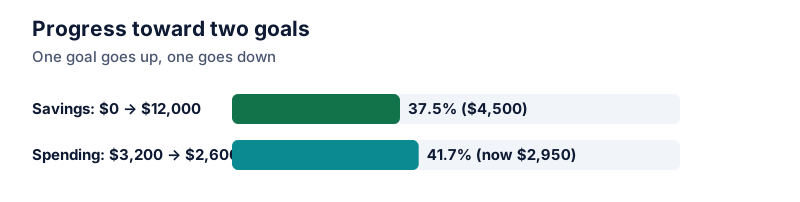
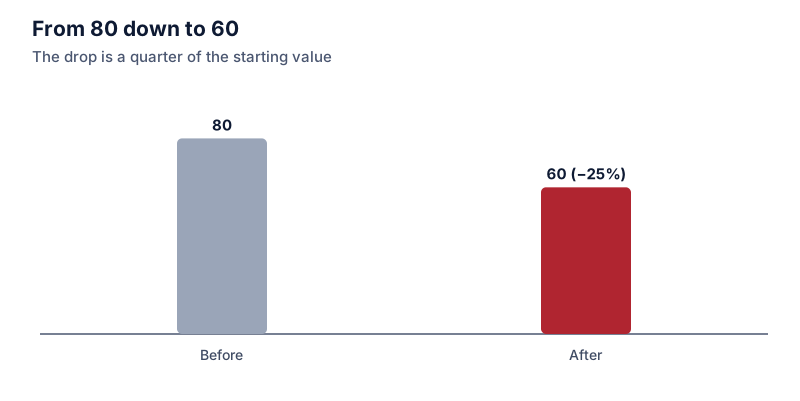
The common mistake is $2,600 ÷ $2,950 = 88%, which looks impressive but measures nothing useful. Another is to report the 7.8% decrease in spending, which is a percentage decrease, not progress toward the goal.
Checking your pace
Compare progress with time elapsed. If the savings goal is due in 12 months and 5 months have passed (41.7% of the time), 37.5% progress is slightly behind an even pace. To finish on time, you’d need $7,500 over the remaining 7 months, about $1,071 a month.
Goals with several parts
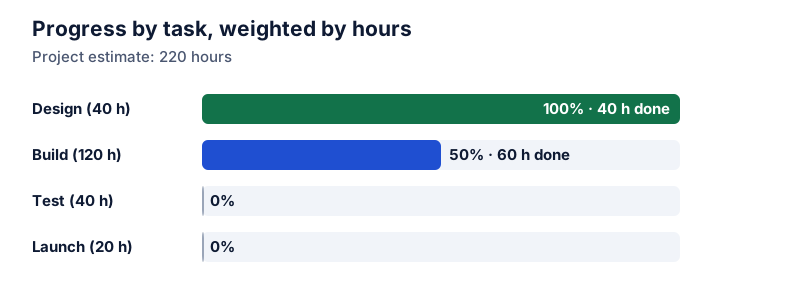
If a goal has parts of different sizes, weight them, just as with project completion. Averaging the percentages of a small and a large sub-goal gives the small one too much influence.
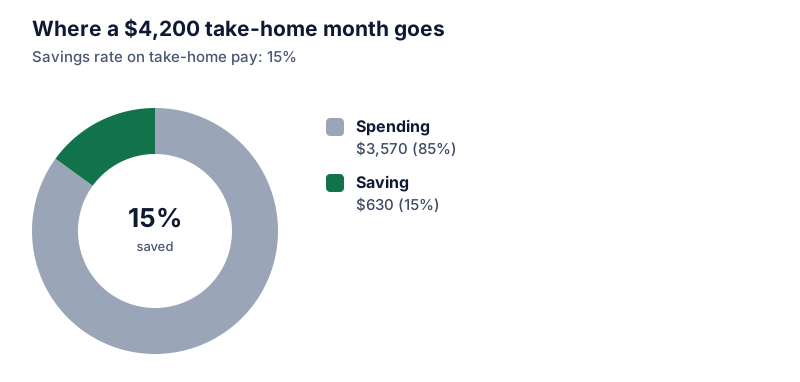
For saving specifically, see savings rate, which measures how much of your income goes to savings each month.
Questions
Can progress be negative or above 100%?
Yes. If spending rose to $3,300, progress would be (3,200 − 3,300) ÷ 600 = −16.7%, meaning you’ve moved away from the goal. Overshooting the target gives more than 100%.
How do I show whether I'm on track for a deadline?
Compare progress with time elapsed. If you’re 40% of the way to the goal and 50% of the way through the time allowed, you’re behind the even pace needed to finish on time.
The calculator links in this guide are checked against the PercentSwift calculator every time the site is built. How we calculate explains the rounding rules. If you spot a mistake, email hello@percentswift.com.