How to calculate your debt-to-income ratio
Debt-to-income ratio is your monthly debt payments divided by your gross monthly income. What usually counts, a worked example, and how paying off one debt changes it.
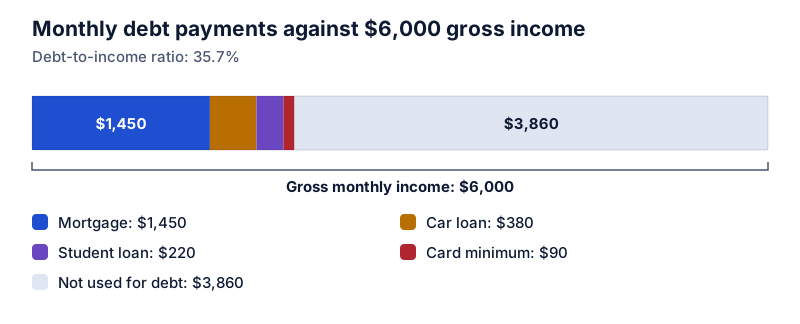
DTI = total monthly debt payments ÷ gross monthly income × 100. With $2,140 of monthly debt payments and $6,000 of gross monthly income, your DTI is 35.7%. Paying off a $380 car payment would bring it down to 29.3%.
On this page
Lenders use your debt-to-income ratio (DTI) to judge how much of your income is already committed to debt.
DTI = total monthly debt payments ÷ gross monthly income × 100
Worked example
Gross monthly income: $6,000 (a $72,000 salary before taxes).
Monthly debt payments:
| Debt | Payment |
|---|---|
| Mortgage (including taxes and insurance) | $1,450 |
| Car loan | $380 |
| Student loan | $220 |
| Credit card minimum | $90 |
| Total | $2,140 |
DTI = 2,140 ÷ 6,000 = 35.7%.
Try it: $2,140 of debt payments on $6,000 income
Open in calculatorWhat usually counts
Included: mortgage or rent (for some lenders), car loans, student loans, minimum credit card payments, personal loans, child support or alimony you pay, and the payment for the new loan you’re applying for.
Usually not included: utilities, groceries, insurance not tied to the mortgage, phone bills, and subscriptions. These affect your budget but aren’t debt.
Use the minimum payment on credit cards, even if you pay more. If a card has a balance but no stated minimum, lenders may use a percentage of the balance.
Front-end and back-end ratios
Mortgage lenders often look at two ratios:
- Front-end (housing) ratio: housing costs only. Here, 1,450 ÷ 6,000 = 24.2%.
- Back-end (total) ratio: all debt payments, the 35.7% above.
When people say “DTI” without qualification, they usually mean the back-end ratio.
How paying off one debt changes it
Pay off the car loan and the total drops to $1,760. DTI = 1,760 ÷ 6,000 = 29.3%, a drop of 6.4 percentage points.
Try it: After paying off the car: $1,760 of $6,000
Open in calculatorThe fastest way to lower DTI is to eliminate a whole payment, not to reduce a balance. Paying a credit card down from $3,000 to $2,000 may barely change the minimum payment, while clearing a small loan removes its payment entirely.
Raising income has the same effect
A raise to $6,500 a month with the original debts gives 2,140 ÷ 6,500 = 32.9%. Lenders usually need documented, stable income, so a new raise may not count until it shows on pay stubs.
DTI vs your own budget
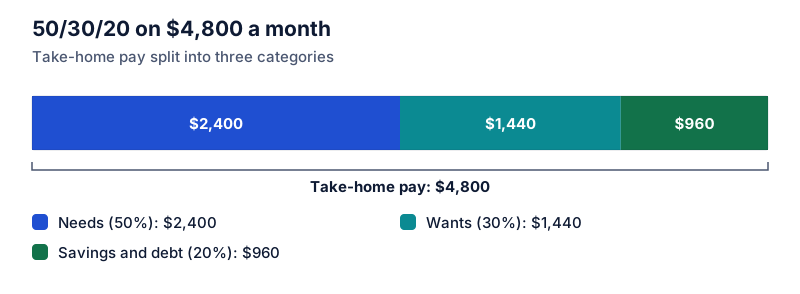
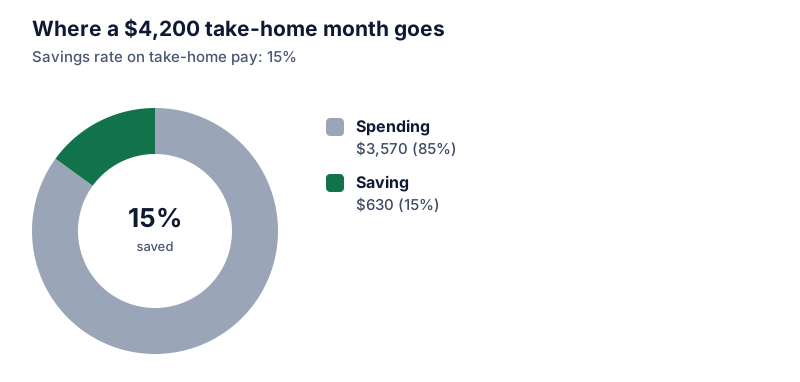
Because DTI uses gross income and excludes living costs, it can look comfortable while your monthly budget is tight. For a fuller view of your spending, compare debt payments with take-home pay too, or use a framework like the 50/30/20 budget. Tracking your savings rate alongside DTI gives a picture of both what you owe and what you’re building.
Questions
Is DTI based on gross or take-home pay?
Lenders almost always use gross income, before taxes and deductions. That makes the ratio look lower than the share of your paycheck that goes to debt.
What DTI do lenders want?
It varies by lender and loan type. Many mortgage lenders prefer a total ratio of about 36% or lower and set a ceiling somewhere in the 40s, but programs differ, so ask the lender.
The calculator links in this guide are checked against the PercentSwift calculator every time the site is built. How we calculate explains the rounding rules. If you spot a mistake, email hello@percentswift.com.