APR vs APY: what the two percentages mean
APR is the yearly rate before compounding; APY includes compounding. How to convert APR to APY for yearly, monthly and daily compounding, and which one to compare.
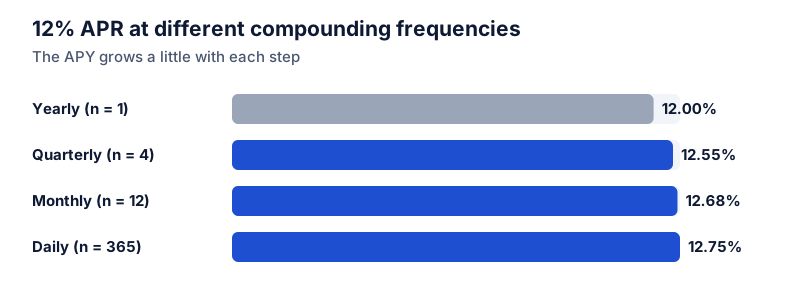
APY = (1 + APR ÷ n)^n − 1, where n is the number of compounding periods a year. A 12% APR compounded monthly is a 12.68% APY. Compare savings accounts by APY. For loans, APR often includes fees as well as interest, so read how the lender defines it.
On this page
Both are yearly percentages, and both come from the same interest rate. The difference is whether compounding is counted.
- APR (annual percentage rate) is the per-period rate multiplied by the number of periods in a year. It ignores the effect of interest earning interest.
- APY (annual percentage yield), also called the effective annual rate, includes compounding. It’s what actually happens to a balance over a year.
Converting APR to APY
APY = (1 + APR ÷ n)^n − 1
Where n is the number of compounding periods per year
A credit card with a 12% APR that compounds monthly charges 1% a month. Over a year, 1.01^12 = 1.1268, so the APY is 12.68%.
The calculator’s successive changes mode shows the first three months of that compounding:
Try it: Three months at 1% a month on $1,000
Open in calculatorThree months at 1% is 3.03%, not 3%. Twelve months gets you to 12.68%.
Comparison table
| APR | Yearly | Quarterly | Monthly | Daily |
|---|---|---|---|---|
| 3% | 3.00% | 3.03% | 3.04% | 3.05% |
| 5% | 5.00% | 5.09% | 5.12% | 5.13% |
| 12% | 12.00% | 12.55% | 12.68% | 12.75% |
| 24% | 24.00% | 26.25% | 26.82% | 27.11% |
At low rates, compounding frequency barely matters. At credit card rates, it adds several points.
Converting APY back to APR
APR = n × ((1 + APY)^(1 ÷ n) − 1)
A savings account paying 5.12% APY with monthly compounding has an APR of 12 × (1.0512^(1/12) − 1) = 5.00%.
Which one to compare
Savings and deposits: compare APY. It’s the rate your money actually grows at, and it puts accounts with different compounding on equal terms.
Loans: check what the APR includes. For many loans, especially mortgages, the APR includes certain fees as well as interest, which makes it a better total-cost comparison than the interest rate alone. Compare loans of the same type using APR, and ask for the total amount you’ll repay.
Credit cards: the APR is the one shown, but if you carry a balance, the effective cost is closer to the APY.
Monthly rate traps
A loan quoted at “2% a month” is a 24% APR and a 26.82% APY. Short-term lenders sometimes quote fees per week or per two weeks, which hides a very high annual rate. Converting to an APY makes the cost visible.
Small changes in rates
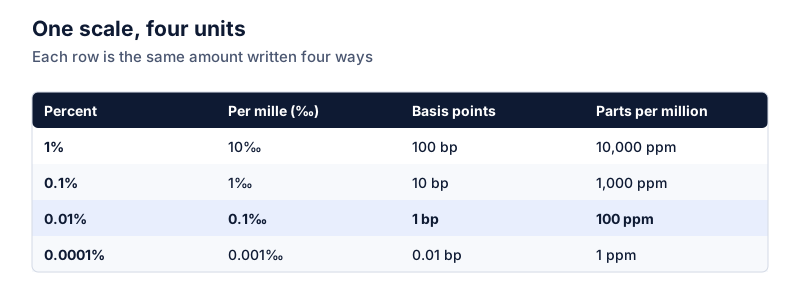
Rates are often discussed in basis points: a rise from 5.00% to 5.25% is 25 basis points. See basis points, per mille and ppm. For the full picture of how compounding builds over time, see compound interest, and for interest without compounding, see simple interest.
Questions
Why do credit cards show APR and savings accounts show APY?
In the US, lending disclosure rules center on APR and deposit disclosure rules on APY. APR makes borrowing look slightly cheaper than its compounded cost, and APY makes savings look slightly better than the base rate.
Can APY be lower than APR?
Not for the same interest rate. With compounding once a year they’re equal; any more frequent compounding makes APY higher.
The calculator links in this guide are checked against the PercentSwift calculator every time the site is built. How we calculate explains the rounding rules. If you spot a mistake, email hello@percentswift.com.