Click-through rate (CTR): formula and examples
CTR = clicks ÷ impressions × 100. Examples for ads, emails and search results, and why the CTR across several campaigns isn't the average of their CTRs.
Click-through rate = clicks ÷ impressions × 100. 240 clicks from 8,000 impressions is a 3% CTR. To get the CTR for several campaigns together, add up all clicks and all impressions and divide; averaging the individual CTRs gives the wrong answer when the campaigns are different sizes.
On this page
CTR = clicks ÷ impressions × 100
An ad was shown 8,000 times and clicked 240 times. CTR = 240 ÷ 8,000 = 3%.
Try it: 240 clicks from 8,000 impressions
Open in calculatorWhere CTR is used
- Search ads and display ads: clicks ÷ times the ad was shown.
- Organic search results: clicks ÷ times your page appeared in results, as reported in tools like Google Search Console.
- Email: clicks ÷ emails delivered (click rate), or clicks ÷ opens (click-to-open rate).
- Buttons and links on a page: clicks ÷ page views.
Combining campaigns
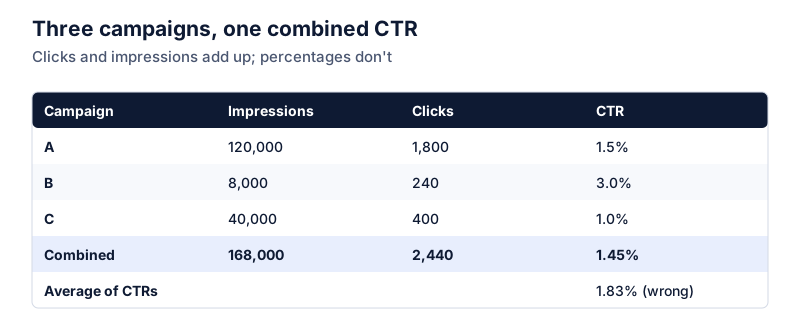
To find the CTR for all campaigns together, add up all the clicks and all the impressions first:
2,440 ÷ 168,000 = 1.45%.
Try it: 2,440 clicks from 168,000 impressions
Open in calculatorAveraging the three CTRs, (1.5 + 3 + 1) ÷ 3 = 1.83%, overstates it. Campaign B had the highest CTR but only 8,000 impressions, so it should count for much less than campaign A’s 120,000. This is the same problem as averaging test scores from sections of different lengths; see average of percentages.
Comparing CTR changes
A CTR moving from 1.5% to 1.8% is a rise of 0.3 percentage points, or a 20% relative improvement. Say which one you mean.
Small numbers make CTR unstable. An email to 500 people with 15 clicks has a 3% click rate; one more click makes it 3.2%. Look at several sends or campaigns before deciding something worked.
What moves CTR
CTR depends on position, audience, wording and format. A higher position on a search results page usually gets a higher CTR regardless of the wording. When comparing ads, compare them in similar positions and for similar audiences, or the comparison says more about placement than about the ad.
CTR isn’t the goal
A high CTR with low conversions can mean the ad attracts clicks it can’t satisfy. Pair CTR with the conversion rate after the click: if 1,800 clicks led to 54 purchases, the post-click conversion rate is 3%, and the overall rate from impression to purchase is 54 ÷ 120,000 = 0.045%. See conversion rate.
For response rates on surveys, which work the same way, see survey response rate.
Questions
What counts as an impression?
Each time the ad, link or result is shown. Platforms define it slightly differently, for example whether an ad must be visible on screen. Use one platform’s definition consistently.
Is email click rate the same as CTR?
Email tools often report click rate as clicks ÷ emails delivered, and click-to-open rate as clicks ÷ opens. Check which denominator your tool uses before comparing.
The calculator links in this guide are checked against the PercentSwift calculator every time the site is built. How we calculate explains the rounding rules. If you spot a mistake, email hello@percentswift.com.