How to calculate a survey response rate
Survey response rate = completed responses ÷ people successfully invited × 100. Worked example from 2,400 invitations to 468 completes, plus completion rate, partial responses, and what the rate does and doesn't tell you.
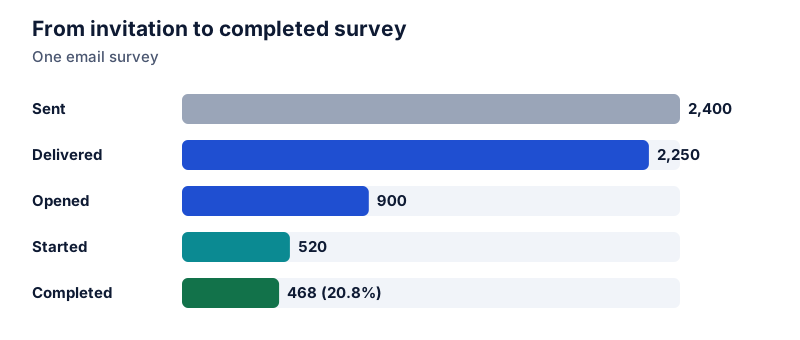
Response rate = completed surveys ÷ eligible people who received the invitation × 100. With 2,400 emails sent, 150 bounced, and 468 completes, the response rate is 468 ÷ 2,250 = 20.8%. Of the 520 people who started, 90% finished.
On this page
The response rate tells you how many of the people you invited actually completed your survey. It’s simple to calculate, but the result depends on which numbers you divide.
The formula
response rate = completed responses ÷ eligible invitees reached × 100
Where invitations that bounced or went to ineligible people are excluded
Worked example
A customer survey was emailed to 2,400 people. 150 emails bounced, so 2,250 were delivered. 900 people opened the email, 520 started the survey and 468 completed it.
Try it: 468 completes of 2,250 delivered
Open in calculatorThe response rate is 20.8%.
Completion rate
Of the people who started, how many finished?
Try it: 468 of 520 who started
Open in calculatorA low completion rate points to a survey that’s too long or has a confusing question. Look for the question where most people dropped out.
Choosing the denominator
- Sent (2,400). Gives 19.5%. Simpler, but penalizes you for bad email addresses.
- Delivered (2,250). Gives 20.8%. The usual choice for email surveys.
- Opened (900). Gives 52%. This is really a different measure, how persuasive the survey was once seen, and shouldn’t be reported as the response rate.
Whatever you choose, state it: “20.8% of delivered invitations.”
Partial responses
If you keep partly finished surveys, report two rates: complete responses only, and complete plus partial. Define “partial” in advance, for example “answered at least half the questions.”
What the rate doesn’t tell you
A high response rate doesn’t guarantee representative results, and a low one doesn’t rule them out. Check whether respondents look like the invited group on known traits. The margin of error only covers random sampling error, not bias from who chose to respond.
Related
Response rates are one kind of conversion. See conversion rate for the general formula, and attendance percentage for a similar “showed up ÷ expected” calculation.
Questions
Is a 20% response rate good?
There’s no universal benchmark. It depends on the audience, how you contact them, survey length and incentives. A rate that’s stable or rising across your own surveys is a more useful comparison than an industry average.
Does a low response rate make the results wrong?
Not automatically. What matters is whether the people who responded differ from those who didn’t in ways that affect the answers. Compare respondents to the invited group on things you know, such as region or customer type.
The calculator links in this guide are checked against the PercentSwift calculator every time the site is built. How we calculate explains the rounding rules. If you spot a mistake, email hello@percentswift.com.