How to calculate customer churn rate and retention rate
Churn rate = customers lost ÷ customers at the start × 100. How to handle new customers in the period, calculate retention, and convert monthly churn to an annual figure.
Churn rate = customers lost during the period ÷ customers at the start × 100. Starting with 2,000 customers and losing 86 in a month is 4.3% monthly churn. Retention is the share of starting customers still there: 95.7%. Don’t multiply monthly churn by 12; 4.3% a month compounds to about 41% a year.
On this page
Churn and retention are two sides of the same number, measured over a fixed period.
churn rate = customers lost during the period ÷ customers at the start × 100
retention rate = (customers at the end − new customers) ÷ customers at the start × 100
Worked example
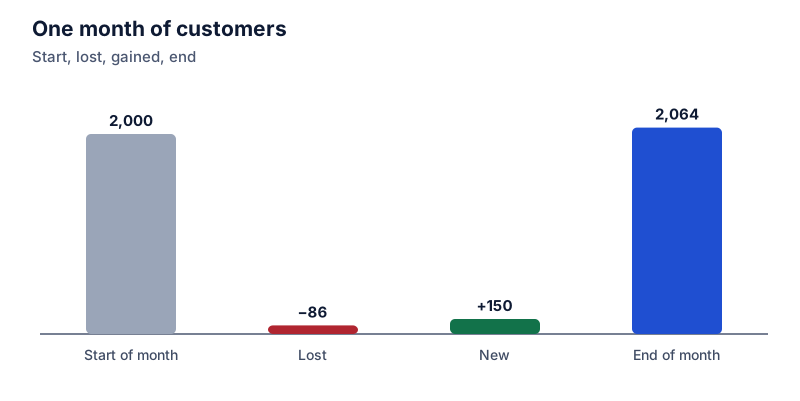
A subscription service starts the month with 2,000 customers. During the month, 86 cancel and 150 sign up. It ends with 2,064.
- Churn: 86 ÷ 2,000 = 4.3%
- Retention: (2,064 − 150) ÷ 2,000 = 1,914 ÷ 2,000 = 95.7%
Try it: 86 lost of 2,000 starting customers
Open in calculatorChurn and retention add up to 100% under these definitions.
Leave new customers out
The new customers grew the business, but they weren’t there at the start, so they couldn’t have churned. Including them in the denominator (for example, dividing by the ending count or by an average) gives a lower churn rate that’s harder to compare month to month, especially when growth is uneven. If you use an average-of-period denominator, document it and keep it consistent.
Monthly to annual
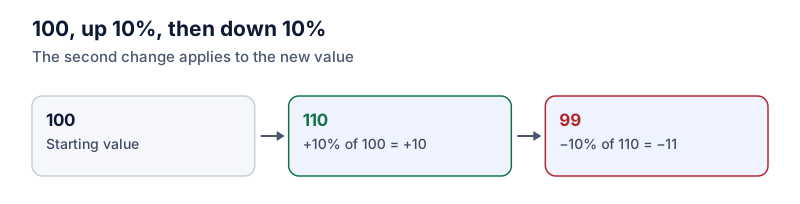
Churn compounds. If 4.3% of remaining customers leave each month, the share of a starting group still around after 12 months is 0.957^12 = 0.590. Annual churn is about 41%, not 4.3 × 12 = 51.6%.
annual churn = 1 − (1 − monthly churn)^12
| Monthly churn | Annual churn |
|---|---|
| 1% | 11.4% |
| 2% | 21.5% |
| 3% | 30.6% |
| 5% | 46.0% |
| 8% | 63.2% |
The same compounding is explained in successive percentage changes.
Average customer lifetime
If churn stays roughly constant, the average customer lifetime is about 1 ÷ churn rate. At 4.3% a month, that’s 1 ÷ 0.043 ≈ 23 months. This is a rough guide; real churn is usually higher in the first months and lower later.
Comparing periods
If churn goes from 4.3% to 3.8%, it fell 0.5 percentage points, an 11.6% relative improvement. In a report, give the points change with both rates.
Watch for seasonality. Annual plans renewing in January, or students leaving in summer, make month-over-month churn jump around. Year-over-year comparisons are steadier; see year-over-year vs month-over-month growth.
Cohort retention
For a clearer picture, follow groups who joined in the same month. “Of customers who joined in March, 72% were still active after six months” separates the behavior of new and long-standing customers. Each cohort’s retention is a simple part-over-whole percentage.
For the step before a customer exists, see conversion rate.
Questions
What about customers who sign up and cancel in the same month?
They weren’t in the starting count, so the standard formula ignores them. If that happens a lot, track it separately, for example as early cancellation rate.
What's revenue churn?
The same idea with money: recurring revenue lost from existing customers ÷ recurring revenue at the start. It can differ from customer churn when large and small customers leave at different rates.
The calculator links in this guide are checked against the PercentSwift calculator every time the site is built. How we calculate explains the rounding rules. If you spot a mistake, email hello@percentswift.com.