Basis points, per mille and parts per million explained
Basis points, per mille and parts per million are smaller cousins of the percent. How they relate, how to convert them, and where each one is used.
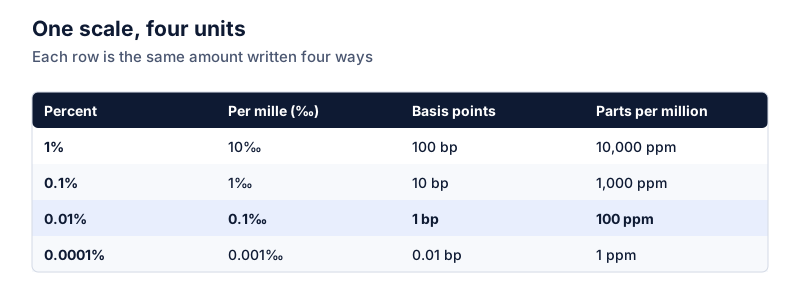
1% = 10‰ (per mille) = 100 basis points = 10,000 ppm. A basis point is 0.01%, a per mille is 0.1%, and one part per million is 0.0001%. To convert to a percentage, divide basis points by 100, per mille by 10, and ppm by 10,000.
On this page
A percent is a count per hundred. When the amounts are small, writing them as percentages means a lot of zeros after the decimal point, so several fields use finer units.
Basis points (bp)
A basis point is one hundredth of a percentage point: 0.01%. Finance uses them for interest rates, bond yields and fees, where a quarter of a percentage point matters.
- 25 bp = 0.25%
- 150 bp = 1.5%
- A rate moving from 5.25% to 5.50% rose 25 bp
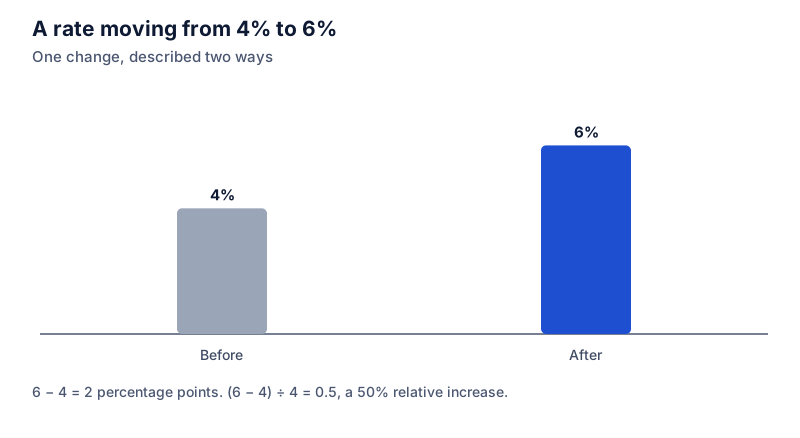
Basis points also remove an ambiguity. “The rate rose 1%” could mean one percentage point or a 1% relative increase. “The rate rose 100 basis points” can only mean the first. The guide on percentage points vs percent explains the difference.
Fees. A fund that charges 45 bp a year takes 0.45% of your balance. On $20,000 that’s 0.0045 × 20,000 = $90.
Try it: A 45 bp fee on $20,000 (0.45%)
Open in calculatorPer mille (‰)
Per mille means per thousand. 1‰ = 0.1%. It’s common in some European countries for things like property transfer taxes, and in demography, where birth and death rates are often given per 1,000 people.
A blood alcohol limit of 0.5‰ is 0.05%. A birth rate of 11‰ means 11 births per 1,000 people per year, or 1.1%.
Parts per million (ppm)
One part per million is 0.0001%. It’s used for concentrations: pollutants in air or water, carbon dioxide in the atmosphere, impurities in materials, and the accuracy of electronic clocks.
To convert ppm to a percentage, divide by 10,000. A water sample with 15 ppm of nitrate contains 0.0015% nitrate by mass. A concentration of 420 ppm is 0.042%.
For even smaller amounts there’s parts per billion (ppb), where 1 ppb = 0.001 ppm.
Converting between them
| From | To percent | Example |
|---|---|---|
| basis points | ÷ 100 | 75 bp = 0.75% |
| per mille | ÷ 10 | 3‰ = 0.3% |
| ppm | ÷ 10,000 | 250 ppm = 0.025% |
To go the other way, multiply instead of divide.
Applying them to a number
Convert to a percentage first, then use the usual method. A transfer tax of 6‰ on a €250,000 property is 0.6% of 250,000 = €1,500. An impurity of 80 ppm in 5,000 kg of material is 0.008% of 5,000 = 0.4 kg.
Try it: A 6‰ tax on 250,000 (0.6%)
Open in calculatorThe step that goes wrong is the conversion. 6‰ is 0.6%, which is 0.006 as a decimal. Writing it as 0.06 would make the tax ten times too large. If you’re unsure, convert through the table above and estimate: 1% of 250,000 is 2,500, so 0.6% must be a bit more than half of that.
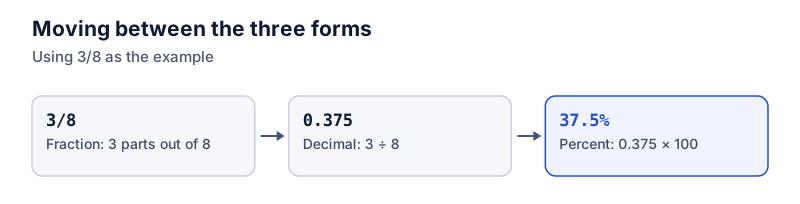
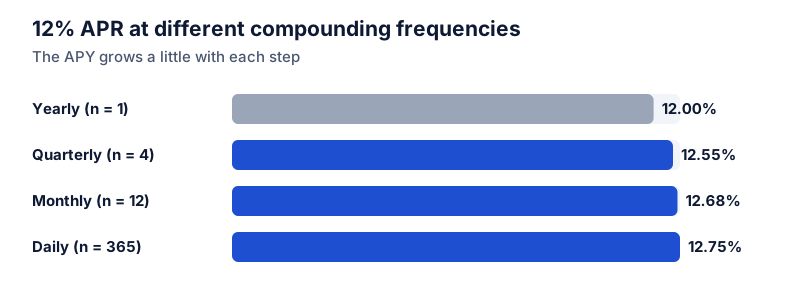
For more on converting between fractions, decimals and percentages, see percentages, fractions and decimals. For how basis points show up in loan and savings rates, see APR vs APY.
Questions
How many basis points is 0.5%?
- Multiply the percentage by 100 to get basis points.
Is ppm a percentage?
It’s the same idea on a finer scale. Percent means per hundred and ppm means per million, so 1 ppm is 0.0001%.
The calculator links in this guide are checked against the PercentSwift calculator every time the site is built. How we calculate explains the rounding rules. If you spot a mistake, email hello@percentswift.com.